Clear Sky Science · en
Nonlinear dynamics of Nosema ceranae and the fragile resilience of honeybee colonies under environmental strain
Why Bee Health Matters to Everyone
Honeybees do far more than make honey. By pollinating a huge share of the fruits, vegetables, and nuts we eat, they quietly support global food supplies and natural ecosystems. Yet many bee colonies are struggling, and one of the lesser-known culprits is a microscopic gut parasite called Nosema ceranae. This study uses mathematics as a kind of "colony X-ray" to uncover why infections with this parasite tend to fade, then mysteriously return, and what that means for keeping bee colonies – and our food system – resilient.
A Hidden Parasite in the Hive
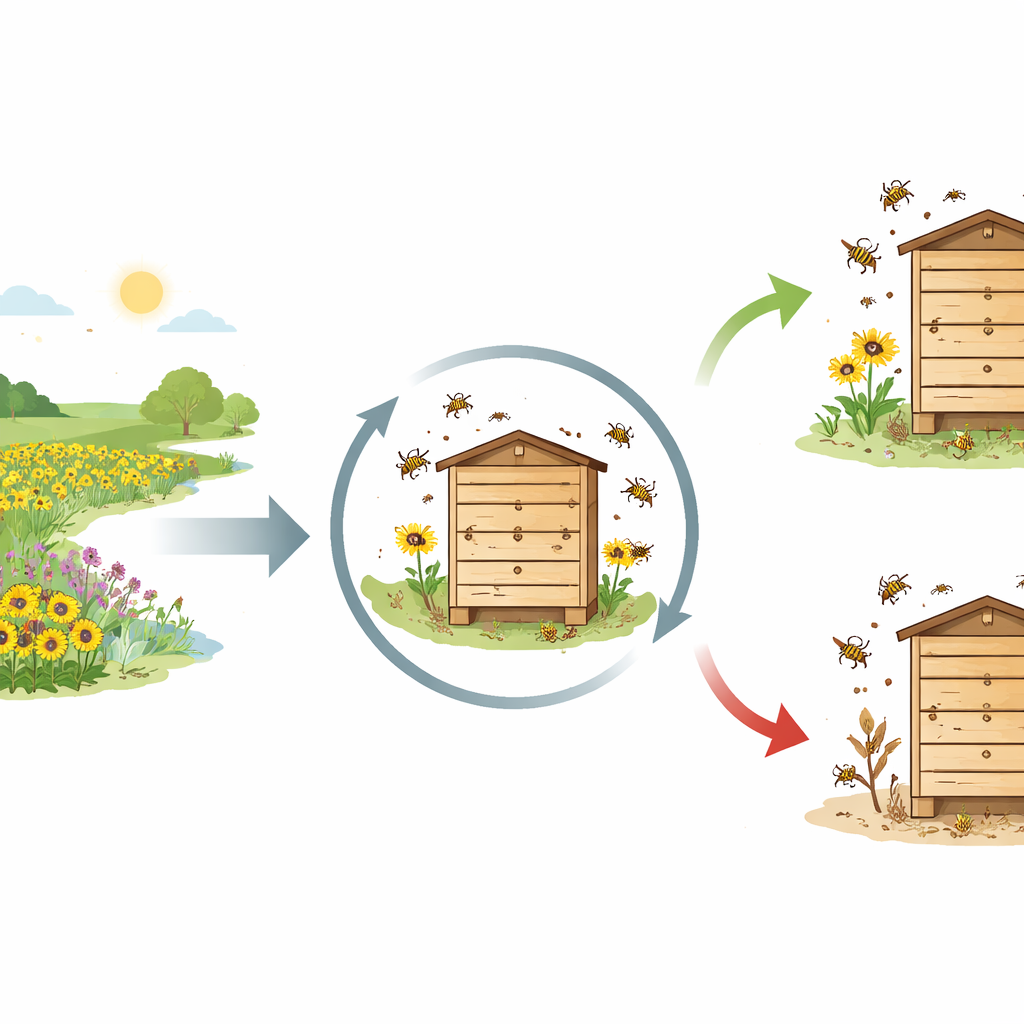
Nosema ceranae infects the intestinal cells of adult worker bees, sapping their energy, shortening their lives, and weakening the colony as a whole. The parasite spreads when infected bees shed hardy spores onto hive surfaces and food, which are then swallowed by healthy nestmates. Even when beekeepers clean equipment or treat colonies, spores can linger in the environment, and new young workers emerge into a hive that is already contaminated. The result is a chronic, stop‑and‑go pattern: infection levels fall after intervention, only to rise again as fresh bees encounter leftover spores.
Colonies Seen as Flowing Populations
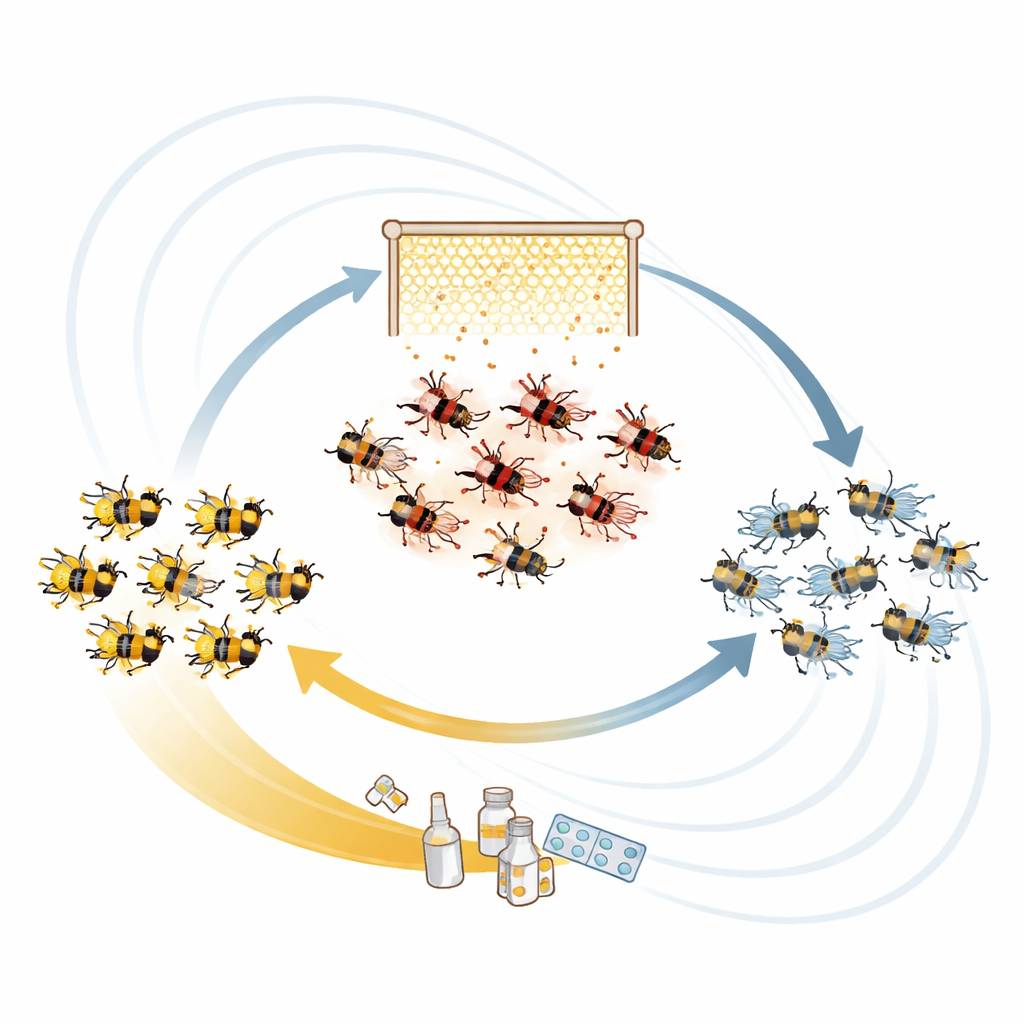
Instead of tracking individual bees, the authors build a model that follows three groups inside a colony: bees that are healthy but vulnerable, bees that are infected, and bees that are functionally recovered – meaning the colony is working better again, even if some spores remain. Bees constantly move between these groups as they emerge, become infected, partially recover, or die. A key twist is that recovery is limited by real‑world constraints: there is only so much labor, medicine, and time for cleaning and treatment. In the model, this limited "recovery capacity" means that as more bees are sick, each one receives less effective help.
When Small Changes Tip a Colony
By analyzing this model, the researchers identify thresholds that separate very different futures for a colony. In one regime, infection cannot sustain itself and gradually disappears. In another, disease settles into a steady, low‑level presence: the colony lives with a chronic burden but does not collapse. Most intriguingly, the model predicts situations where infections never quite settle – instead they oscillate in cycles of rise and fall. These cycles arise when recovery processes become saturated: once too many bees are sick at once, control measures lag behind, allowing big waves of infection before the colony can catch up.
Fragile Resilience and Sudden Swings
The study also uncovers regions of "bistability," where the same environment and management efforts can lead either to a relatively stable, mildly infected colony or to dramatic boom‑and‑bust infection cycles. Which path a colony takes depends on its starting condition and on the size of disturbances it experiences. A colony that begins with only a modest parasite load may remain stable under moderate care, while a colony that crosses a critical infection level can be pushed into recurring crises that are hard to reverse. In this sense, resilience is fragile: a small shift in infection burden or a short lapse in treatment can tip the system into a very different and riskier pattern.
What This Means for Bees and Food Security
For non‑specialists, the message is clear: Nosema ceranae is not just another bee disease that can be "knocked down" once and forgotten. Because new workers are constantly entering the colony and control resources are limited, the system is primed for repeated flare‑ups. The model shows that strong, well‑timed management – enough treatment capacity, applied efficiently – can keep infection either eliminated or stable at low levels, while weak or delayed responses invite cycles of illness that threaten colonies and the pollination services they provide. By turning the complex life of a hive into a tractable set of interacting processes, this work offers a scientific roadmap for designing interventions that keep bee colonies – and the crops that depend on them – on the stable side of these invisible tipping points.
Citation: Salman, A.M., Mohd, M.H., Almansoori, A.K.K. et al. Nonlinear dynamics of Nosema ceranae and the fragile resilience of honeybee colonies under environmental strain. Sci Rep 16, 10905 (2026). https://doi.org/10.1038/s41598-026-45351-1
Keywords: honeybee health, Nosema ceranae, pollinator resilience, disease dynamics, colony management