Clear Sky Science · en
Prediction of individual optimal drop height in drop jump from anthropometric and strength variables
Why finding the right jump height matters
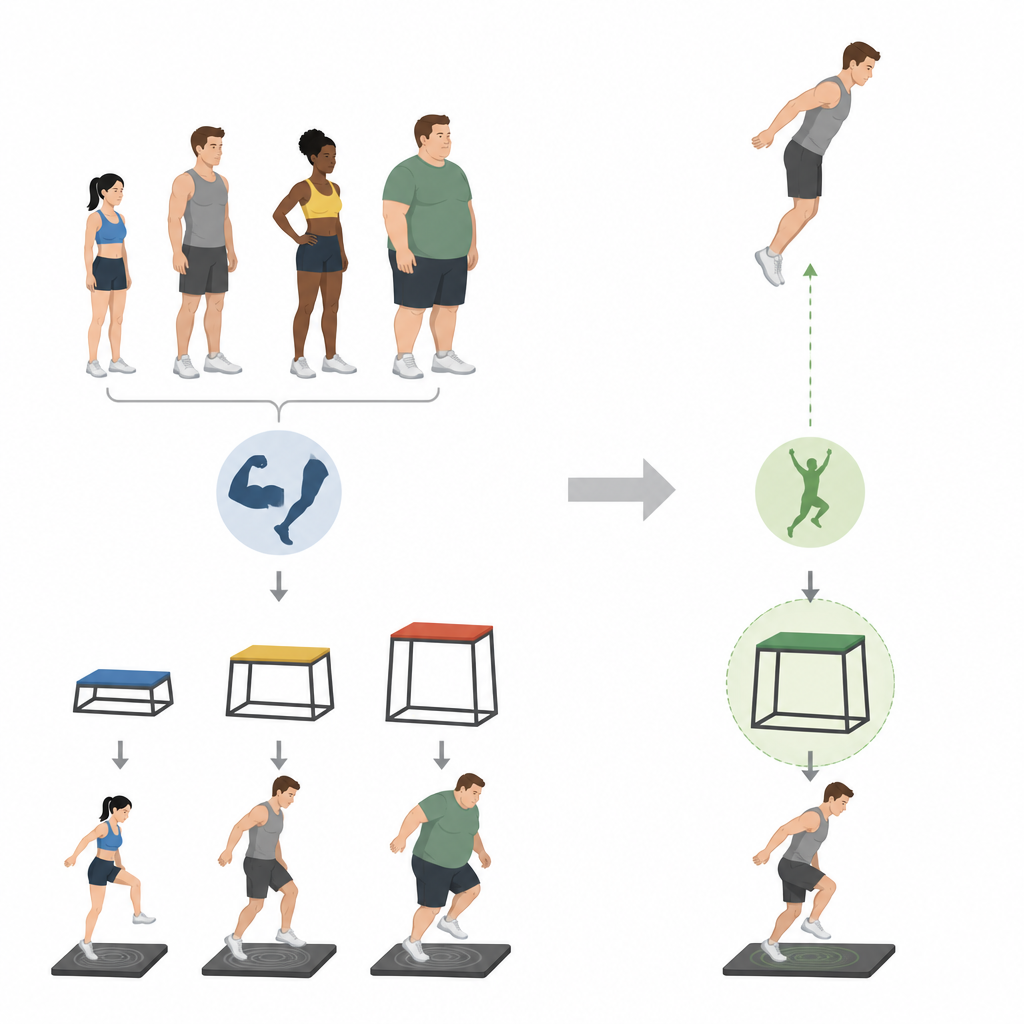
For many athletes, jumping off a box and bouncing straight back up is a routine drill. Yet the height of that box quietly shapes how much power they gain and how much strain their joints feel. This study looks at how to choose a drop height that is not only challenging but also safe and effective for each individual, and whether coaches can estimate that height using simple measurements instead of lengthy lab tests.
The challenge of picking the best box
Drop jumps involve stepping from a raised platform, landing, and then jumping upward as quickly and as high as possible. If the platform is too high, the landing forces can trigger the body’s built in safety brakes, wasting stored elastic energy and raising injury risk. If it is too low, the drill does not stress the muscles and tendons enough to drive improvement. Researchers call the height that gives the best balance the optimal drop height. Traditionally, this height is found by testing an athlete at many different box heights while measuring how high and how quickly they jump, which is time consuming for teams.
What the researchers set out to learn
The scientists wanted to know whether simple traits like body height and weight, leg strength, and basic jump performance could predict an athlete’s personal best drop height. They studied forty male elite athletes from several sports including basketball, volleyball, sprinting, gymnastics, combat sports, rugby, and trampoline. First, they measured body size and maximal leg strength in the back squat. Then they assessed how high the athletes could perform a regular countermovement jump and how well they could perform quick repeated hops, which reflect how rapidly the legs can switch from landing to take off.
How they tested drop jumps
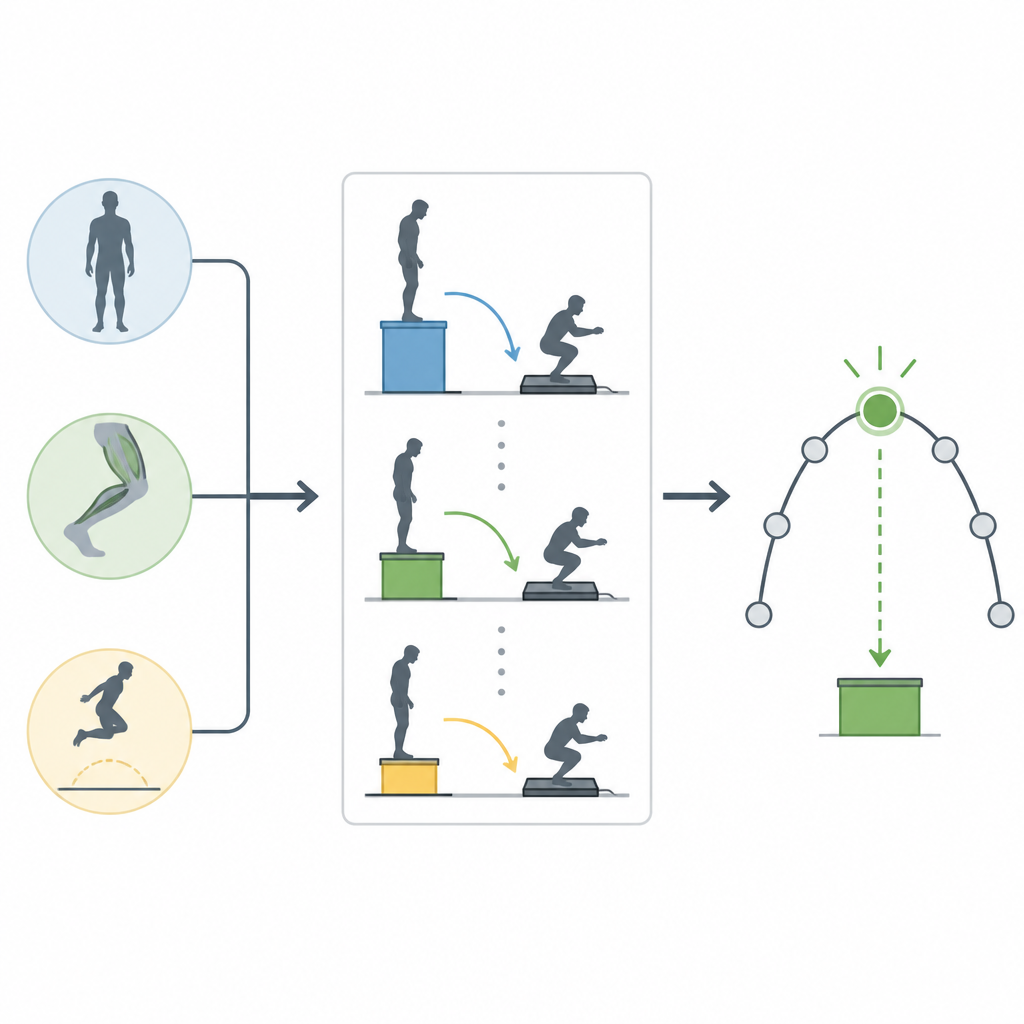
To find each athlete’s true optimal height, the team used force platforms to record landing and take off forces as the men performed drop jumps from boxes ranging from 30 to 75 centimeters in small 5 centimeter steps. At every height, athletes tried to minimize ground contact time while maximizing jump height. From these two pieces of information, the researchers calculated a score that captures how much height an athlete gains per unit of contact time. The box height that produced the highest score was defined as that athlete’s optimal drop height.
Which body traits really mattered
The results showed that relative leg strength, meaning squat strength divided by body weight, was the strongest single predictor of optimal drop height. Athletes with higher relative strength could safely and effectively use higher boxes. Two other factors also helped explain differences: how high an athlete could jump in a simple vertical jump test, and how well they performed in the rapid hopping test. Taller and heavier athletes tended to have slightly lower optimal heights, likely because their landings create larger forces and may place more stress on the knees and other joints.
A practical shortcut for coaches
By combining relative strength, basic jump height, and hopping performance, the researchers created an equation that explained nearly four fifths of the differences in optimal drop height among the athletes. A simpler version using only relative strength and vertical jump height also performed well and relies on tests that are common in most training programs. In plain terms, stronger athletes who can jump higher can generally handle taller boxes, while lighter adjustments should be made for bigger athletes. This means coaches can estimate an effective starting drop height without lengthy lab testing and then fine tune it as an athlete’s strength and jump ability improve over time.
Citation: Xie, Y., Peng, F., Pan, X. et al. Prediction of individual optimal drop height in drop jump from anthropometric and strength variables. Sci Rep 16, 15270 (2026). https://doi.org/10.1038/s41598-026-45266-x
Keywords: drop jump, plyometric training, jump height, leg strength, sports performance