Clear Sky Science · en
A multi-objective optimization consensus model for large-scale group decision-making considering dynamic social networks
Why choosing solar sites is harder than it looks
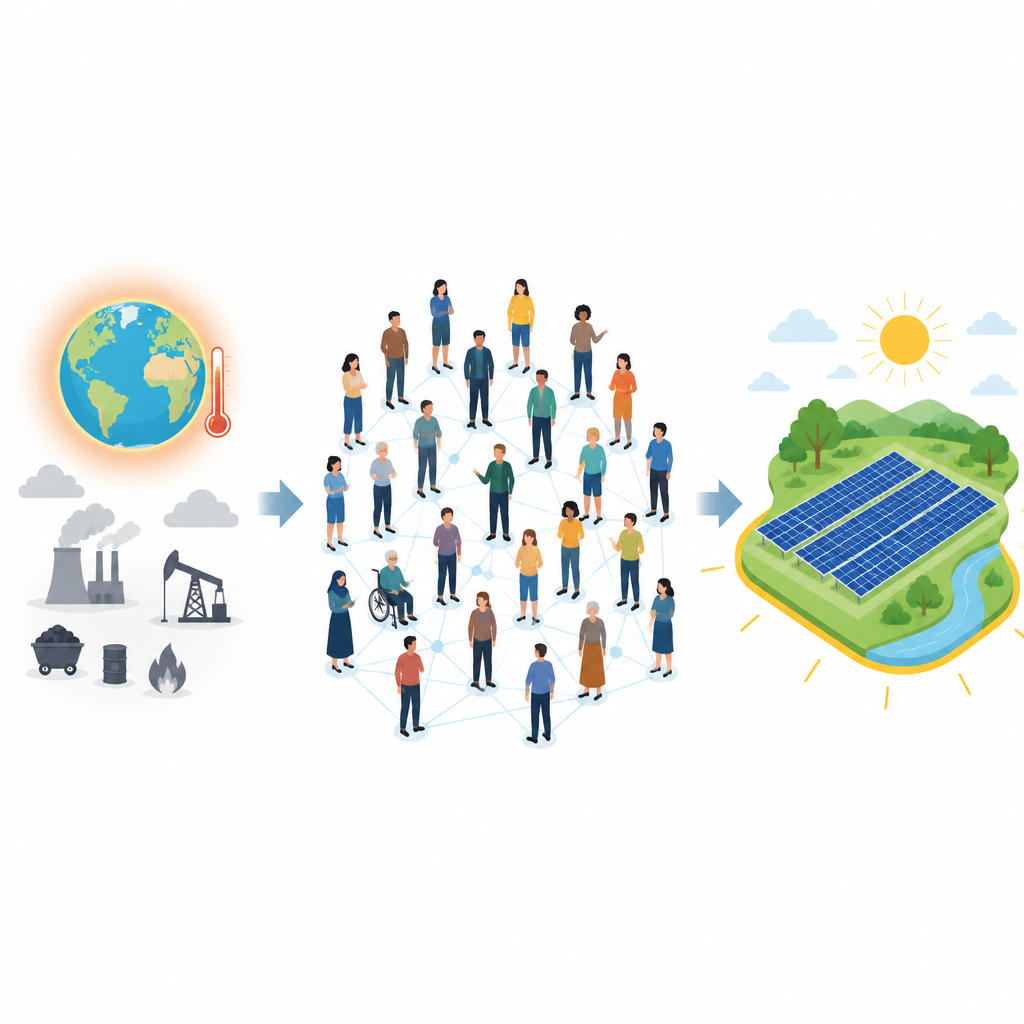
As countries race to cut carbon emissions, governments and companies must decide where to build new solar power plants. These choices affect local landscapes, jobs, and electricity prices, and they often involve dozens of experts with different backgrounds and priorities. This paper introduces a new way to help large groups of people reach fair, efficient agreement on such complex choices, focusing on a case of picking the best site for a photovoltaic (PV) power plant.
Many voices, one shared decision
Large projects like solar farms rarely depend on a single expert. Instead, engineers, environmental scientists, planners, and community representatives all weigh in. Each person has their own view of which site is best based on factors such as local sunshine, cost of construction, environmental impacts, and social acceptance. When 20 or more people are involved, simple voting or averaging can hide disagreements and may favor a vocal minority. The authors study this challenge as a large-scale group decision, where the goal is not only to pick a site but also to reach a level of agreement that most participants consider acceptable.
Blending trust and similarity in expert networks
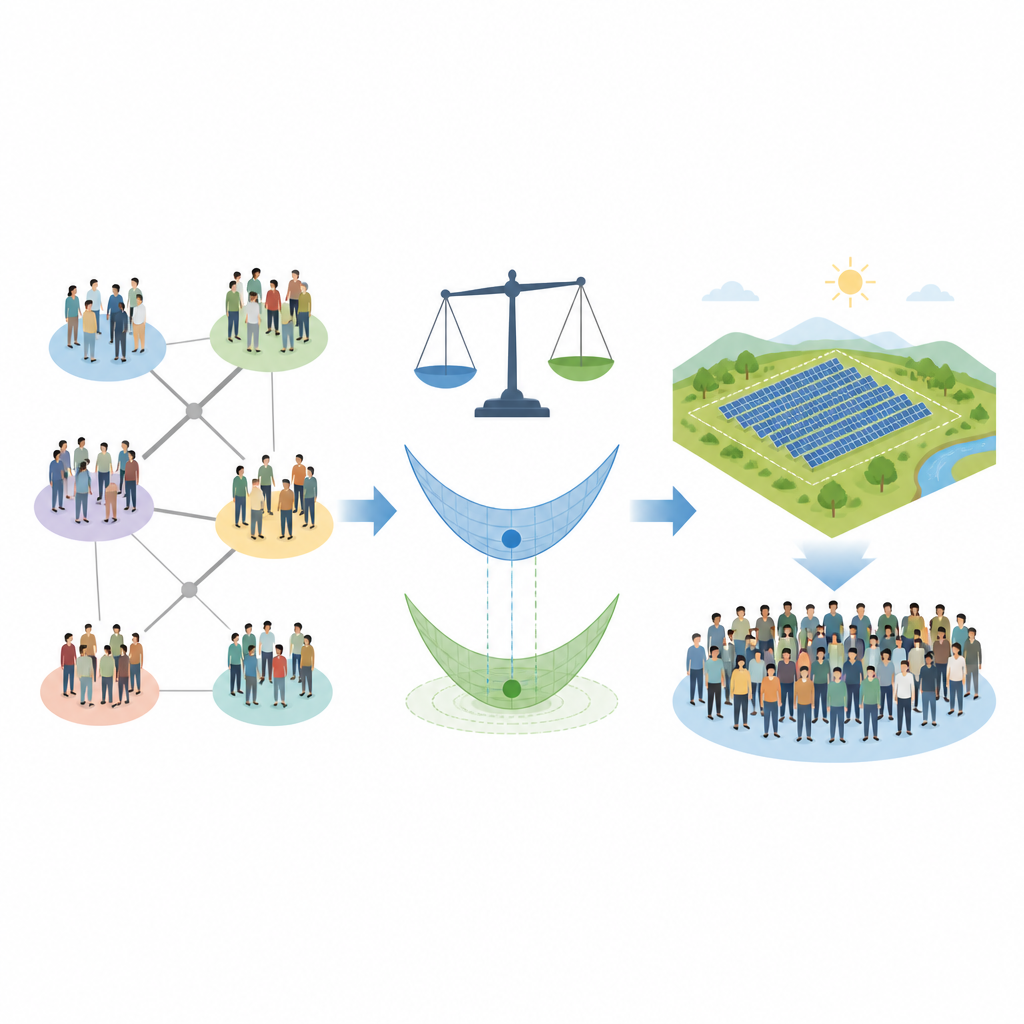
The study builds on the idea that experts do not operate in isolation. Some know each other, some have collaborated before, and some naturally trust certain colleagues more. At the same time, experts who express similar opinions are more likely to influence one another. The authors merge these two elements into what they call a hybrid trust network. In this network, each expert is linked to others based on how much they trust them and how similar their evaluations are. A community detection method, the Louvain algorithm, then automatically groups experts into subgroups that are closely connected. This clustering simplifies the problem by letting the process work with a few coherent teams instead of many disconnected individuals.
Balancing cost, fairness, and agreement
Reaching agreement almost always requires some people to adjust their positions. The authors design a multi-objective optimization model that tries to manage three goals at once: reduce the overall effort of adjustment, treat participants fairly, and raise the overall level of consensus. Cost here reflects how far each expert must move from their initial opinion. Fairness measures whether the burden of adjustment is shared evenly, instead of falling mostly on a few people. Consensus captures how close the final opinions are within and across subgroups. Using an evolutionary search method, the model produces a set of compromise solutions, each offering a different trade-off among cost, fairness, and agreement. Decision organizers can then pick the solution that best fits their situation.
Letting trust evolve as people talk
In real discussions, people change not only their ratings but also how much they trust others. The paper captures this by updating the trust network after each round of adjustment. When two experts’ views become more alike, their mutual trust is strengthened; if their views remain far apart, trust grows more slowly or not at all. After updating these trust links, the method regroups experts and recalculates their influence in the decision. This dynamic process continues until the overall agreement exceeds a preset threshold or a maximum number of rounds is reached, reflecting how real committees gradually move toward shared conclusions.
What the solar case shows
The authors test their approach on a PV power plant siting problem with 20 experts, four candidate locations, and four evaluation factors: resource availability, construction cost, environmental impact, and social acceptance. At first, the method divides the experts into four subgroups and finds that the group has not yet reached the desired level of agreement. After applying the optimization and updating the trust network, the experts are re-clustered into three subgroups, and their relative weights shift. The process ultimately reaches a high consensus level of 0.9597 while keeping adjustment cost and fairness in a reasonable range, and it identifies one site as the best compromise choice.
Why this matters for real-world decisions
To a lay reader, the main message is that complex public decisions do not have to be a tug-of-war between competing interests. By explicitly modeling who trusts whom, who thinks alike, and how much each person must bend, the proposed method helps large groups reach decisions that are not only efficient but also perceived as fair. Although demonstrated on solar plant siting, the same framework could guide choices about infrastructure, health policy, or other issues where many stakeholders must share responsibility for the outcome.
Citation: Chen, G., Lang, A., Han, X. et al. A multi-objective optimization consensus model for large-scale group decision-making considering dynamic social networks. Sci Rep 16, 15314 (2026). https://doi.org/10.1038/s41598-026-45239-0
Keywords: group decision-making, social networks, trust modeling, solar power siting, multi-objective optimization