Clear Sky Science · en
Characterisation of the signal to noise ratio of 2-photon microscopes
Why picture clarity in microscopes matters
Modern biology relies on microscopes that can peer deep into living tissues without cutting or staining them. Two photon microscopes are a popular tool for this job because they can look hundreds of micrometers below the surface. But not all such microscopes produce images with the same clarity. This study asks a practical question that many labs face: how can we fairly measure how “clean” or noisy the images are, and how does a custom built microscope stack up against commercial systems?
Looking at signal versus fuzz
The authors focus on signal to noise ratio, or SNR, which compares the useful image information to the random fuzz that hides fine detail. In a perfect world, the main source of noise is the random arrival of light particles, a statistical effect that sets a hard physical limit. The team explains how this limit depends on how many photons reach the detector, how efficiently they are converted into an electrical signal, and how long each pixel is allowed to collect light. Under these conditions, SNR grows only with the square root of the number of detected photons, which means that simply turning up the power or waiting longer gives diminishing returns.
How electronics shape image quality
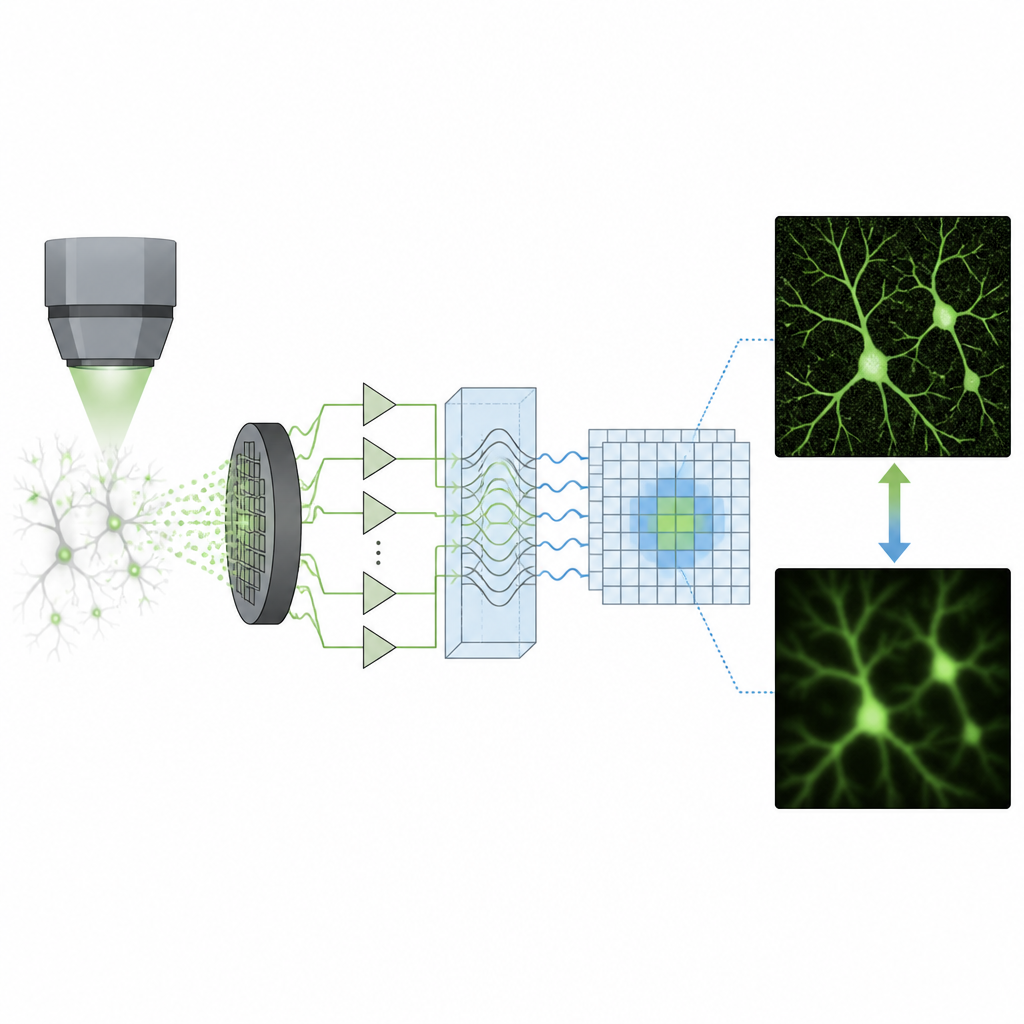
In a two photon microscope, very faint flashes of light are first captured by light sensitive tubes and then turned into measurable voltages by amplification electronics. The study shows that these electronics can quietly change image quality in ways that are not obvious from the outside. If the amplifier gain is set too high, the brightest parts of the image hit a ceiling, making different bright regions look the same and bending the expected relationship between average brightness and noise. The authors use plots of noise versus signal to identify the safe “linear” region where the system behaves predictably and to flag when saturation starts to distort the data.
Hidden smoothing and the sharpness trade off
A key finding is that the speed of the amplifiers also matters. When the electronics cannot keep up with very fast scanning, they effectively smear information from several neighboring pixels together along the scan direction. This silent averaging boosts the SNR because fluctuations are evened out, but it also blurs small structures. By analyzing how similar nearby pixels are to one another, the researchers show that systems with low electronic bandwidth can appear to have better SNR simply because they have traded away spatial detail. They even mimic this effect by deliberately averaging pixels in software, confirming that much of the apparent advantage comes from this smoothing rather than from truly superior detection.
Custom versus commercial microscopes
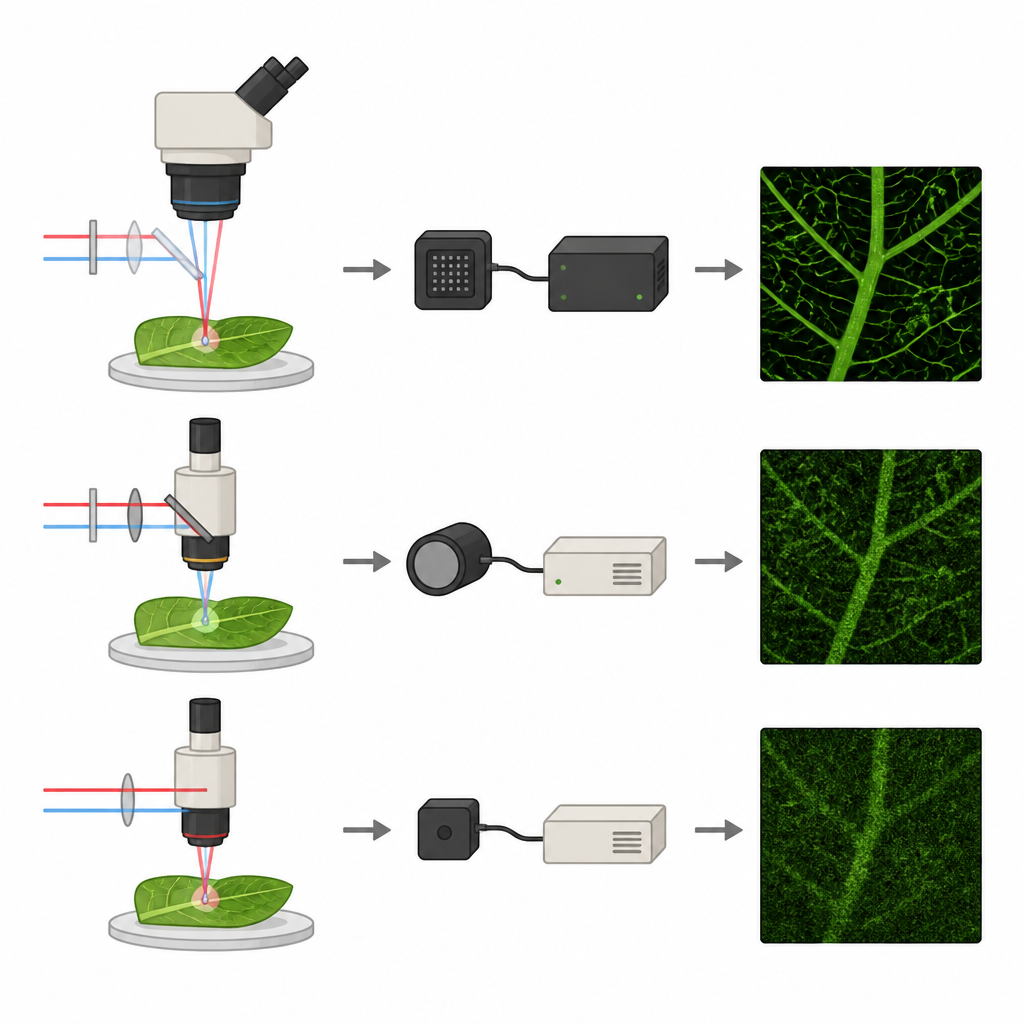
To see how their home built two photon microscope compares to well known commercial instruments, the team images the same robust plant sample on each system under matched conditions. They adjust laser power and lens properties so that the tissue experiences similar light levels and use both pixel based and whole image measures of SNR. One commercial microscope delivers slightly higher SNR but clearly shows the telltale streaking that reveals strong pixel averaging along the fast scan line. The other commercial system avoids such averaging and preserves sharpness, yet shows lower SNR, likely due to shorter pixel viewing times and electronic settings that force them to stop increasing detector gain before reaching its best operating point.
What this means for everyday imaging
For non specialists, the take home message is that a “cleaner” looking image is not always a better one, especially if that smoothness comes from hidden blurring in the hardware. The authors show that a carefully designed custom microscope can match or beat commercial instruments in signal quality while retaining fine detail, provided that the detector and amplifier are chosen and tuned with both bandwidth and saturation in mind. They also offer practical analysis methods that any lab can use to monitor the health of their microscopes over time, alongside more familiar checks of focus sharpness and field uniformity.
Citation: Macháň, R., Chong, S.P., Lee, K.L. et al. Characterisation of the signal to noise ratio of 2-photon microscopes. Sci Rep 16, 15115 (2026). https://doi.org/10.1038/s41598-026-45224-7
Keywords: two photon microscopy, signal to noise ratio, fluorescence imaging, microscope performance, image quality