Clear Sky Science · en
Parametric resonance and chaos in a duffing-type oscillator with periodic inertia modulation
Shaking machines and hidden patterns
Many everyday technologies from power plant generators to compact sensors rely on parts that vibrate. When those vibrations stop behaving in a simple, regular way, engineers often see it as trouble. This study shows how such complicated motion can be predicted and even used on purpose to squeeze more electrical energy out of mechanical shaking, offering a roadmap for smarter energy harvesters and more robust rotating machines.
From simple springs to restless motion
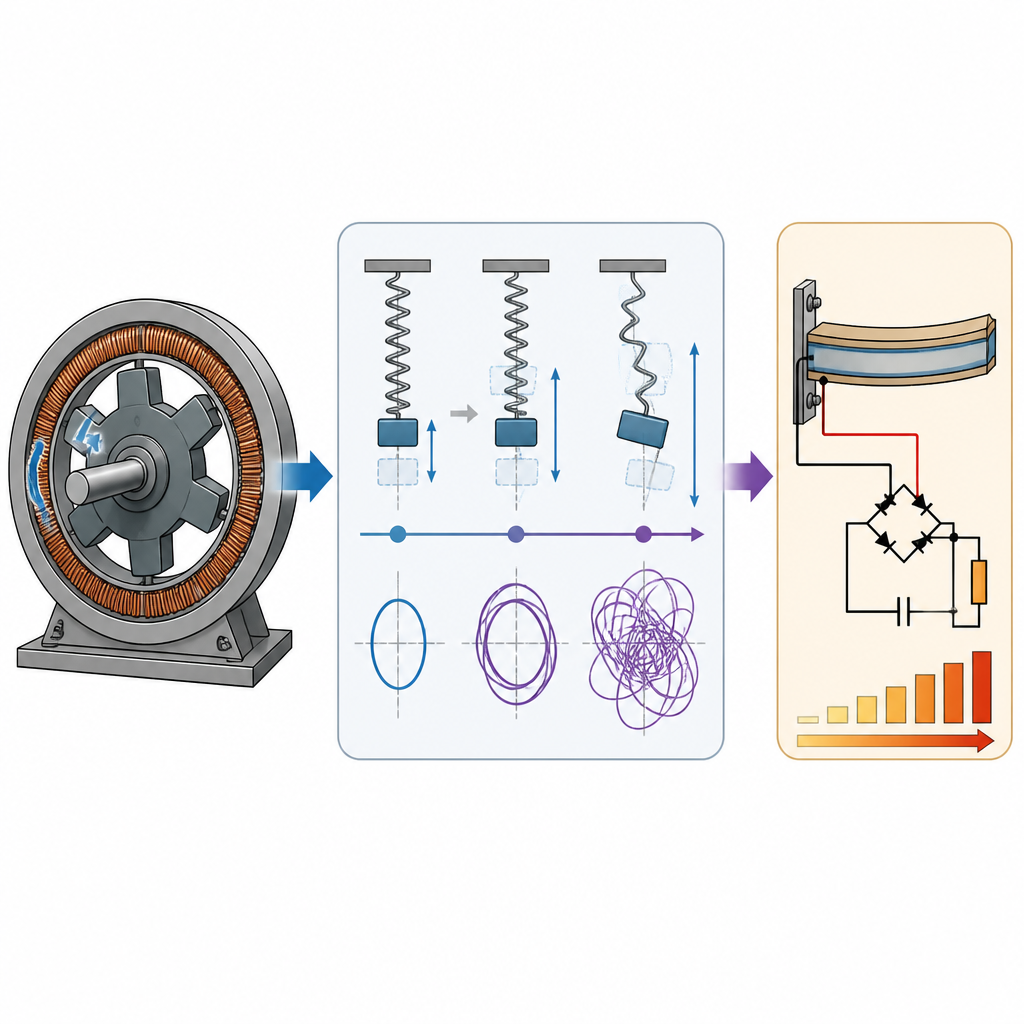
The authors start from a classic model used to describe vibrating systems: a spring and mass that can move back and forth, but with a twist. Here the effective stiffness of the spring is nonlinear, so the restoring force does not grow in a perfectly proportional way. On top of that, the "inertia" of the moving part slowly oscillates in time, similar to a child whose mass seems to change rhythmically as they shift their weight on a swing. This combination already allows for rich behaviors such as sudden jumps in vibration level and the onset of irregular motion as the system is shaken harder.
A generator as a real world test bed
To keep the work grounded in reality, the model is tied to a specific device: a salient pole synchronous machine, a kind of electrical generator whose rotor has projecting poles. As the rotor turns, the magnetic gap between rotor and stator changes periodically, which in turn makes the electrical inductance vary in time. Magnetic saturation adds another wrinkle by making the response nonlinear at higher currents. By carefully simplifying the full electromechanical description, the authors arrive at a compact equation for the rotor’s small angular wobble that captures both the time varying inertia and the nonlinear restoring effect.
Tools for reading the vibration landscape
To understand how this wobbling system responds when it is periodically driven, the study combines two analytical tools and direct numerical simulations. The harmonic balance method treats the motion as a sum of a few simple waves and solves algebraic equations for the resulting amplitude and phase, revealing how the response curve bends and where multiple coexisting states appear. The method of multiple scales zooms in on behavior near key resonances, tracking how the envelope of the motion slowly evolves. These approaches show where the system responds strongly at the main frequency, at multiples of it, or at fractions of it, and they predict which of these rhythmic states are stable.
Following the road to chaos
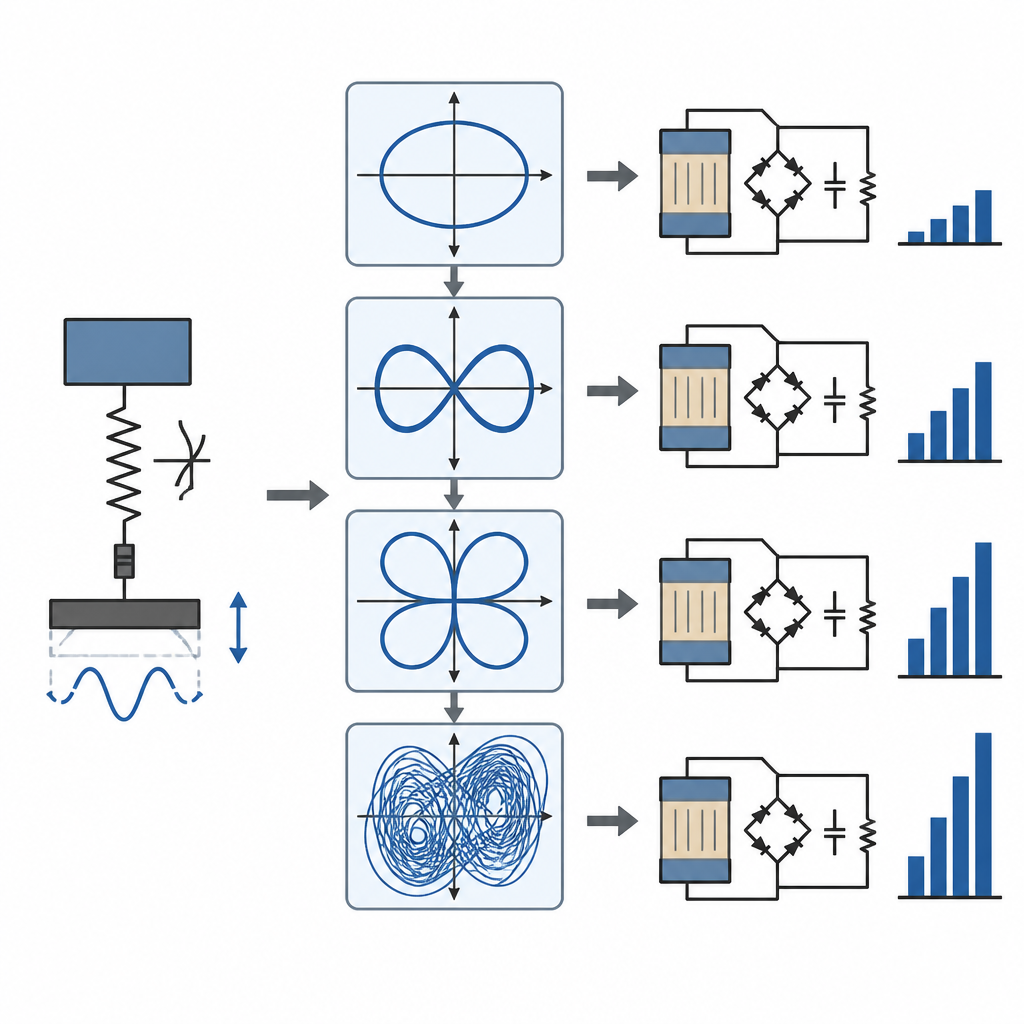
Because the analytical methods rely on small effect assumptions and a limited number of waves, they may miss what happens when the shaking becomes intense. The authors therefore turn to detailed numerical simulations, plotting how the motion sampled once per driving cycle changes as the forcing grows. They observe the familiar route to chaos seen in many nonlinear systems: a once per cycle response splits into two cycles, then four, then eight, and eventually becomes fully irregular. Alongside these pictures they compute Lyapunov exponents, standard measures of sensitive dependence on initial conditions, to confirm when the behavior has truly become chaotic. They also show how tuning the nonlinear stiffness and damping shifts the thresholds at which these changes occur.
Turning restless motion into useful power
The final part of the work couples the vibrating rotor model to a simple electrical branch that mimics a piezoelectric energy harvester. In this setup, the mechanical motion produces a voltage across a resistor, and the average power delivered to the load can be estimated both analytically and numerically. The results reveal that larger, more complex motions tend to generate higher average power, especially when the electrical circuit is tuned to the vibration frequency. By introducing a mild nonlinearity in the electrical coupling, the authors show that the harvested power can increase further and spread over a wider frequency band, at the cost of more intricate motion.
What this means for practical devices
In summary, this paper builds a bridge between abstract nonlinear vibration theory and practical design rules for machines and harvesters. It shows that periodic changes in inertia combined with nonlinear stiffness can drive a system through a sequence of resonances into chaotic motion, and that this journey can be tracked accurately with a mix of analytical approximations and simulations. Importantly for applications, the same features that reduce simple stability can be harnessed to widen the frequency range and raise the power output of vibration based energy harvesters, provided designers are willing to manage the resulting complexity.
Citation: El-Borhamy, M., Nasef, A.A., Attia, AF. et al. Parametric resonance and chaos in a duffing-type oscillator with periodic inertia modulation. Sci Rep 16, 15747 (2026). https://doi.org/10.1038/s41598-026-45221-w
Keywords: nonlinear vibrations, parametric resonance, chaotic oscillations, energy harvesting, piezoelectric devices