Clear Sky Science · en
Dynamical analysis of lump, breather, M-shaped and other wave profiles propagating in a nonlinear PDE describing the nonlinear low-pass electrical transmission lines
Why strange waves in wires matter
Modern communication and power systems rely on electrical signals that must travel long distances without losing their shape. This paper explores how unusual signal patterns can move through a special kind of circuit called a nonlinear low pass transmission line. By understanding these patterns, engineers can design circuits that send data and energy more reliably, even when signals are strong, fast, and prone to distortion.
From simple circuit parts to rich wave behavior
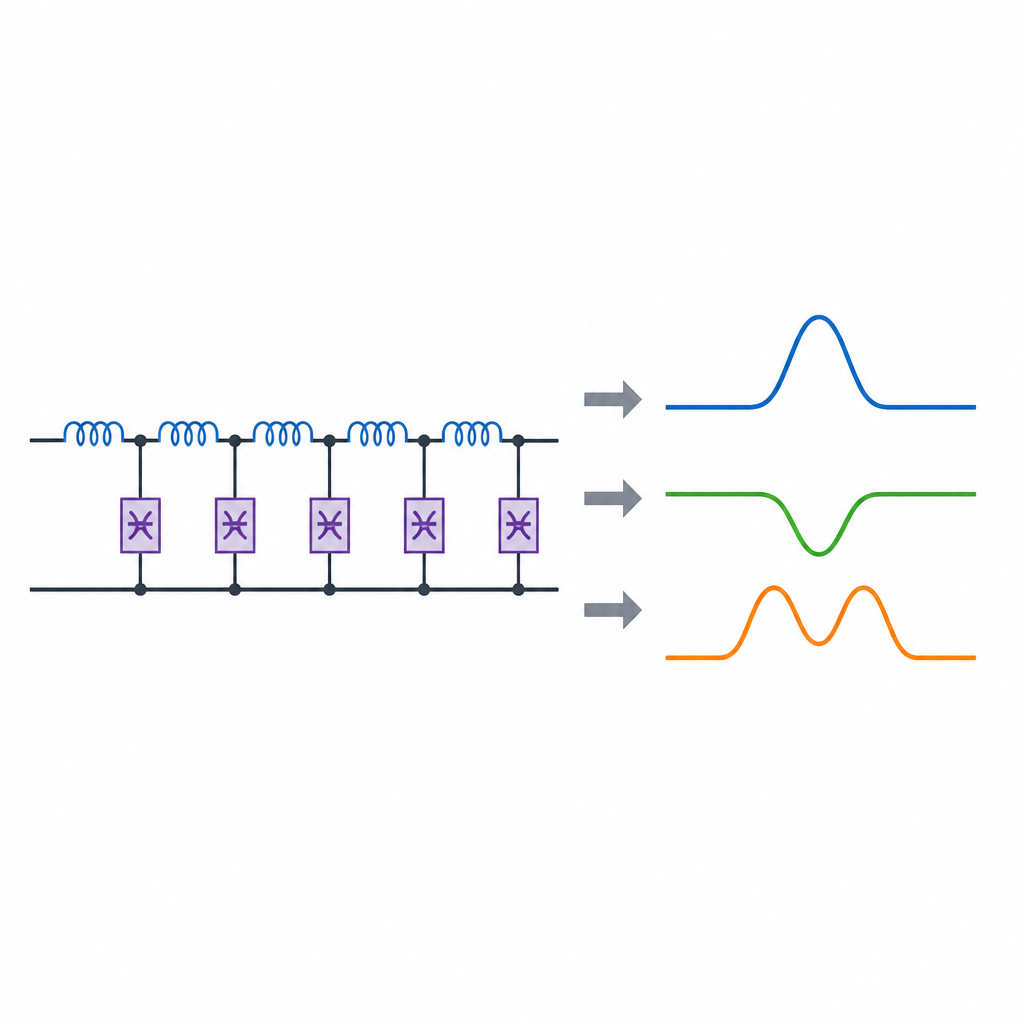
The study begins with a familiar setting from basic electronics: a long chain of identical units, each made of an inductor in series and a capacitor connected to ground. The twist is that the capacitor is not ordinary; its ability to store charge depends on the applied voltage. By applying the standard current and voltage rules of Kirchhoff, the authors first write a discrete equation for how the voltage changes from one unit to the next. Then they imagine that the units are packed very closely, turning the chain into a continuous medium and replacing the discrete equation with a nonlinear partial differential equation that describes how voltage waves move along the line.
How balance creates self shaped signals
In this new equation, inductors cause dispersion, which tends to spread out a pulse, while the voltage dependent capacitors introduce nonlinearity, which can steepen or focus it. When these two tendencies balance, the system supports special waves that keep their shape while traveling. These include solitons, which behave like solitary pulses, and other localized structures such as lumps, breathers, and kink shaped waves. The paper focuses on writing down these waves in exact mathematical form, turning the rather abstract equation into a catalog of concrete signal shapes that can, in principle, exist on such lines.
A toolbox for building many wave shapes
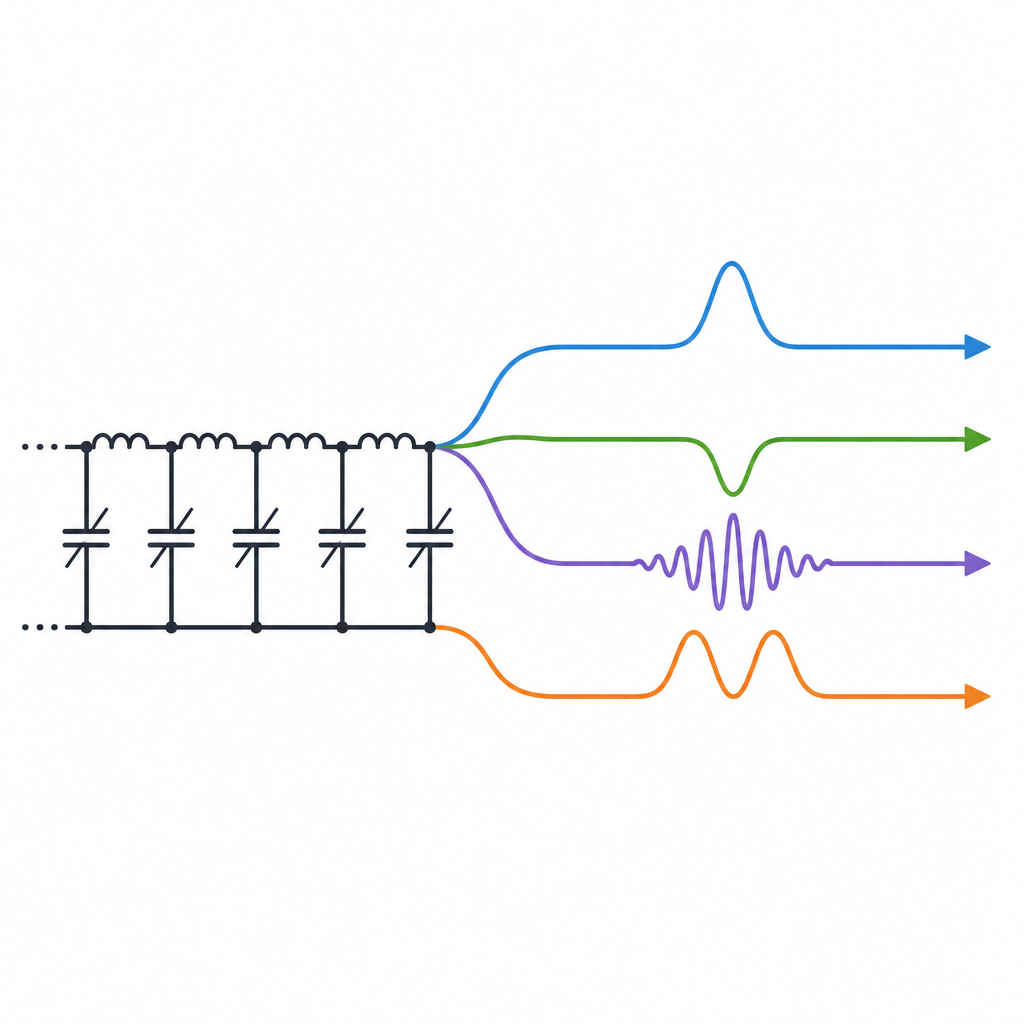
To uncover this variety of waves, the authors use a powerful method known as the Hirota bilinear transformation. They first assume that the voltage behaves like a traveling wave that depends on a single combined variable built from space and time. This reduces the original equation to a more manageable ordinary differential equation. They then express the solution through a helper function and systematically insert different trial forms for this function, involving combinations of exponential, trigonometric, and hyperbolic functions as well as simple polynomials. With the aid of computer algebra, they identify parameter choices that satisfy the equation and thereby generate many families of exact solutions.
From single pulses to M shaped and breathing waves
The resulting family tree of waves is surprisingly rich. The authors find multiple wave patterns that correspond to energy lumps concentrated in small regions, in both bright (peaked) and dark (dipped) forms. They obtain periodic lump waves that repeat in space and time, and cross kink waves that resemble smooth steps or transitions between two voltage levels. Breather waves oscillate in place while remaining localized, like a pulse that rhythmically swells and shrinks. Mixed waves combine features of lumps and breathers. Particularly striking are the M shaped waves, in which the voltage profile forms one or two sharp peaks separated by valleys, sometimes attached to kink like steps. By plotting these solutions in three dimensions, together with contour views from above and simple two dimensional cuts, the study shows how energy can be organized and transported along the line in many structured ways.
Why these patterns are useful ideas
Although the work is theoretical and does not build a physical circuit, its results offer a detailed map of what kinds of self shaped electrical signals a nonlinear low pass line can sustain. Knowing that such lines can host stable pulses, dips, breathing packets, and M shaped patterns helps designers think about how to encode information, manage high speed data, or route energy without undue loss or distortion. In short, the paper translates a complex circuit model into a clear picture of possible traveling signal shapes, laying groundwork for future numerical studies and experimental designs that could harness these waves in real communication and signal processing systems.
Citation: Baber, M.Z., Shafee, A., Ceesay, B. et al. Dynamical analysis of lump, breather, M-shaped and other wave profiles propagating in a nonlinear PDE describing the nonlinear low-pass electrical transmission lines. Sci Rep 16, 14942 (2026). https://doi.org/10.1038/s41598-026-45214-9
Keywords: nonlinear transmission line, soliton waves, breather waves, signal propagation, electrical circuits