Clear Sky Science · en
Artificial neural network analysis of a fractional cyber-epidemic model in wireless sensors under the proportional Hadamard–Caputo operator
Why digital infections can linger
Malicious software does not always spread through computer networks in quick, clean bursts. In wireless sensor networks—tiny devices scattered in buildings, fields, or cities to measure the world—attacks can smolder for a long time, flaring up when old connections or delayed updates come back to haunt the system. This article introduces a new way to describe such “long-memory” cyber outbreaks, helping engineers understand when malware will fade quickly and when it may stubbornly persist.
From sick people to sick sensors
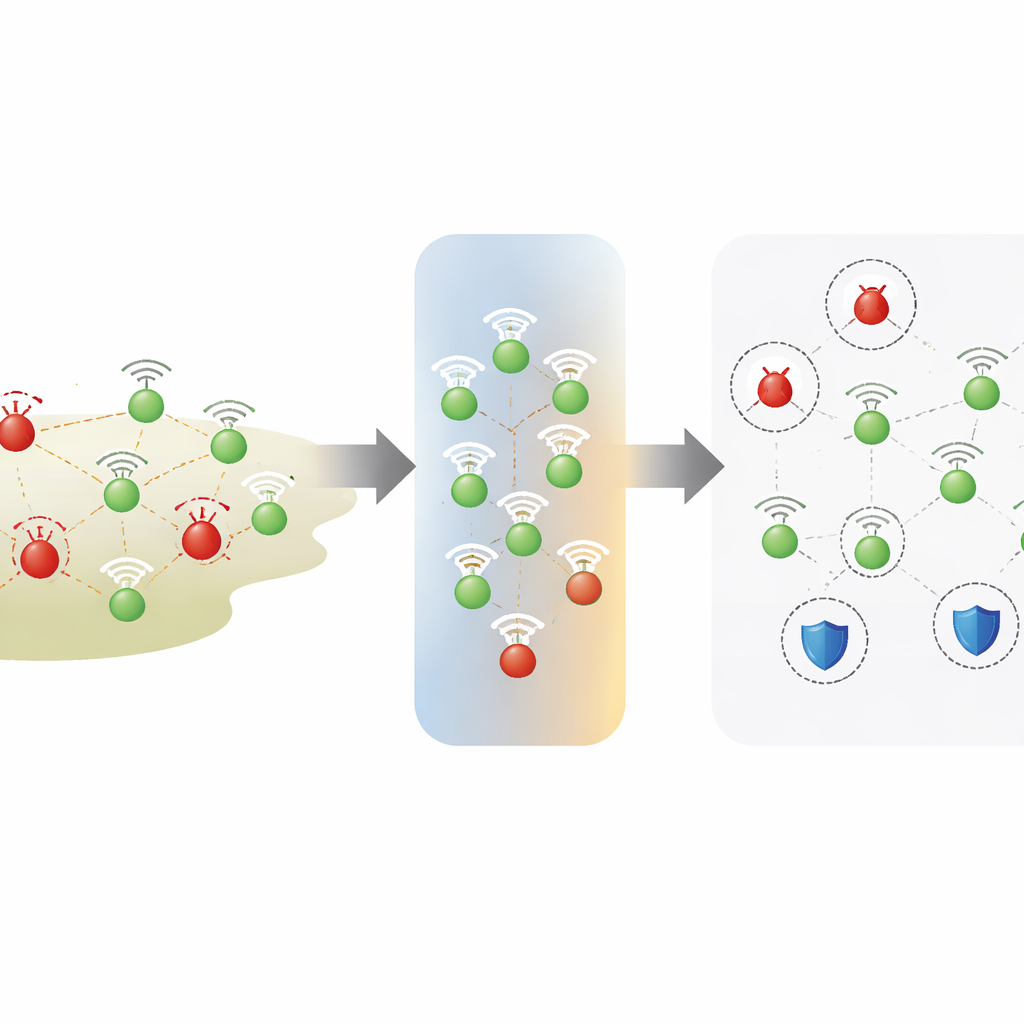
The authors borrow ideas from classic disease modeling, where populations are split into groups such as susceptible, infected, and recovered. Here, the “population” is a wireless sensor network. Devices are divided into six classes: healthy but vulnerable, exposed but not yet spreading malware, actively infectious, quarantined, recovered, and vaccinated (hardened by updates or patches). This structure lets the model follow how devices move between states as they contact each other, are isolated, repaired, or protected. By translating human epidemic thinking into the digital realm, the work links decades of public-health mathematics to modern cyber defense.
Building memory into the math
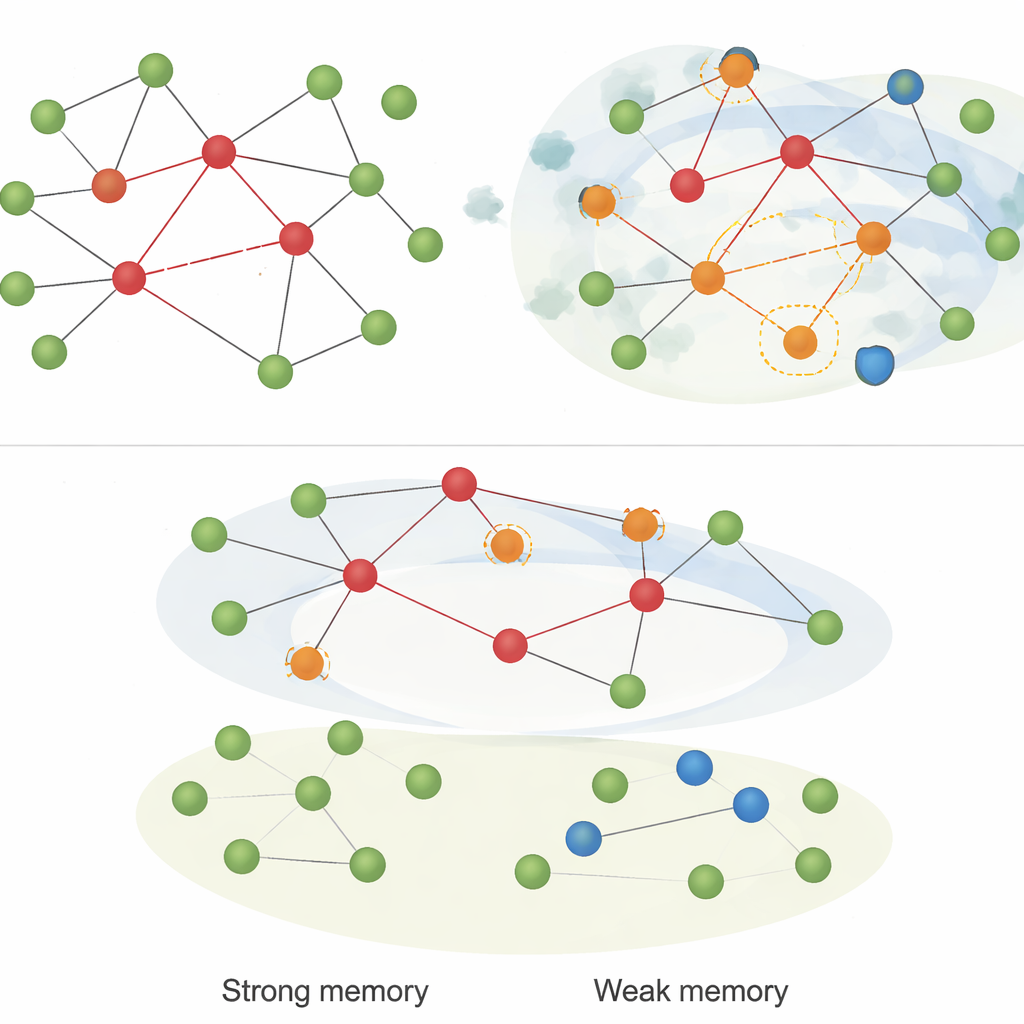
Standard models assume that only the current state of the network matters: what happens next depends only on the present, not on detailed history. That is often unrealistic. In practice, old connections, slow patching, and lingering vulnerabilities mean the past keeps tugging on the present. To capture this, the authors use a “fractional” version of calculus that allows rates of change to depend on a weighted history of earlier activity. A specialized tool, the proportional Hadamard–Caputo operator, lets this memory be tuned and expressed on a logarithmic time scale, which is well suited to processes that slow down over time. Two key parameters control how strongly the past influences the future, so that classical, memory-free behavior appears as a special limiting case.
Ensuring the model behaves sensibly
Any useful model must not only be realistic, but also mathematically sound. The authors prove that their system has at least one solution that evolves smoothly in time, and that this solution is unique under mild conditions. They do this by rewriting the original fractional equations as an integral equation and then applying powerful “fixed point” theorems—tools that show an equation maps a function back onto itself in a controlled way. They also establish a form of stability known as Ulam–Hyers stability: if the equations or data are slightly off because of measurement noise or numerical error, the resulting solutions stay close to the true ones. This means that simulations and forecasts based on the model can be trusted within clear error margins.
Simulating long digital outbreaks
To make the framework practical, the team designs a step-by-step numerical method, adapting a well-known predictor–corrector scheme to handle the special memory kernel of their operator. Working in a transformed time variable, they derive simple weights that encode how much influence past states retain. Simulations of malware spread in a sensor network reveal a striking pattern: when memory is strong or the fractional order is lower, infection declines more slowly and the “active spread” phase lasts longer. As the model settings move closer to the classical, memory-free case, infection peaks and dies out much more quickly, leading to rapid stabilization of the network.
What this means for protecting networks
In plain terms, the study shows that accounting for digital memory—past contacts, delayed cleaning, and slowly fading vulnerabilities—can significantly change expectations about how long malware will circulate in wireless sensor systems. The fractional model offers knobs that allow security planners to match observed long tails in real data, while the stability results ensure that those predictions are robust to modest uncertainty. When memory effects are weak and quick decisions are needed, a simpler classical model may suffice. But when infections seem to “hang around” despite countermeasures, this fractional, memory-aware framework provides a more cautious and realistic guide for designing quarantine, patching, and vaccination strategies for the sensor networks that quietly monitor our world.
Citation: Barakat, M.A., Hyder, AA., Aboelenen, T. et al. Artificial neural network analysis of a fractional cyber-epidemic model in wireless sensors under the proportional Hadamard–Caputo operator. Sci Rep 16, 10742 (2026). https://doi.org/10.1038/s41598-026-45202-z
Keywords: wireless sensor networks, malware propagation, fractional calculus, cyber epidemiology, network security modeling