Clear Sky Science · en
Domain knowledge-integrated reinforcement learning control of nonlinear tunable vibration absorber under nonstationary excitation
Quieter Machines for a Noisy World
From high-speed trains to factory compressors, many machines live in a world of constant shaking. These vibrations waste energy, wear out parts, and make our surroundings noisy and uncomfortable. This paper explores a new way to calm those shakes using a combination of smart rubber and a learning computer program, aiming to build vibration absorbers that adjust themselves automatically as conditions change.
Why Ordinary Dampers Fall Short
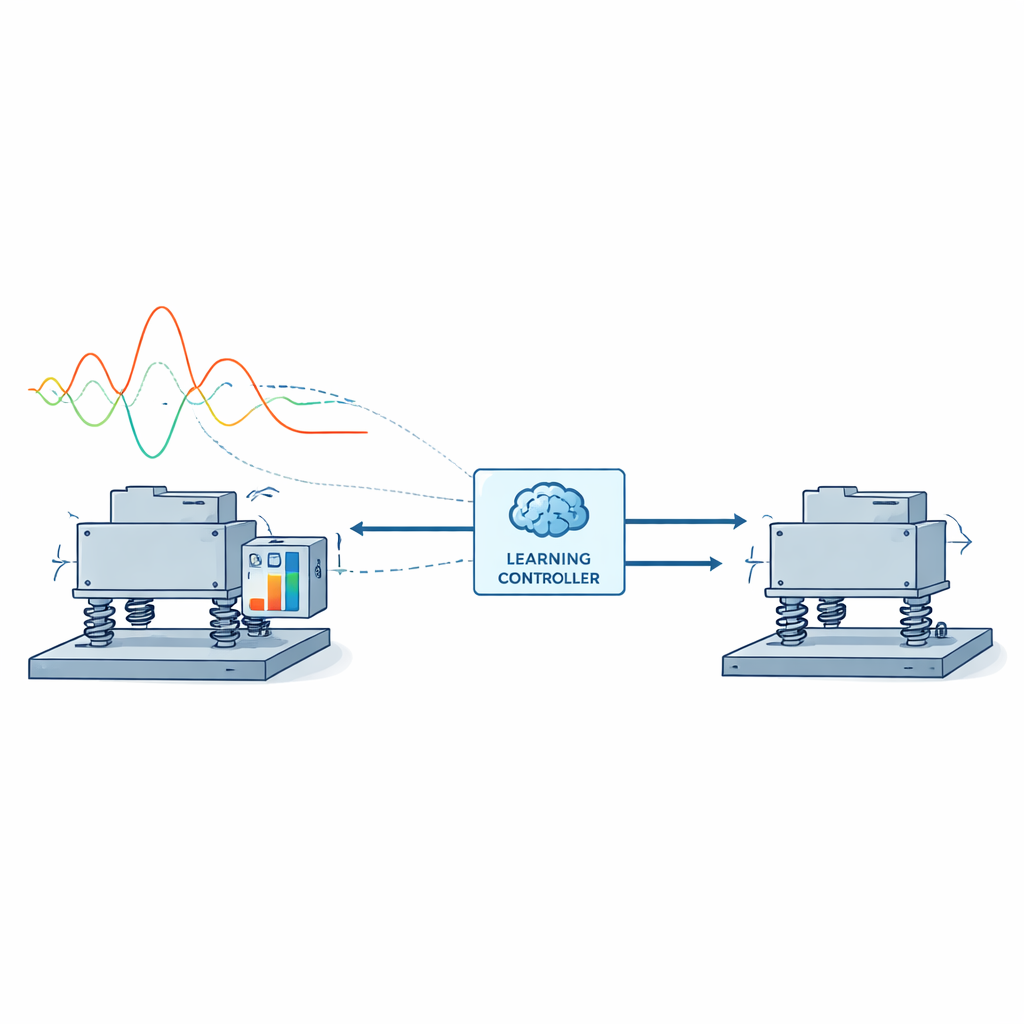
Traditional vibration absorbers are often tuned for one narrow range of conditions. They work well when the machine vibrates at a single, steady tone, but real industrial environments are anything but steady. Temperatures rise and fall, components age, humidity shifts, and the vibration pattern itself can wander across many tones at once. Modern semi-active absorbers made from smart materials, such as magnetically controlled rubber, can change their stiffness and damping on the fly. However, because these materials behave in complex and drifting ways, it is extremely difficult to build a fixed mathematical model that stays accurate over time, and most rule-based controllers cannot keep up.
Teaching a Damper to Learn
The authors propose a different strategy: instead of painstakingly modeling every detail of the absorber and its environment, they let the system learn directly from vibration data. They use a branch of artificial intelligence called reinforcement learning, where a controller tries different actions and receives a “reward” when vibrations decrease. Here, the action is how strongly a magnetic field is applied to the smart rubber, which changes how stiff and how damping it is. Rather than work with raw time traces, the controller converts measurements into frequency content—how much vibration energy sits at each tone—so that it can reason in the same language engineers use to describe vibration behavior.
Using Physics to Make Learning Smarter
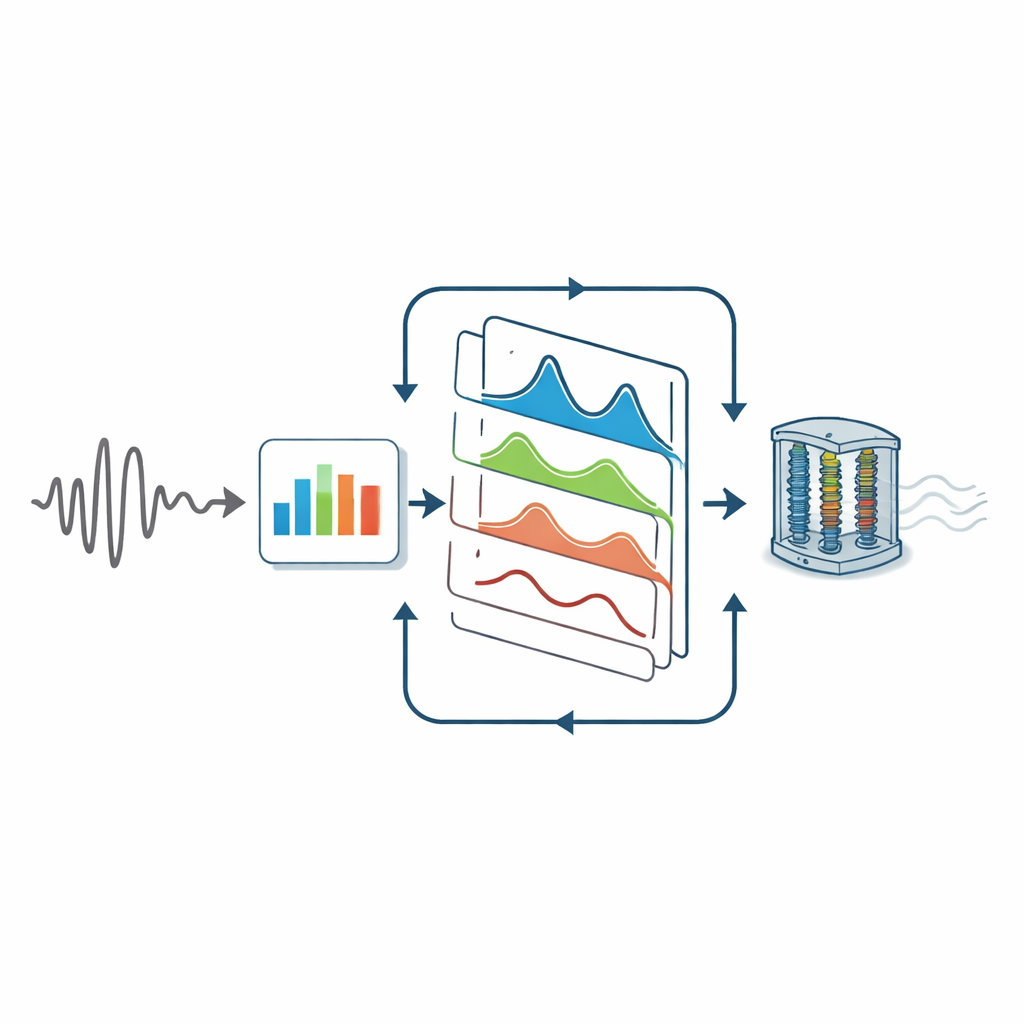
Learning naively from every possible vibration pattern would take far too long, because real machines face countless combinations of tones and amplitudes. To avoid this, the authors embed basic vibration physics into the learning process. They use a simple but powerful idea: energy measured over time is equal to energy measured over frequency. This allows them to define the learning problem around total vibration energy rather than every wiggle in the signal. They also focus on learning the system’s frequency response—how each possible setting of the absorber changes the vibration level at each tone—rather than memorizing responses to individual scenarios. This greatly shrinks the problem and turns each measurement into a quick, self-contained learning episode, speeding up training while remaining independent of any detailed material model.
Real-World Tests with Smart Rubber
To see if the approach works in practice, the researchers tested it on a real system made of a linear compressor attached to a block of magnetorheological elastomer, a rubber filled with iron particles that stiffens under a magnetic field. The controller observed vibrations from sensors, adjusted the magnetic field in eight discrete steps, and updated its internal description of how the absorber behaved. Over time, it learned the system’s true response with very high accuracy, even though the stiffness of the rubber slowly drifted over several days of operation. When challenged with complex, changing vibration patterns built from multiple tones whose frequencies and strengths varied over minutes, the learned controller cut vibration energy by as much as 58 percent compared with an uncontrolled case and nearly matched the best performance that could be achieved by exhaustively testing all possible fixed settings.
What This Means for Future Machines
In everyday terms, the study shows that a vibration damper can be taught to “listen” to a machine, understand how it currently shakes, and retune itself without a detailed blueprint of the hardware. By blending simple physical insight with a learning algorithm, the authors create a controller that is both efficient and adaptable, coping with changing materials and messy, real-world vibration patterns. This approach could lead to quieter, longer-lasting machines in vehicles, factories, and other settings where conditions are too complicated for traditional, hand-designed vibration control.
Citation: Park, JE., Kang, H. & Kim, YK. Domain knowledge-integrated reinforcement learning control of nonlinear tunable vibration absorber under nonstationary excitation. Sci Rep 16, 10849 (2026). https://doi.org/10.1038/s41598-026-45189-7
Keywords: vibration control, smart materials, reinforcement learning, adaptive damping, magnetorheological elastomer