Clear Sky Science · en
Response of curved laminated glass under quasistatic and blast loads
Why bending glass matters for safety
Glass walls and windows make modern buildings bright and open, but when a blast or severe impact hits, those same panes can become flying knives. This study asks a simple question with big safety implications: can gently curved safety glass keep people safer than flat glass when exposed to intense, fast-rising loads such as explosions? Using full-scale tests and computer simulations, the researchers show how adding curvature can change the way glass panels carry force, helping them stay in place longer and bend less when it matters most. 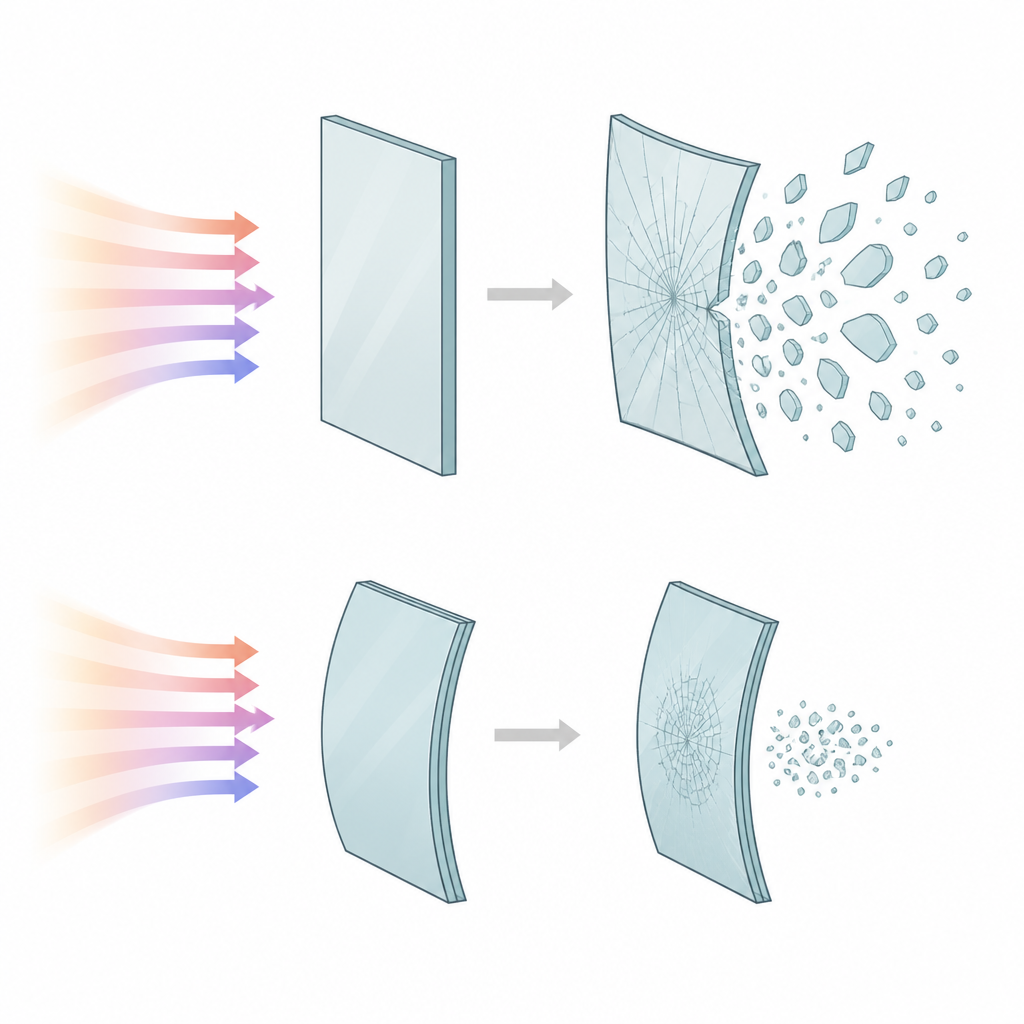
From flat sheets to gently arched panels
The work focuses on laminated glass, the type used in car windshields and many protective windows. Laminated glass is made of two glass sheets bonded by a plastic-like interlayer that holds shards together after cracking. Most earlier research examined flat panels, even though architects and engineers increasingly use curved glass in facades, roofs, and security glazing. This team built three large test panels with the same size and material: one flat, one slightly curved, and one with a more pronounced curve. The curvature was in two directions, forming a shallow dome that can act like an arch. The goal was to see how these shapes respond under slow, controlled pressure and under sudden blast-like loads.
Slow squeeze tests that reveal hidden strength
First, the panels were tested in a water-filled chamber that pressed evenly against the glass. This quasistatic setup let the team increase pressure slowly and track how far each panel deflected before the glass cracked and, later, before the interlayer finally tore. The curved panels clearly outperformed the flat one. The mild curve raised the cracking pressure by about ten percent, while the stronger curve lifted it by about fifty percent, even though all panels used the same glass and interlayer. The more curved panel also absorbed much larger deflections after cracking before complete failure. The researchers explain this by a shift from simple bending, which concentrates tension in the middle of a flat sheet, to an arch-like action that spreads forces across the surface and lets the interlayer share more of the load. 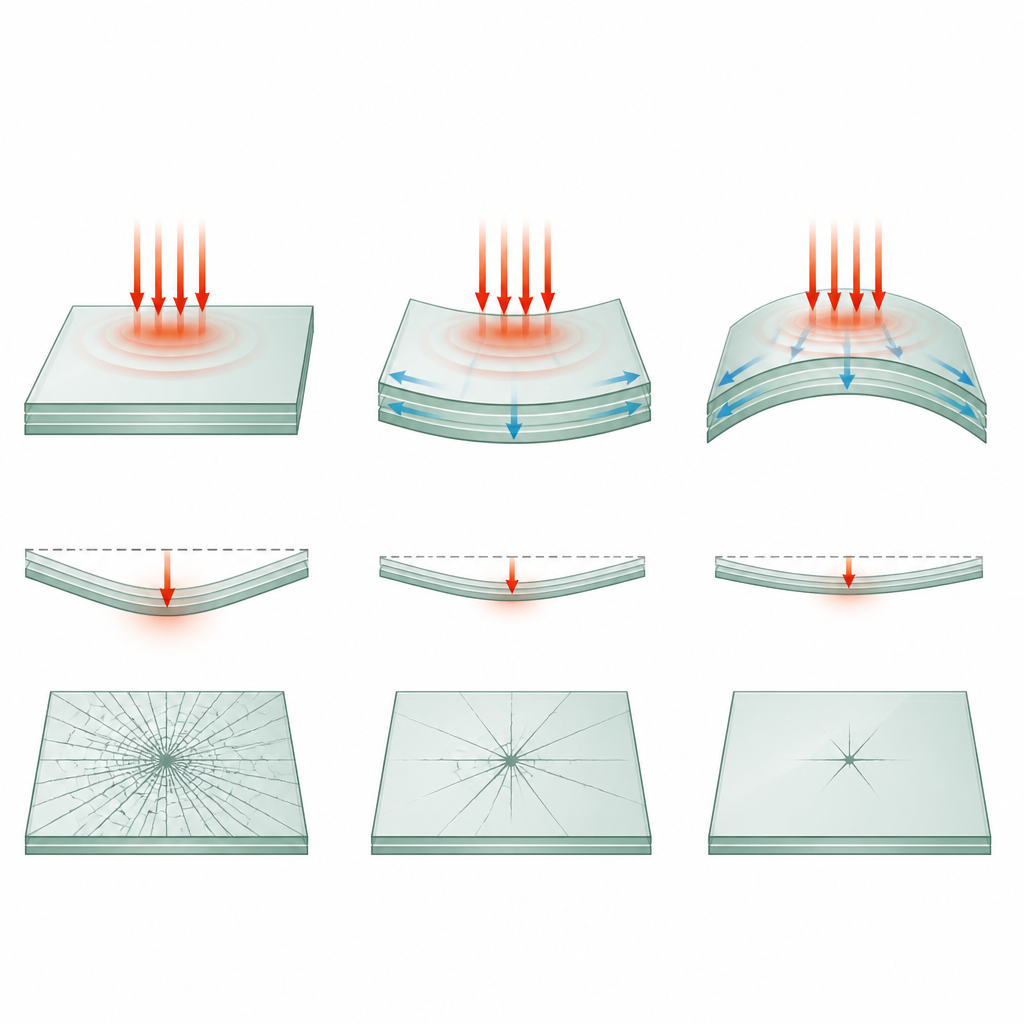
Blast-like tests that mimic real threats
Next, the team moved to a large shock tube facility that uses explosive charges to send controlled pressure waves against the panels, imitating the sharp, short loading from a nearby blast. Sensors and high-speed cameras captured the pressure history, the motion of the glass center, and the damage patterns. By adjusting the charge step by step, they drove each panel to failure. Under equivalent blast pressure and impulse, the curved panels bent far less than the flat one. After carefully normalizing the data, the slightly curved panel showed roughly seventy percent less midspan deflection than the flat panel, and the more curved panel showed about eighty-five percent less. While the curved panels could eventually fail suddenly once their capacity was exhausted, they resisted initial deformation much better.
Computer models that broaden the picture
To see whether these trends hold beyond the specific test specimens, the researchers built detailed computer models of the laminated glass using well-established material laws for brittle glass and flexible interlayers. The models matched the measured blast responses within a few percent, then were used to explore a wider range of panel shapes and curvatures under the same blast loading. As curvature increased from flat to mildly arched and then to more pronounced domes, the simulated peak deflection dropped sharply, by thirty to more than ninety percent. The simulations also showed how the load-carrying behavior shifts from bending in flat plates to a membrane-like, arching response in strongly curved panes, limiting out-of-plane motion and changing crack patterns.
What it all means for safer glass
For non-specialists, the takeaway is straightforward: gently bending a laminated glass panel can make it significantly tougher against blasts and other extreme loads without changing the basic materials. Curved panels crack at higher pressures, bend less under the same blast, and can absorb more energy before the interlayer finally gives way. This makes curved laminated glass an attractive option for protective windows, facades, and vehicle glazing in high-risk settings, offering designers a way to combine transparency, architectural freedom, and improved safety in a single element.
Citation: Elgholmy, L., Elbelbisi, A., Elsisi, A. et al. Response of curved laminated glass under quasistatic and blast loads. Sci Rep 16, 15427 (2026). https://doi.org/10.1038/s41598-026-45171-3
Keywords: laminated glass, curved glass, blast resistance, protective glazing, structural safety