Clear Sky Science · en
The Drosophila tyramine beta-hydroxylase gene is required for ethanol tolerance
Why tiny flies and alcohol make a big story
Humans are not the only creatures that react to alcohol or become tolerant to its effects over time. In this study, scientists turned to the humble fruit fly to uncover how a single brain chemical pathway helps animals cope with repeated alcohol exposure. By dissecting the genetics and neural circuits behind this process, the work sheds light on how brains translate past experience into changed behavior, and how small tweaks in a single gene can alter both stress responses and motivation to move.
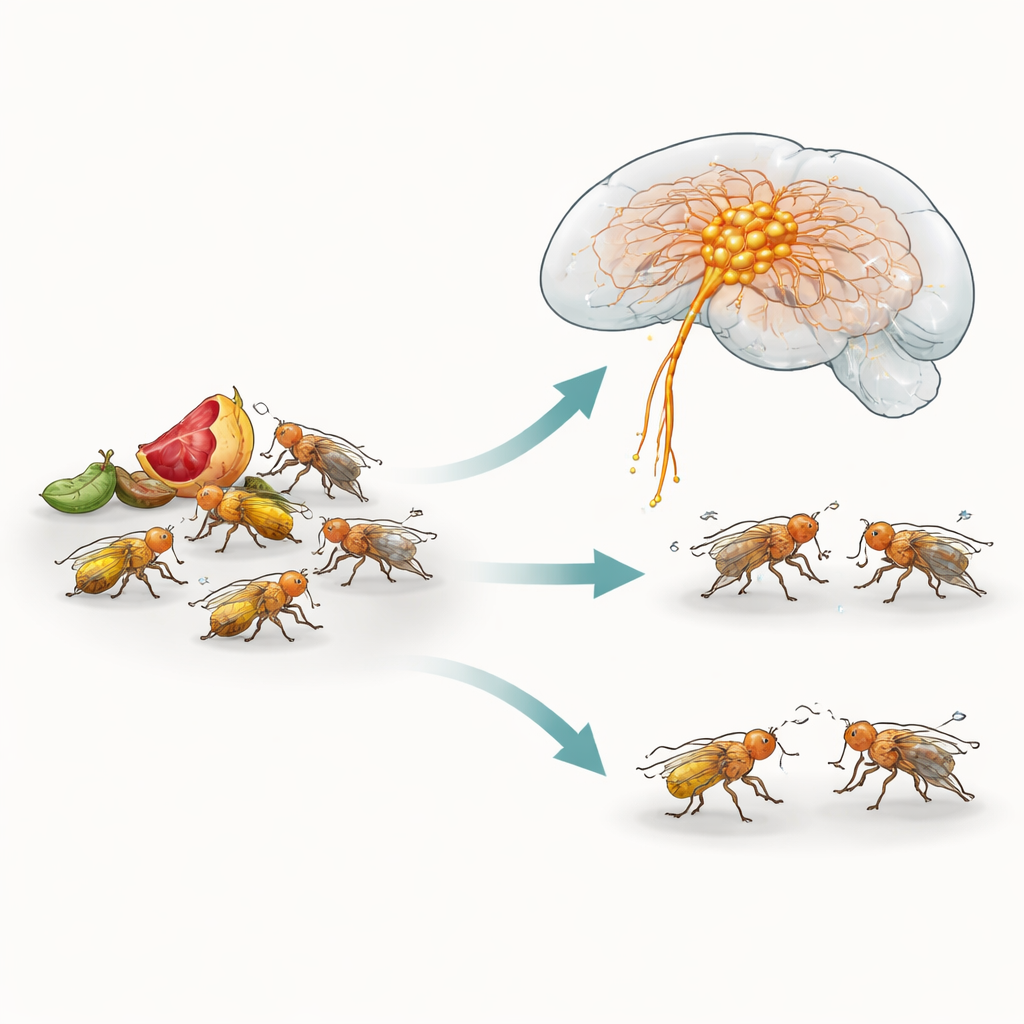
A brain messenger with many faces
The research centers on tyramine beta-hydroxylase, or Tbh, a gene that allows fruit flies to produce octopamine, a signaling chemical related to the adrenaline-like messengers in vertebrates. Earlier work showed that flies completely lacking octopamine are fertile only with difficulty, initiate movement poorly, and react unusually to ethanol, the type of alcohol found in beverages. Here, the authors first asked how the Tbh gene itself is organized. They discovered that it produces at least four different RNA transcripts, which in turn encode three slightly different versions of the Tbh protein. These versions vary mainly in regions that are likely controlled by phosphate “switches,” suggesting that cells can fine‑tune this enzyme’s activity during development or under stress.
Building a stronger loss-of-function mutant
One widely used Tbh mutant, called TbhnM18, lacks detectable octopamine, yet the new analysis showed that its DNA change does not remove the starting point for making some Tbh proteins and still leaves behind reduced amounts of transcript. To create a cleaner loss of function, the team engineered a new allele, TbhDel3, by deleting key starting exons using a recombination technique. This larger deletion sharply lowered Tbh transcript levels and removed most protein-coding capacity, while sparing one unusual transcript that begins further downstream. Comparing the original and new mutants allowed the researchers to tease apart which behaviors truly required Tbh function.
Alcohol tolerance, stress, and movement
Using an “inebriometer” column that measures how long flies can keep their balance in ethanol vapor, the authors tested how well different genotypes adapt to alcohol. Normal flies become more resistant after a first exposure, a phenomenon known as functional ethanol tolerance. Both TbhDel3 and TbhnM18 males showed normal initial sensitivity but developed much less tolerance after a second exposure, revealing a specific defect in behavioral adaptation rather than in basic motor control. After many repeated or chronic doses, however, even mutants eventually caught up to controls, indicating that Tbh-dependent and Tbh-independent forms of tolerance coexist. The two mutants diverged under heat stress: a brief heat shock before ethanol made control and TbhnM18 flies more resistant, but actually reduced resistance in TbhDel3 flies, implying that certain Tbh transcripts or protein forms are especially important for stress‑induced protection. Parallel tests of walking and crawling showed that mutants could move as far as, or farther than, normal flies when strongly motivated—by salt as an unpleasant stimulus or by the need to leave food and find a pupation site. Their problem lay not in movement itself, but in deciding when and how strongly to respond.
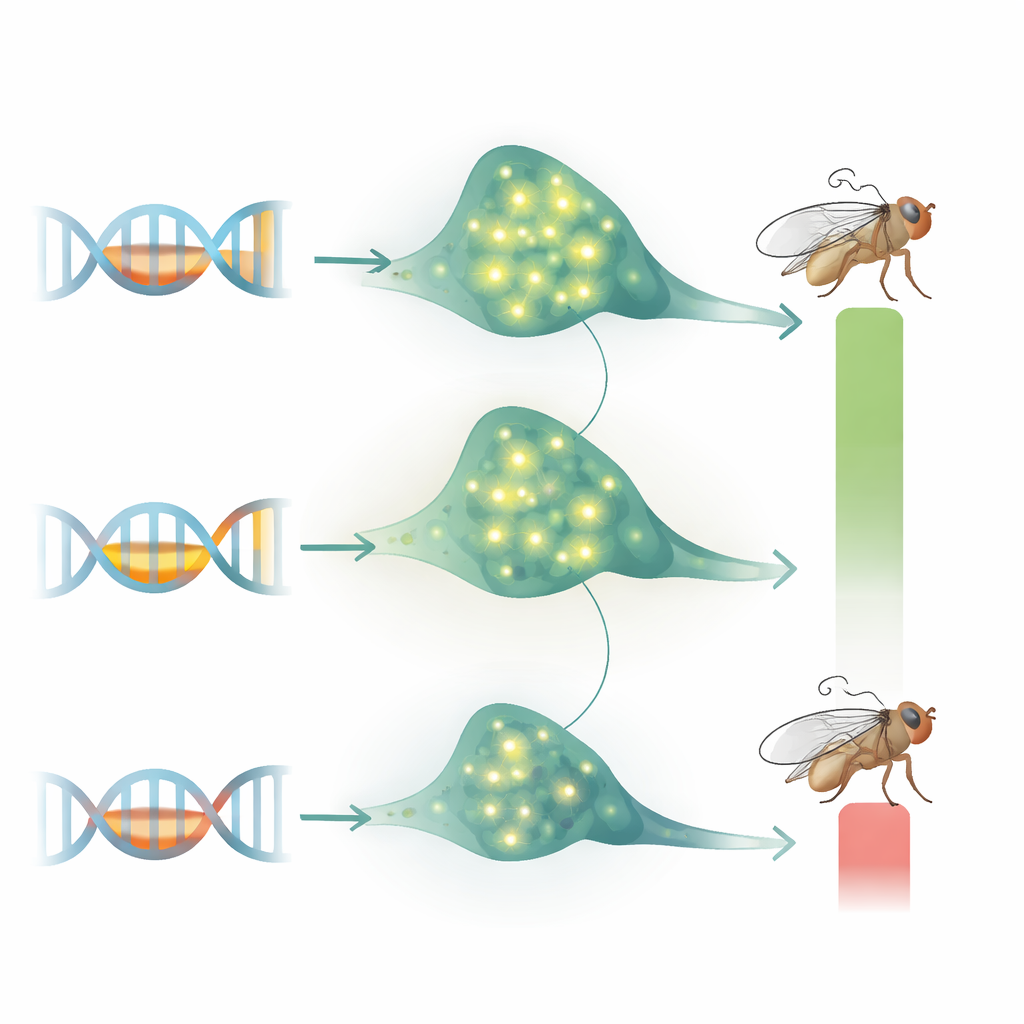
Pinpointing the neurons that matter
The next question was where in the nervous system Tbh must act for ethanol tolerance. By turning on a heat‑inducible Tbh gene only in adult flies, the researchers restored normal tolerance in TbhnM18 mutants, proving that adult rather than developmental expression is crucial. They then used a series of genetic driver lines to switch Tbh back on in selected sets of neurons. Surprisingly, drivers that mark many known octopamine cells, including those previously shown to control innate attraction to ethanol, failed to rescue tolerance, arguing that preference and tolerance rely on distinct circuits. A newly engineered 4.6‑Tbh-Gal4 driver, which labels a restricted set of brain and ventral nerve cord neurons, did restore tolerance when used to express Tbh in mutants. Yet overexpressing Tbh with the same driver in otherwise normal flies reduced tolerance, showing that both too little and too much enzyme are detrimental and that octopamine levels must be tightly balanced for proper adaptation.
What this means for brains and alcohol
Taken together, the findings reveal that a single enzyme for making a brain messenger can be controlled by multiple gene versions and by protein-level switches, and that its activity in a specific subset of adult neurons is essential for learning to withstand alcohol’s effects. Rather than crippling basic movement, loss of Tbh disrupts the fly’s ability to use prior experience and changing internal state to adjust behavior, including how it responds to alcohol and to stress. Because octopamine in insects resembles noradrenaline in vertebrates, the work hints that similar fine-tuned control of related pathways may shape how more complex brains handle repeated exposure to drugs, stress, and other powerful experiences.
Citation: Ruppert, M., Hampel, S., Claßen, G. et al. The Drosophila tyramine beta-hydroxylase gene is required for ethanol tolerance. Sci Rep 16, 12180 (2026). https://doi.org/10.1038/s41598-026-45082-3
Keywords: fruit fly alcohol tolerance, octopamine signaling, neurotransmitter genes, stress and ethanol, Drosophila behavior