Clear Sky Science · en
Contrasting spatial and temporal structuring of seawater and sediment bacterial communities in coastal environments
Why the Life in Beach Water and Sand Matters
When we visit the beach, we often think about waves, shells, and maybe water quality warnings—but rarely about the invisible world of bacteria living in the water and sand. These tiny organisms help recycle nutrients, break down organic matter, and keep coastal ecosystems functioning. This study asks a deceptively simple question with big implications: do the bacteria in seawater and in beach sand change in the same way over space and time, or do they follow very different rules? The answer matters for predicting how coasts will respond to pollution, climate change, and extreme weather events.
Watching Microbes Along a Stretch of Coast
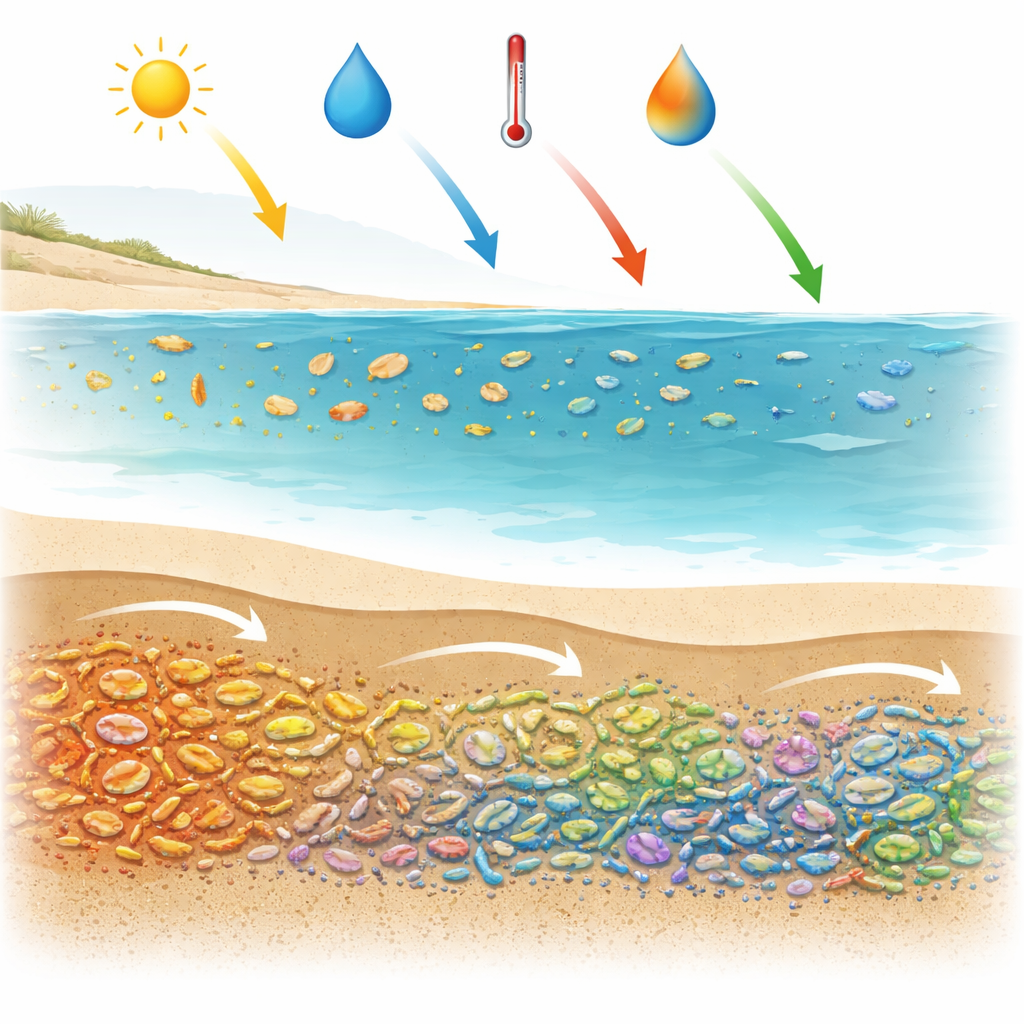
The researchers focused on five sandy beaches along nearly 40 kilometers of Mississippi’s Gulf Coast, an area increasingly influenced by river water, flood-control structures, and storms. Over 15 months, they collected more than 800 samples of seawater and surface sand from the surf zone, sometimes monthly, sometimes weekly, and even daily during an intensive period. From each sample they extracted DNA and used a standard gene marker (the 16S rRNA gene) to identify which kinds of bacteria were present and how many types there were. They then combined these community snapshots with measurements of temperature, saltiness (salinity), oxygen, and acidity to look for patterns through both time and space.
Two Neighborhoods, Two Different Stories
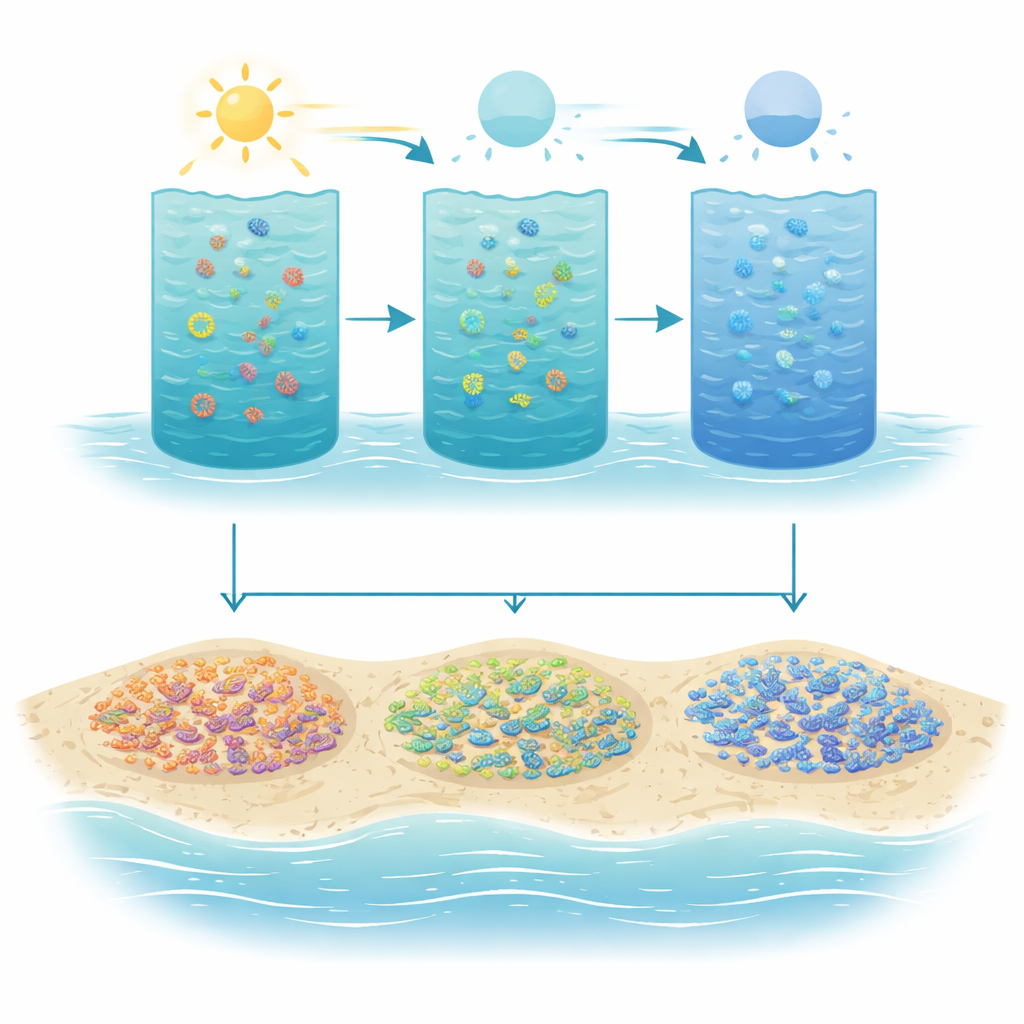
Seawater and sand turned out to host very different bacterial communities. The water contained fewer types of bacteria overall, and its community makeup shifted strongly with the seasons. Warm, less salty summer water favored some groups, while cooler, saltier periods favored others. The statistical analyses showed that when two water samples were taken farther apart in time, they tended to be more different from each other, up to about six to eight months; after that, the community “came back around,” suggesting a repeating yearly cycle. In contrast, the sand was more like a crowded, diverse city: many more bacterial types lived there, and the overall community changed much less from month to month, showing only a weak seasonal signal.
Sand Holds Its Ground While Water Swings with the Seasons
Where the water community was driven mainly by time and changing conditions, the sand community was shaped more by place. Bacterial groups in the sediment differed clearly from beach to beach, even though the sites were relatively close together. The sand communities also responded less strongly to shifts in temperature, salinity, oxygen, and pH than their seawater counterparts. The authors suggest that the high richness and possible “backup” functions among similar sand bacteria help buffer this habitat against short-term environmental swings. In other words, the sand hosts a robust, spatially distinct community that resists rapid change, while the water above it is more sparsely populated and more sensitive to seasonal pulses and freshwater inputs.
Following the Ups and Downs of Key Microbes
Looking closer at individual bacterial lineages sharpened this picture. In seawater, a few very common types—such as tiny photosynthetic cells related to Cyanobium and small heterotrophic cells known as Candidatus Actinomarina—rose and fell in tightly timed patterns that tracked temperature and salinity. Some flourished in warm, fresher conditions; others thrived when the water cooled and became saltier. A freshwater-associated group became more abundant during months with frequent rain, hinting at pulses of river or runoff water reaching the coast. In the sand, even the most frequent bacteria were found in less than half the samples and showed stronger differences from beach to beach than from season to season, reinforcing the idea that location matters more than time for these buried communities.
What This Means for Coasts and Their Future
For a layperson, the key takeaway is that coastal water and sand, though tightly connected, do not respond in lockstep to environmental change. The bacteria in the surf water act like a responsive early-warning system, shifting quickly with seasons, rainfall, and salinity, whereas the richer and more spatially distinct sand communities change more slowly and may buffer the ecosystem against rapid swings. Understanding these different rhythms will help scientists and managers better interpret coastal monitoring data, design smarter sampling programs, and anticipate how nearshore microbial life—and the essential services it provides—will fare as climate change and human activities continue to reshape our coasts.
Citation: Vaughn, S.N., Pavlovsky, J.C., Heiman, J.A. et al. Contrasting spatial and temporal structuring of seawater and sediment bacterial communities in coastal environments. Sci Rep 16, 14586 (2026). https://doi.org/10.1038/s41598-026-45076-1
Keywords: coastal microbiome, seawater bacteria, sediment bacteria, Gulf of Mexico, microbial diversity