Clear Sky Science · en
Nonlinear vibration behavior of self-sustaining CNT nanobeams under thermo-magnetic fields: surface energy insights for advanced sports applications
Smarter gear for faster, safer play
Modern sports gear is no longer just metal, plastic, and foam. Designers now weave in tiny building blocks called carbon nanotubes to make rackets, bike frames, and helmets that are lighter, stronger, and more responsive. This study explores how these nanotube-based parts vibrate when they are hit, bent, or shaken, and how heat and magnetic fields can be used to fine-tune that motion for better performance and protection on the field or court.
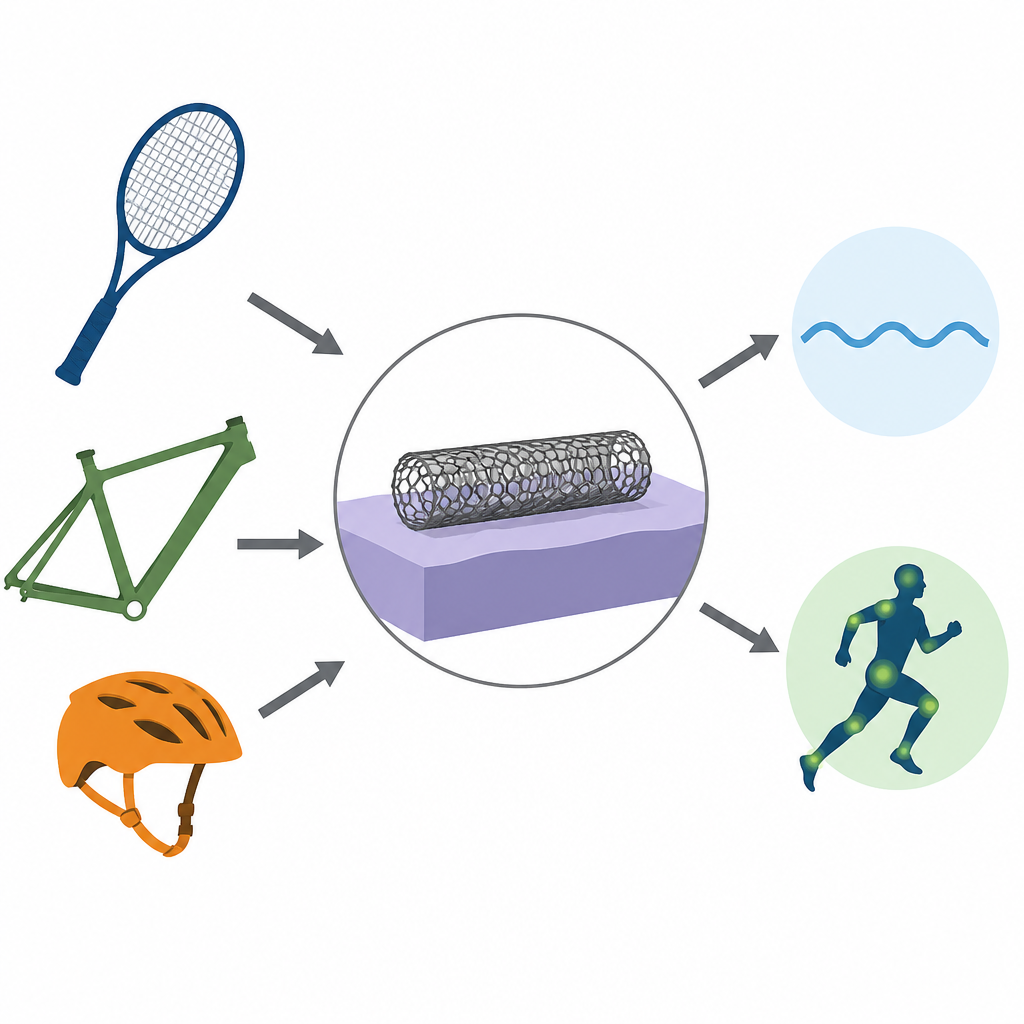
Tiny beams hidden inside sports gear
The authors focus on nanotube "beams" only billionths of a meter thick that can be embedded inside sporting equipment. When a tennis racket strikes a ball or a cyclist hits a bump, these beams flex and vibrate. Because their surface area is huge compared with their volume, the behavior of their outer skin matters a lot. The study treats each nanotube as a slim beam with a special surface layer that can store extra energy and stress, wrapped around a more ordinary inner core. This layered picture lets the researchers capture how the surface helps or hinders shock absorption and stiffness at very small scales.
How the team modeled motion and control
Instead of testing full products, the researchers built a detailed mathematical model of a single nanotube beam resting on a soft, rubber-like support. They described how the beam bends, how the soft base damps motion, and how heat and magnetism change the effective stiffness. Using methods that break the motion into simple vibration patterns and track how they evolve over time, they derived compact equations linking input force, frequency, and vibration size. These equations reveal how the beam can show a "self-sustaining" rhythm, where it keeps oscillating on its own once disturbed, as well as sudden jumps between quiet and strongly vibrating states when the driving frequency is slowly changed.
Knobs engineers can turn
The team then explored how different design knobs alter the vibration landscape. Changing the surface properties of the nanotube, which depend on its crystal orientation, can make the beam either more flexible or stiffer; one direction ([111]) produced noticeably smaller motion than another ([100]) for the same forcing. Raising the temperature typically made the vibration more nonlinear and boosted peak amplitudes, while also growing a second closed loop in the frequency response that marks another possible motion state. Adjusting the driving force amplitude could cause this loop to merge with the main branch and disappear, simplifying the response into a single curve with a clear jump point.
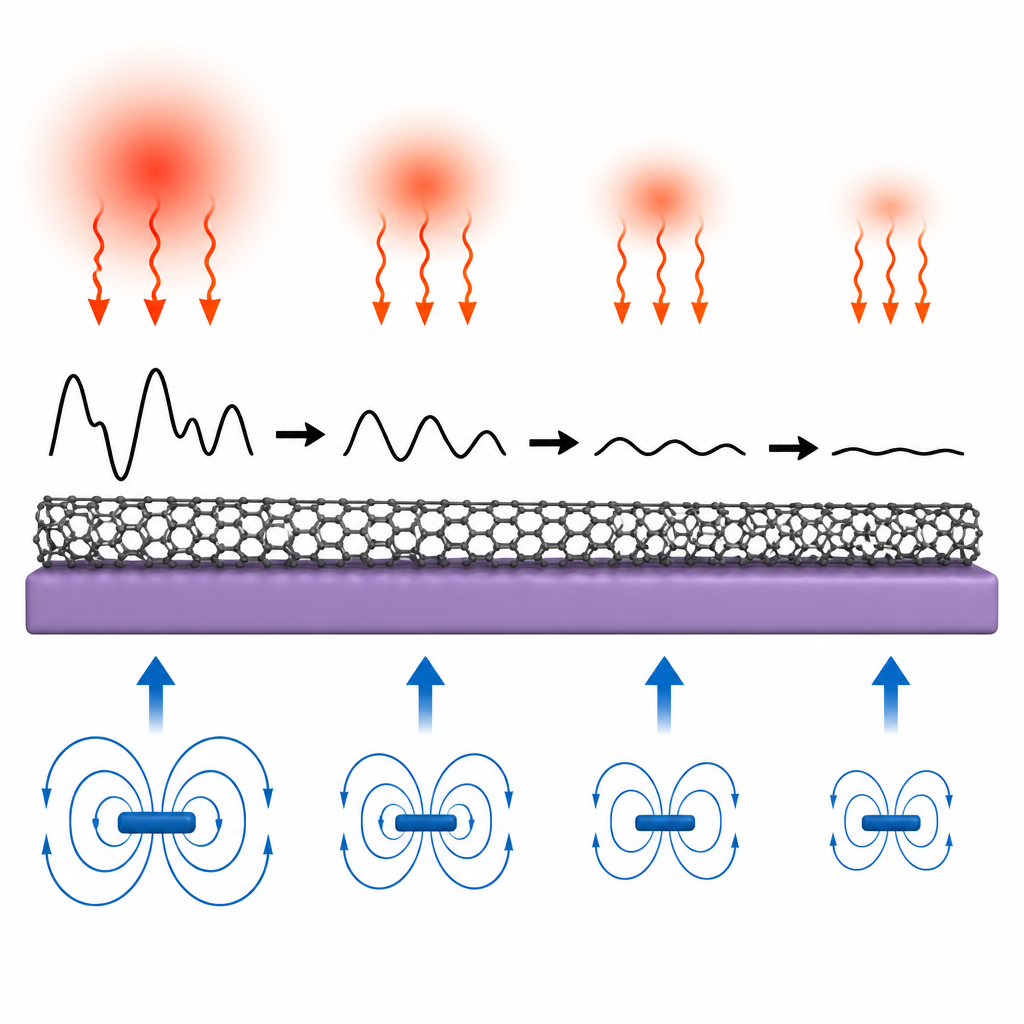
Role of size, shape, support, and magnetic field
The authors also varied the beam length, width-to-thickness ratio, and the details of the soft supporting layer. Longer beams reached higher peak responses but showed weaker forward-jump behavior, because stretching along their length adds a strong stiffening effect. Making the cross section wider increased the influence of the surface layer, stretching the closed region of the response and amplifying nonlinear behavior. The soft foundation contributed both linear and nonlinear damping; tuning these two types of damping could either separate the open and closed regions of the response or cause them to merge into one. Finally, applying a stronger magnetic field generally made the system behave more like a simple, predictable spring by increasing effective stiffness and damping out extreme nonlinear swings.
What this means for future sports gear
For a non-specialist, the key outcome is that tiny changes in material choices, geometry, temperature, magnetic field, and support properties can be used to sculpt how nanotube-based parts vibrate under impact. By reading the model as a design map, engineers can select combinations that avoid sudden jumps in vibration, maximize energy absorption where protection is needed, or tune the "feel" of a racket or frame for a specific athlete. In short, the study turns complex nanoscale vibration physics into practical guidelines for crafting lighter, longer-lasting, and more comfortable sports equipment that quietly manages shocks and vibrations in the background.
Citation: Hadj Lajimi, R., Hajlaoui, K., Mostafa, L. et al. Nonlinear vibration behavior of self-sustaining CNT nanobeams under thermo-magnetic fields: surface energy insights for advanced sports applications. Sci Rep 16, 15070 (2026). https://doi.org/10.1038/s41598-026-45044-9
Keywords: carbon nanotubes, sports equipment, vibration control, nanobeam dynamics, thermo magnetic field