Clear Sky Science · en
Data-driven optimisation of sustainable high-performance concrete incorporating SCMs, biomass ash, and graphene nanoplatelets
Greener Concrete for a Hotter Planet
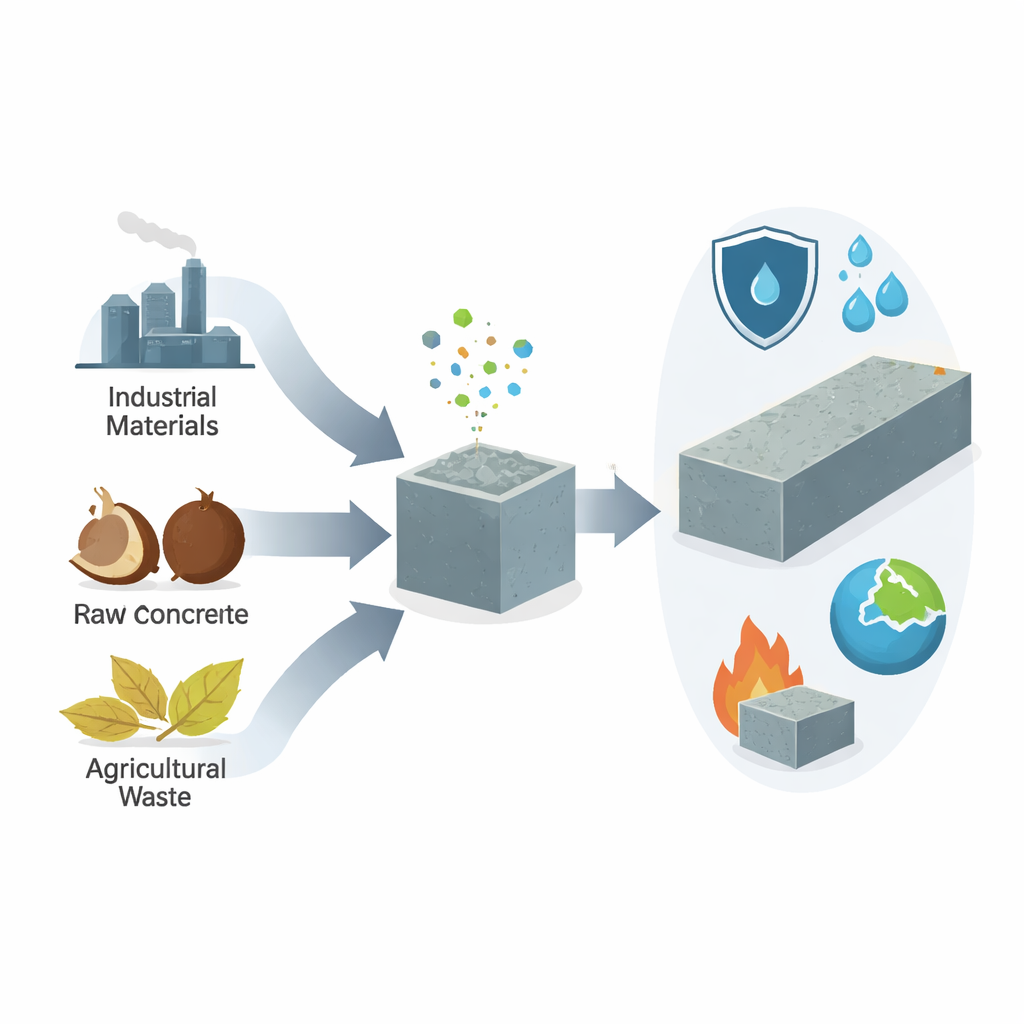
Concrete underpins modern life, but ordinary cement is one of the world’s largest industrial sources of carbon dioxide. This study explores how to redesign concrete so it stays strong and durable while cutting its climate impact and reusing industrial and agricultural waste. The authors blend power‑plant ash, steelmaking slag, burnt coconut waste, and tiny sheets of graphene to create a new kind of high‑performance concrete, then use machine learning and evolutionary algorithms to fine‑tune the recipe.
Turning Waste into Building Blocks
Instead of relying almost entirely on ordinary Portland cement, the team replaces a large share of it with three ingredients: fly ash from coal power plants, ground blast‑furnace slag from steelmaking, and a fine ash made by carefully burning discarded coconut coir. These powders react with cement and help fill in its microscopic gaps, reducing the amount of fresh clinker (and therefore CO2) needed. On top of this, they add an ultra‑small ingredient: graphene nanoplatelets, wafer‑thin carbon flakes only billionths of a meter thick. The idea is to build a concrete where waste materials work together from the nano‑ to the millimeter scale.
From Fibers and Flakes to a Denser Inner Structure
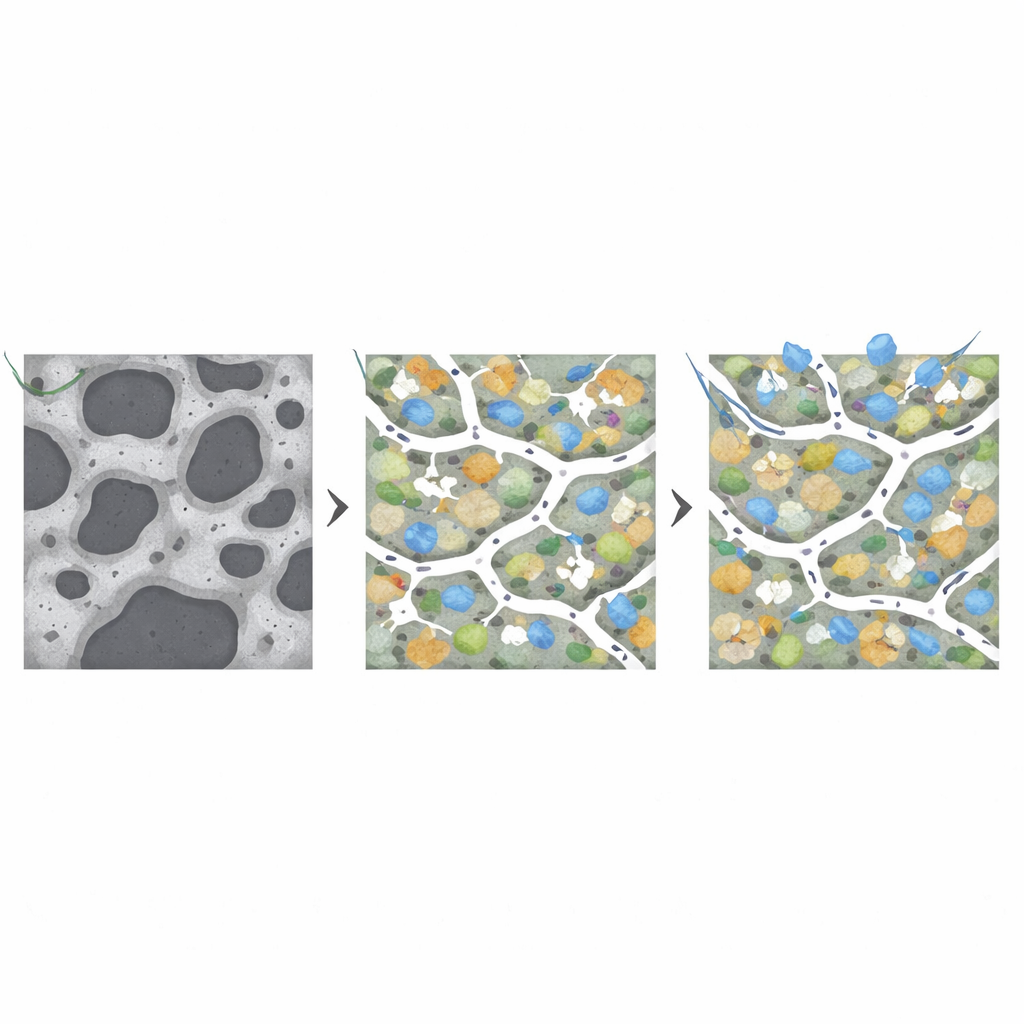
The coconut‑based ash is engineered so that its particles are rich in reactive silica and have a layered, rough surface. This makes them good at both reacting with lime in the hardening cement and helping to spread the graphene flakes evenly rather than letting them clump. Fly ash and slag gradually react with the cement’s by‑products to form extra binding gel, while well‑dispersed graphene sheets act as tiny starting points for new crystals and as bridges that span micro‑cracks. Together, these processes create a denser inner structure with fewer connected pores and stronger contact zones around the sand and gravel.
Testing Strength, Durability, and Heat Resistance
The researchers cast ten different concrete mixes, all designed to meet a common structural grade, and tested them for workability when fresh, strength after 7 and 28 days, resistance to water and chloride penetration, and leftover strength after heating to 300 °C. One optimized mix stood out: it reached about 55 megapascals of compressive strength at 28 days, roughly 23% higher than a conventional control mix, while cutting chloride permeability by about 42% and water absorption by around 40%. Even after heating, it kept over 80% of its original strength, indicating improved thermal stability. Microscopy showed this winning mix had very little leftover lime, a tightly packed gel, and far fewer micro‑voids than ordinary concrete.
Letting Algorithms Explore the Recipe Book
Because laboratory trials are slow and expensive, the team trained several machine‑learning models on their experimental results to act as fast “surrogate” testers. Gradient‑boosted trees (XGBoost) predicted strength especially well, while random forests proved most stable for exploring trade‑offs. Using these models inside multi‑objective optimisation algorithms, the authors searched within realistic bounds for mixes that balance four goals at once: high strength, low chloride permeability, low embodied CO2, and reasonable material cost. The resulting Pareto fronts revealed families of mixes where improving one goal (for example, cutting carbon further) inevitably nudges others (like cost or workability) in the opposite direction.
What This Means for Future Buildings
The study shows that carefully tuned blends of industrial by‑products, biomass ash, and nanoscale carbon can deliver concrete that is stronger and more durable than standard mixes while roughly halving the cement‑related carbon footprint, at the expense of higher material cost and more complex production. By combining lab testing, microstructural analysis, and interpretable machine learning, the authors demonstrate a practical, repeatable way to design eco‑efficient concrete mixes within a defined range of ingredients—pointing toward buildings and infrastructure that are kinder to the climate without sacrificing safety or service life.
Citation: Anand, P., Singh, S.D., Pratap, S. et al. Data-driven optimisation of sustainable high-performance concrete incorporating SCMs, biomass ash, and graphene nanoplatelets. Sci Rep 16, 10657 (2026). https://doi.org/10.1038/s41598-026-45032-z
Keywords: sustainable concrete, supplementary cementitious materials, biomass ash, graphene nanoplatelets, machine learning optimisation