Clear Sky Science · en
A sustainable hybrid FEA–AI optimization framework for multistage deep drawing of unidirectionally rolled copper micro-cups
Why tiny metal cups matter
From smartphones to medical implants, many modern devices hide tiny metal cups that hold, shield, or connect delicate parts. Making these micro-cups from copper sounds straightforward, but getting each one to have the right shape while using as little energy and material as possible is surprisingly difficult. This study shows how combining computer simulations with artificial intelligence can tune the manufacturing process so these parts come out right the first time, with less waste.
How micro-cups are made
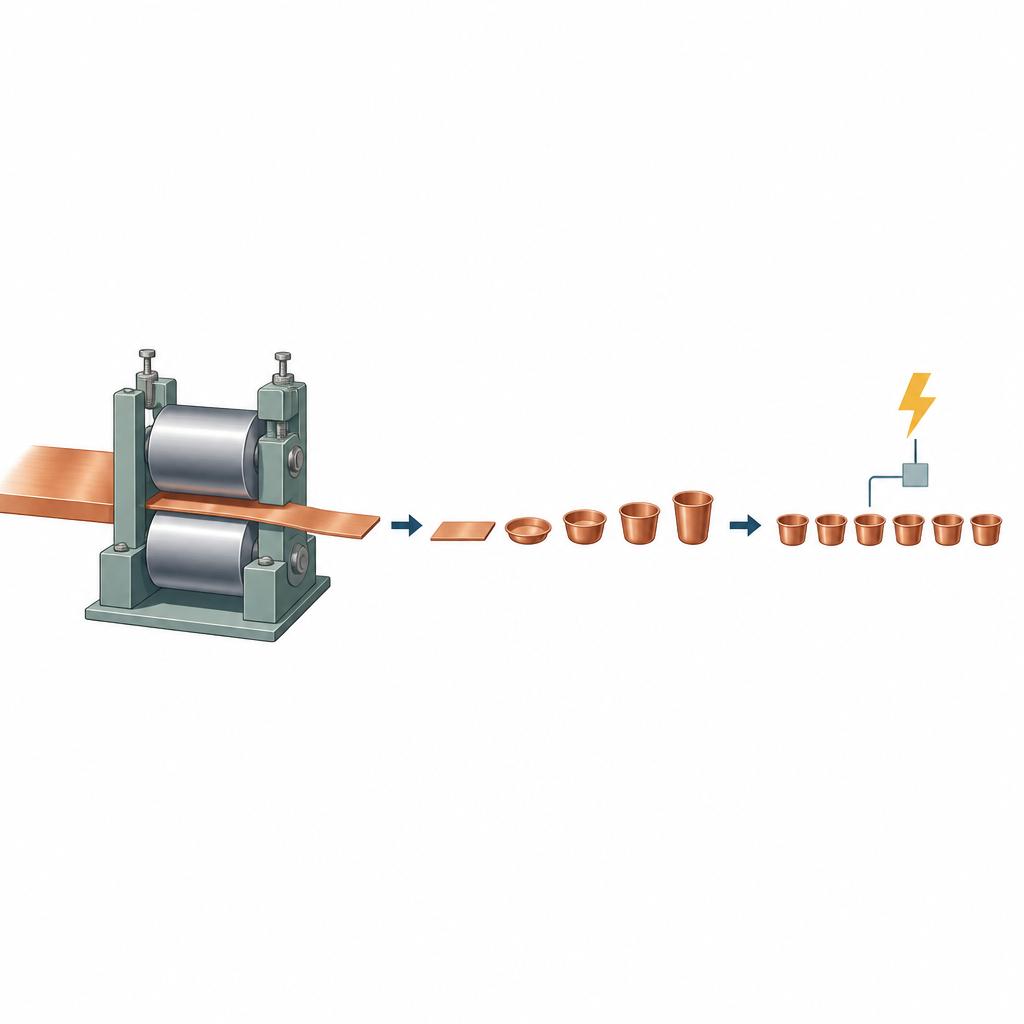
Micro-cups are often formed by pushing a flat metal strip into a die so it flows into a cup shape, a process known as deep drawing. As the cups shrink to millimeter scale, small changes in friction, tool shape, or metal texture can cause big problems: the tools may need much higher force than expected, and the cups can spring back after forming, changing size and shape. The authors focus on copper strips that have been heavily rolled to make them strong and fine-grained, which also makes their behavior highly directional and harder to predict. They design an eight-stage route that gradually squeezes thick copper plate into thin-walled micro-cups without tearing.
Watching metal flow in a virtual press
Instead of relying on trial and error in the workshop, the team builds a detailed virtual version of the process using the finite element method, a standard engineering simulation tool. They feed in measured properties of the rolled copper, including how it stretches differently along and across the rolling direction. In the simulation they vary three key knobs: the gap between punch and die, the roundness of the punch nose, and the roughness of contact, expressed as friction. For each combination, the model predicts two important outcomes: the maximum force on the tools during forming and how much the cup walls spring back after the load is removed. These runs create a rich, consistent data set that maps how process settings affect cup quality.
Teaching an artificial brain to predict outcomes
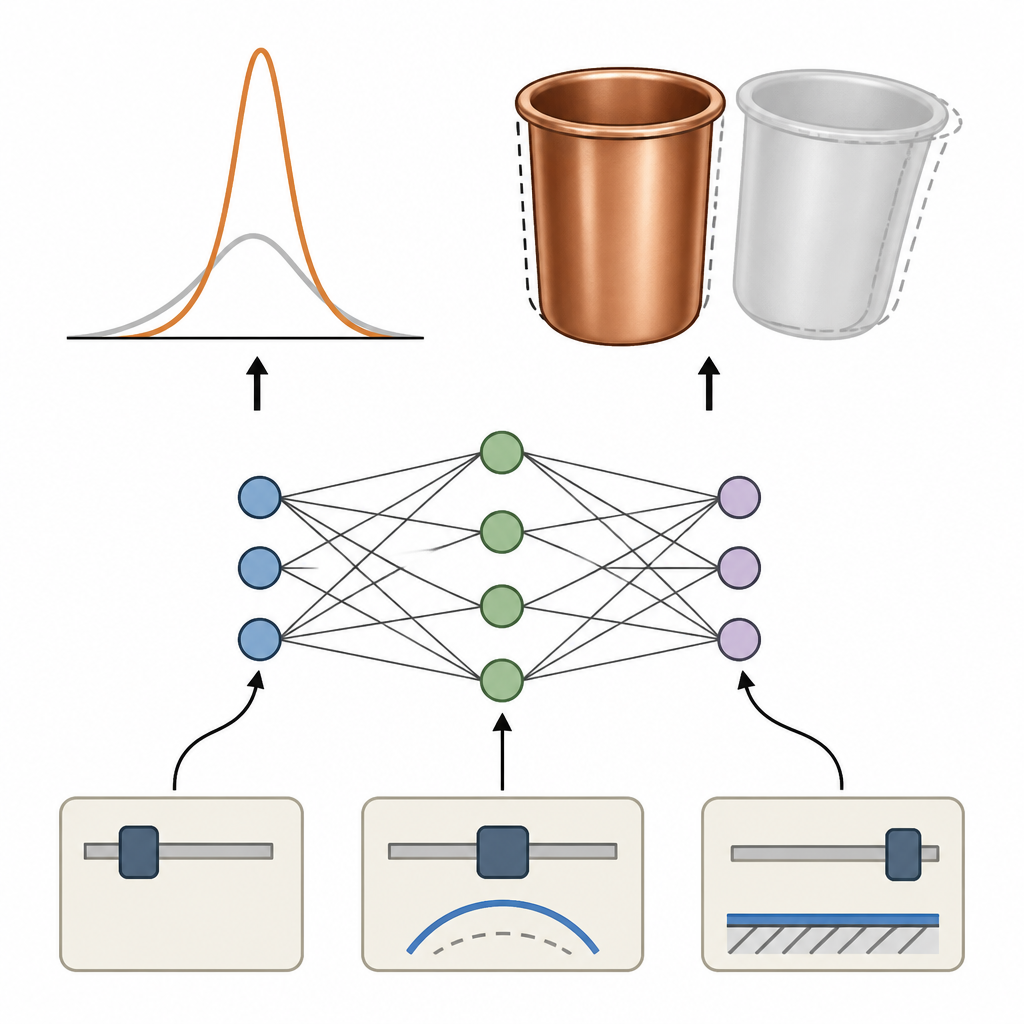
To turn the simulation data into a fast decision tool, the researchers train mathematical surrogates that can predict force and spring-back without re-running heavy calculations. They try a traditional curve-fitting approach and two flavors of artificial neural networks, which are computer models inspired by brain-like connections. All of these are trained only on the simulated data, then checked against real experiments on a hydraulic press. Among them, a neural network that uses Bayesian regularization, a method that guards against overfitting, provides the most reliable predictions for both the virtual and real test cases, keeping typical errors around or below a few percent.
Letting evolution search for the best settings
With a trustworthy fast predictor in hand, the team adds a genetic algorithm, which mimics natural selection by evolving many candidate settings and keeping the best performers. The combined system searches for process conditions that keep both tool force and spring-back low while still forming defect-free cups. It identifies an optimal region with a moderate clearance, a relatively small punch nose radius, and low friction. Experiments using these settings confirm that the required force and the amount of spring-back both drop noticeably compared with a baseline case, with force reduced by about six percent and spring-back by nearly ten percent. Because forming force is closely tied to power use, these improvements suggest direct energy savings in high-volume production.
What this means for greener manufacturing
For readers, the key message is that careful use of virtual experiments and AI can make it much easier to dial in the right conditions for making tiny metal parts. In this work, the hybrid framework learns from physics-based simulations, passes those lessons to a neural network, and then uses an evolutionary search to find sweet spots that keep parts accurate while reducing tool loads, energy use, and scrap. The approach has so far been tested only for simple, round copper micro-cups, but it offers a template for making many other small components more efficiently, supporting both precise devices and more sustainable manufacturing.
Citation: Sivam, S.P.S.S., Kesavan, S. & Santhosh, A.J. A sustainable hybrid FEA–AI optimization framework for multistage deep drawing of unidirectionally rolled copper micro-cups. Sci Rep 16, 15934 (2026). https://doi.org/10.1038/s41598-026-45011-4
Keywords: micro deep drawing, copper micro-cups, artificial neural networks, genetic algorithm optimization, sustainable manufacturing