Clear Sky Science · en
Dance movement reconstruction via a 2D matrix model and Haute Monde Chimp Optimization
Dancing Meets Digital Insight
Behind every graceful turn on stage lies an invisible storm of motion that is surprisingly hard to capture. This study explores how to record and rebuild complex dance movements when cameras and sensors miss parts of the body, whether because of flowing costumes, fast spins, or unusual poses. By blending ideas from mathematics and nature-inspired computer search, the authors present a way to turn noisy, incomplete dance recordings into clean, continuous motion that could help choreographers, animators, game designers, and rehabilitation specialists alike.
Why Recording Dance Is So Hard
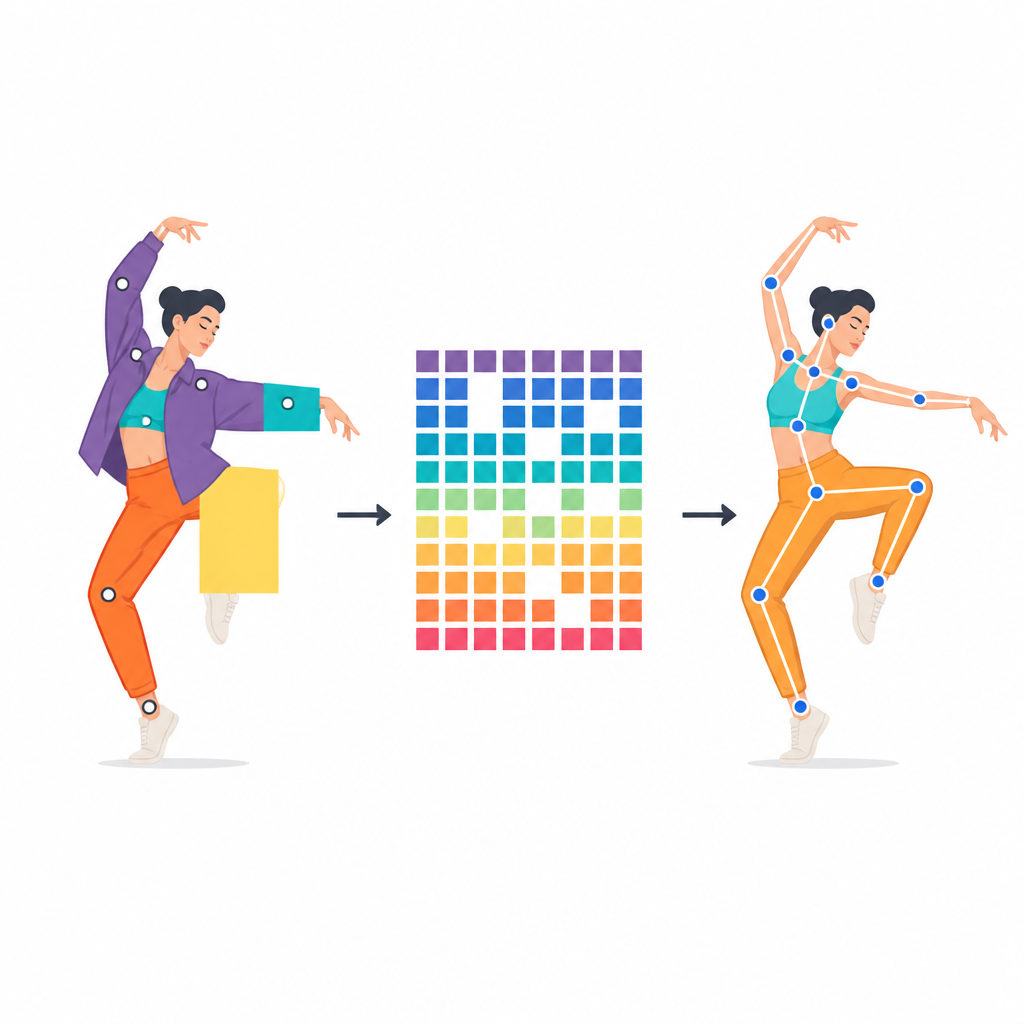
Modern motion capture systems promise to turn dancers into streams of digital data, but real performances rarely behave like lab demos. Limbs block each other, loose fabric hides joints, and dancers improvise movements that twist far beyond simple patterns. As a result, the data often has gaps where joints vanish and paths that bend in highly non-linear ways over time. Earlier tools, such as neural networks, low-rank matrix methods, or depth cameras like Kinect, can handle short clips or simple gestures, but they lack firm guarantees that they will correctly recover the full motion when the dance becomes intricate and the data gets messy.
A New Way to Represent Motion
To tackle this, the authors introduce a multidimensional matrix calculation model that treats human motion as a rich geometric object rather than just a list of joint coordinates. In this view, the dancer’s skeleton is drawn as a network of joints in three-dimensional space, and each pose is mapped onto a curved mathematical surface that better reflects how real joints rotate. These poses are then organized into a large matrix whose entries describe how body parts move together over time. Missing joints show up as empty entries, turning motion recovery into a kind of “intelligent fill-in-the-blanks” task on this matrix. By designing the model to favor simple, low-rank structures in a careful way, the method seeks out the most coherent full motion that fits the incomplete data.
Nature-Inspired Search With Digital Chimps
The second pillar of the work is a search strategy called the Haute Monde Chimp Optimization Algorithm. Inspired by how chimpanzees cooperate while hunting, this approach imagines many candidate solutions roaming through the space of possible model settings. Some play the role of leaders, others act as drivers or blockers, and their influence shifts as the search progresses. Unlike earlier versions of this idea, which gave every leader equal weight or only tweaked numerical parameters, the new algorithm introduces a hierarchy among these roles and coordinates long jumps with fine local adjustments. This structure allows it to focus more strongly on promising regions of the search space while still exploring alternatives, which is crucial when the landscape of possible motions is full of local traps.
Putting the System to the Test
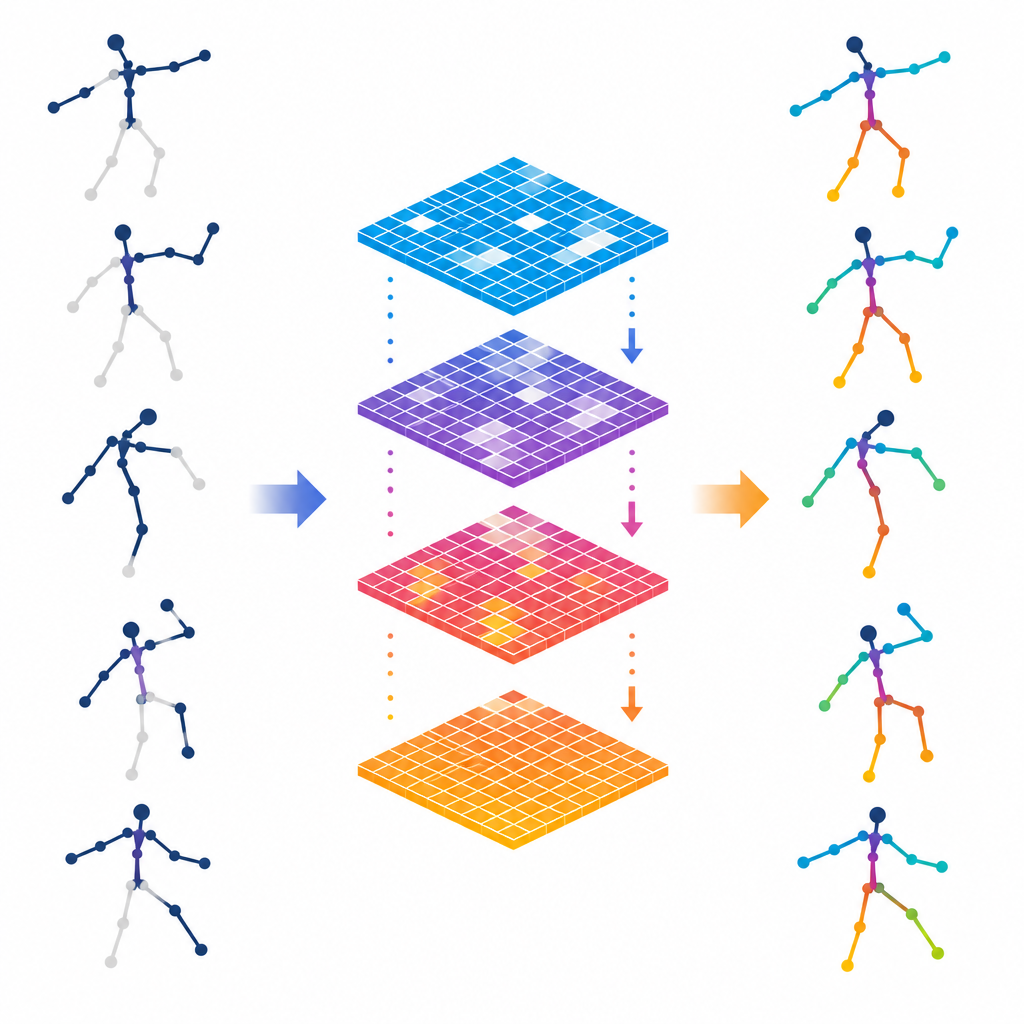
The combined framework, called MMC-HMCOA, was tested on dance-like motions represented with a standard digital body model. The authors varied how complex the movements were, how many computational “nodes” were used in the model, and how much motion data was missing. They then compared their method to several well-known baselines, including recurrent neural networks, standard matrix-completion tools, a multimodal data approach, Kinect-based tracking, and a version of their own matrix model without the new search strategy. Across a wide range of conditions, MMC-HMCOA consistently achieved higher accuracy, lower error, and better ability to distinguish correct from incorrect reconstructions, while also remaining stable when up to half of the data points were removed.
What This Means for Dance and Beyond
For a non-specialist, the main takeaway is that the authors have found a principled way to “repair” broken recordings of human movement so the resulting digital dances look natural and complete. By pairing a motion description that respects how bodies actually move with an organized, cooperative search inspired by animal behavior, the system can recover fine details that other approaches miss. While the study focuses on dance, the same ideas could apply wherever we need to track people reliably despite occlusion and noise, from virtual reality and sports analysis to robotics and clinical movement assessment.
Citation: Liang, D., Khishe, M., Alenizi, F.A. et al. Dance movement reconstruction via a 2D matrix model and Haute Monde Chimp Optimization. Sci Rep 16, 14989 (2026). https://doi.org/10.1038/s41598-026-44993-5
Keywords: dance motion capture, human movement reconstruction, optimization algorithm, matrix model, computer animation