Clear Sky Science · en
Pancreatic amylase activity and development of the gastrointestinal tract in C57BL/6J mice before and after weaning
Why this matters for growing bodies
When a baby mammal switches from mother’s milk to solid food, its entire digestive system has to retool itself. This study looks closely at how that transition plays out in one of science’s most important model animals, the C57BL/6J laboratory mouse. By tracking how the pancreas and intestines change around weaning, the researchers shed light on how young animals learn to handle starch-rich diets—information that can improve both animal welfare in research and our broader understanding of digestion.
From milk meals to solid snacks
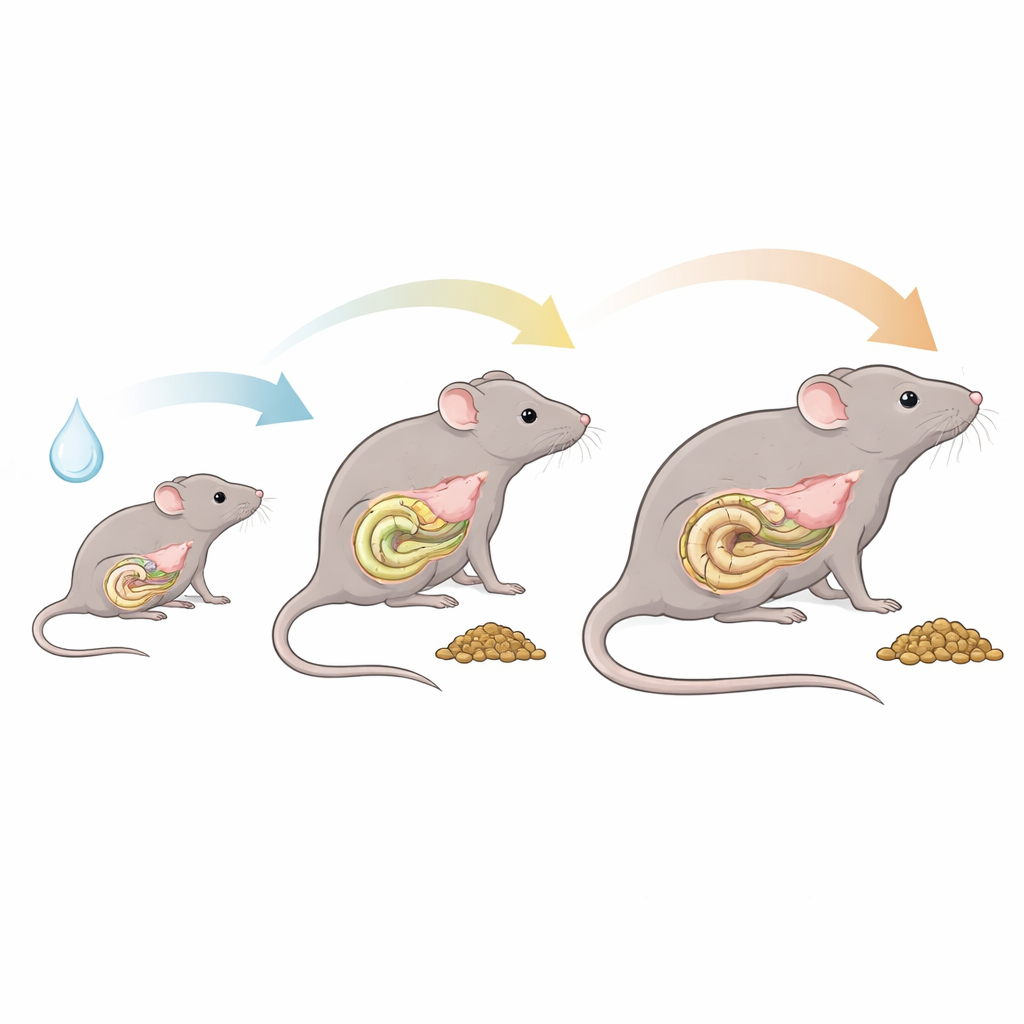
The researchers focused on the crucial window when mouse pups stop relying on milk and move to a dry, pelleted diet. Milk is rich in lactose, while standard lab chow contains a lot of starch, a very different kind of carbohydrate. To cope, the digestive tract must dial down enzymes that split lactose and ramp up others that attack starch. The star of this story is pancreatic amylase, an enzyme that chops long starch chains into smaller sugar units the body can use for energy. Understanding exactly when and how this switch happens in mice has been surprisingly underexplored, despite their central role in biomedical research.
Taking a detailed look inside young mice
The team studied 59 mice at seven ages, from 12 days old—when pups were still living entirely on milk—up to 10 weeks, when they were fully weaned and growing rapidly. At each age, the scientists recorded body weight, measured the size of organs such as liver, spleen, stomach, pancreas, and caecum (a fermentation pouch at the start of the large intestine), and measured the lengths of the small intestine and colon. They also determined blood sugar levels and, most importantly, tested how active amylase was in the pancreas and in the contents of the small intestine.
How the gut grows and gears up
Body weight rose steeply with age, with males eventually outgrowing females, but the pattern was not a straight line—growth was fastest in the first couple of months and then slowed. Many organs showed a noticeable “jump” in relative size around 3 to 4 weeks of age, just as pups shifted to solid food. The liver’s share of body weight, for example, roughly doubled in this period, consistent with a greater role in handling carbohydrate-rich meals. The small intestine and colon also lengthened quickly until about 5 weeks, creating more surface area to absorb nutrients. Meanwhile, the caecum transformed from a tiny, nearly empty appendage in 12‑day‑old pups into a large, content-filled fermentation chamber in weaned mice, mirroring the arrival of fiber and undigested starch into the hindgut.
The starch-digesting engine switches on
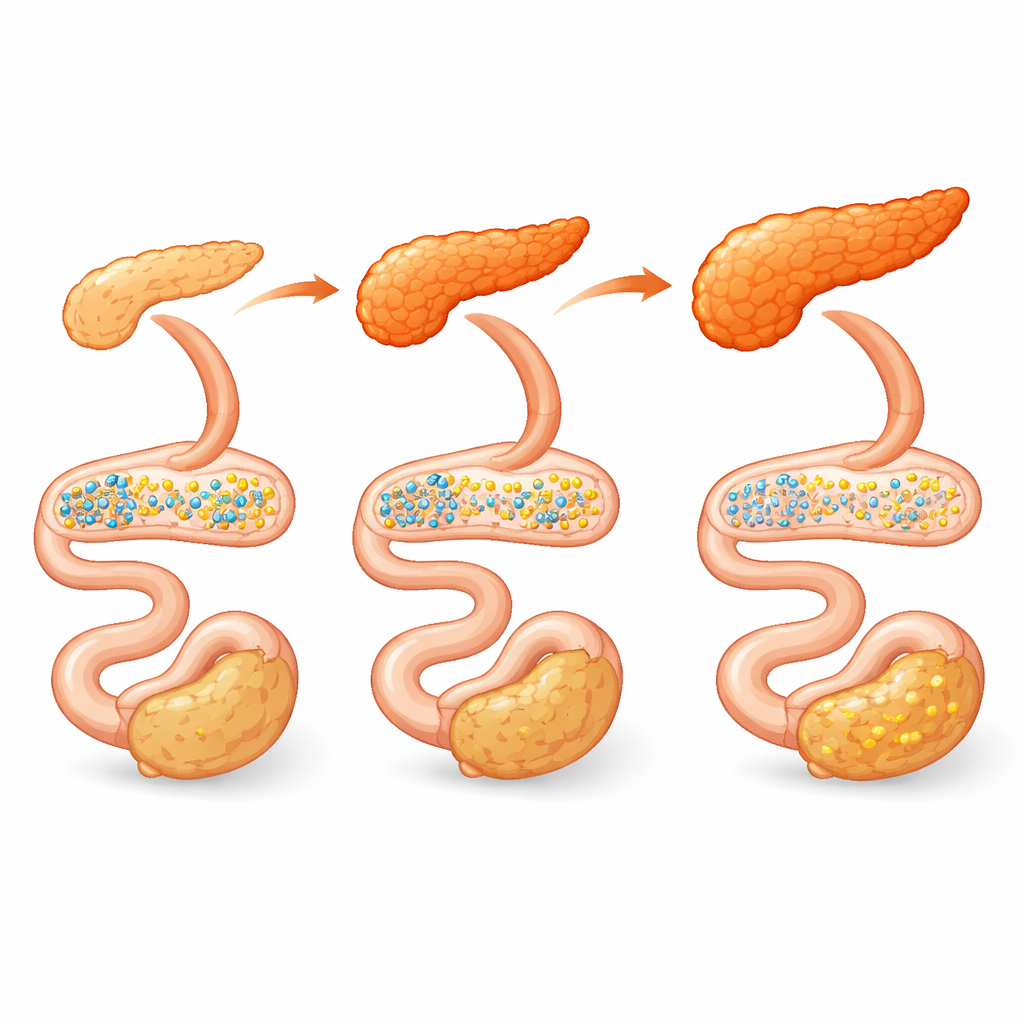
The most striking changes appeared in the pancreas. At 12 days, when pups had not yet eaten solid feed, pancreatic amylase activity was lowest. As pups began nibbling pellets before the formal weaning age of 21 days, enzyme activity rose sharply by 3 weeks and continued to climb between 3 and 4 weeks, in step with greater starch intake. When total activity per whole pancreas was calculated, the increase was even more dramatic because the gland itself was growing. Amylase activity tended to remain high through 8 weeks of age, suggesting ongoing fine-tuning to the standard lab diet. In contrast, measurements of amylase in the small intestinal contents were more erratic and did not show a clear age trend, likely because individual differences in recent meals made these samples less representative.
What this means for research and animal care
For non-specialists, the key message is that young mice do not instantly become miniature adults at weaning. Their digestive organs, especially the pancreas, go through a rapid remodeling period as they shift from milk sugars to starchy solid food. Pancreatic amylase ramps up steeply around weaning, the intestines grow longer, and the caecum swells as fermentation kicks in. These findings help define when mice are truly ready to rely on solid diets and offer reference values for normal organ development. That, in turn, can guide better weaning practices, reduce stress on laboratory animals, and improve how scientists interpret experiments that depend on metabolism and gut function.
Citation: Ernst, A., Böswald, L.F. Pancreatic amylase activity and development of the gastrointestinal tract in C57BL/6J mice before and after weaning. Sci Rep 16, 10502 (2026). https://doi.org/10.1038/s41598-026-44974-8
Keywords: weaning, digestive enzymes, pancreas, mouse model, starch digestion