Clear Sky Science · en
Bang-bang control optimization in infectious disease model with incorporating breakthrough and reinfection
Why repeat outbreaks still surprise us
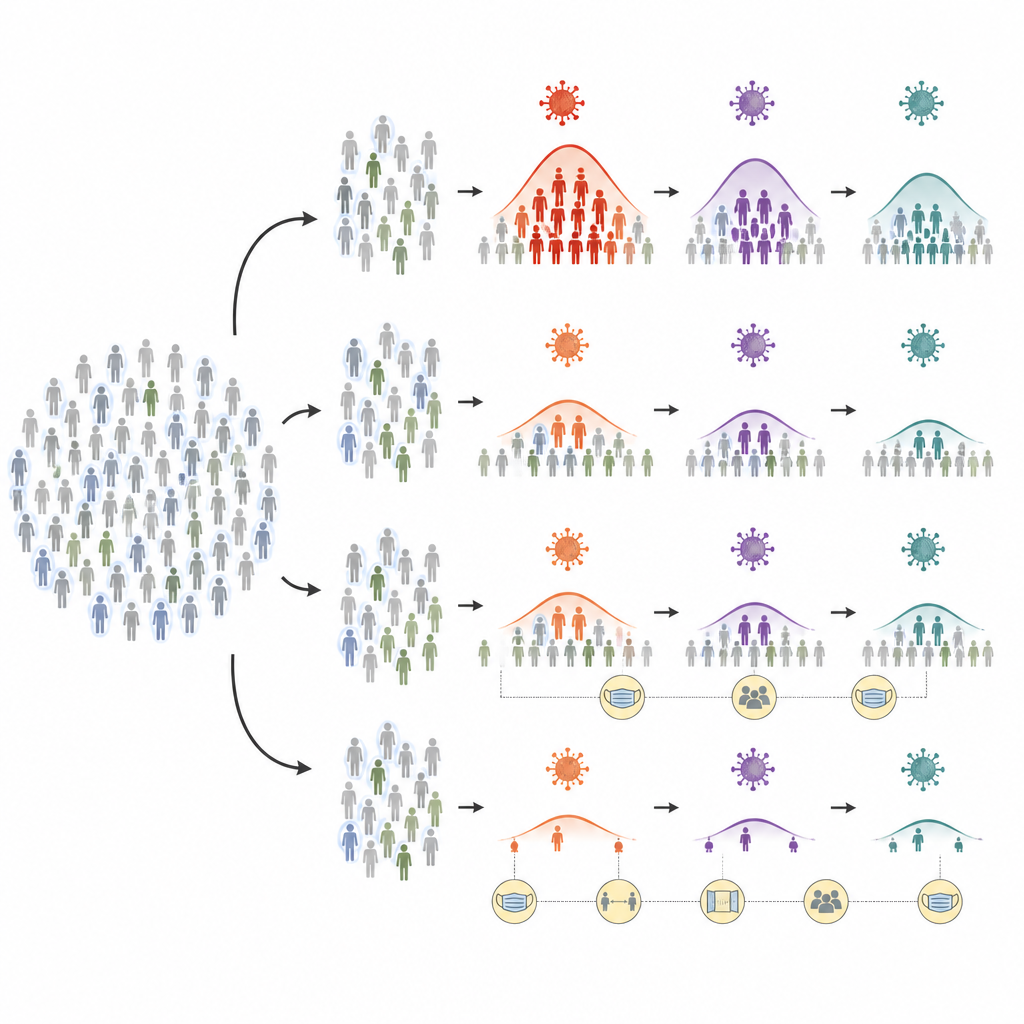
Many people assume that once they have been vaccinated or recovered from an infection, the threat of that disease largely fades away. Yet the COVID-19 pandemic and other illnesses have shown that waves of cases can keep returning. This study explores why these rebounds occur and how health officials can use short, intense bursts of control measures to curb disease spread while avoiding long periods of disruption.
What the study set out to explain
The authors focus on two real world features of infections that are often studied separately. The first is breakthrough infection, when vaccinated people still become sick because protection is not perfect or fades over time. The second is reinfection, when people who have recovered lose immunity and can catch the disease again. For illnesses like COVID-19, influenza and dengue, both effects are present at once. The researchers wanted a single mathematical model that joins these pieces and helps clarify when a disease dies out, becomes a small recurring problem, or settles into a long term endemic pattern.
How the model tracks people and immunity
The team divides the population into four groups: those who are susceptible, vaccinated, currently infected, and recovered. People move between these groups over time. Vaccinated individuals can lose protection and become susceptible again, while recovered individuals can slowly lose natural immunity. Two key parameters describe how often vaccinated people are infected despite their shots and how often recovered people are infected again. By adjusting these rates, the model can mimic situations where vaccines work very well, where immunity fades quickly, or where the virus itself changes to evade defenses.
When old rules about thresholds no longer work
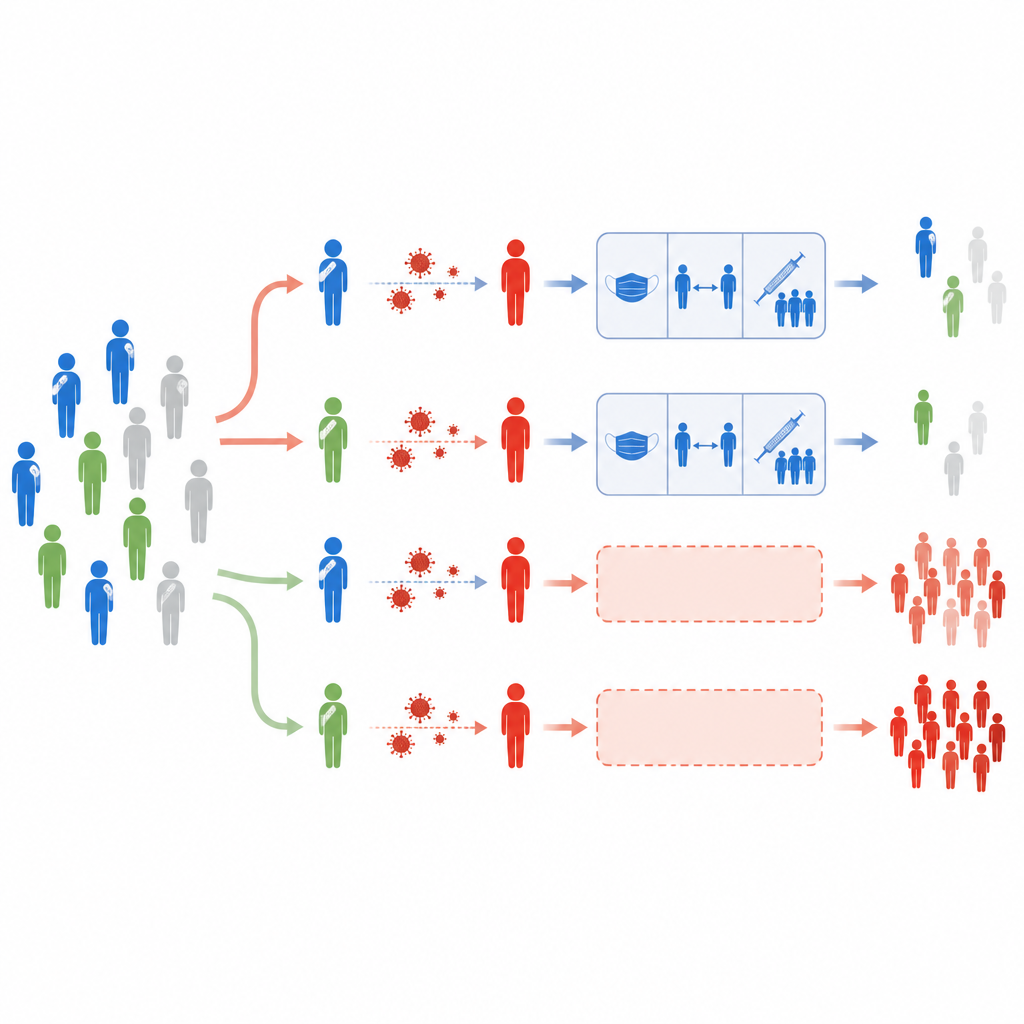
A central quantity in infectious disease modelling is the basic reproduction number, which describes how many new infections each case causes in a fully susceptible population. In simple models, if this number is below one, the disease eventually disappears; if it is above one, it persists. The new model shows that with both breakthrough infections and reinfections, this neat rule can fail. Under some conditions the system experiences what mathematicians call a backward bifurcation, meaning that even when the reproduction number is below one, the disease can still settle into a stable endemic state. The study finds that this problematic behavior appears whenever at least one of the two effects, breakthrough or reinfection, is present at a meaningful level.
Short sharp controls instead of endless measures
Beyond theory, the authors ask how best to act when vaccines and past infections do not fully stop spread. They study a type of time optimal control known as bang bang control. Instead of keeping measures partially on for long periods, this strategy switches interventions fully on or fully off. In practical terms this corresponds to clear phases, such as a period of strict mask use, distancing, and rapid vaccination, followed by a phase with minimal restrictions. Using numerical simulations, the researchers compare different combinations of controls: lowering the chance of transmission, increasing how many people are vaccinated, and improving vaccine protection.
What the results say about smart public health
The simulations reveal that combining all three actions in short, intense bursts reduces both how long an outbreak lasts and how many people are ultimately infected. Relying only on higher vaccination rates, or only on better vaccine protection, may temporarily reduce cases but can allow the disease to rebound or remain endemic. In contrast, coordinated bursts that cut transmission, raise coverage and boost vaccine quality can drive infections down quickly to very low levels, even when breakthrough infections and reinfections are common. For a lay reader, the main message is that imperfect immunity means we cannot expect vaccines alone to end some epidemics, but well timed packages of strong measures applied for limited periods can control disease spread while using resources more efficiently.
Citation: Chen, Y., Jing, W., Zhang, J. et al. Bang-bang control optimization in infectious disease model with incorporating breakthrough and reinfection. Sci Rep 16, 15272 (2026). https://doi.org/10.1038/s41598-026-44921-7
Keywords: breakthrough infection, reinfection, epidemic waves, vaccination strategy, optimal control