Clear Sky Science · en
Multiple opsin expression in cubozoan ocelli indicates functional redundancy
Why jellyfish eyes matter
Box jellyfish may look like simple drifting blobs, but their vision is surprisingly sophisticated. The Caribbean species Tripedalia cystophora carries 24 eyes of four different kinds on small sensory structures around its bell. Two of these eye types form images, but the roles of the smaller eyes have been mysterious. This study asks a deceptively simple question with big implications: why does this jellyfish have so many different light-sensitive molecules, and are they all truly needed?
A tiny jellyfish with many eyes
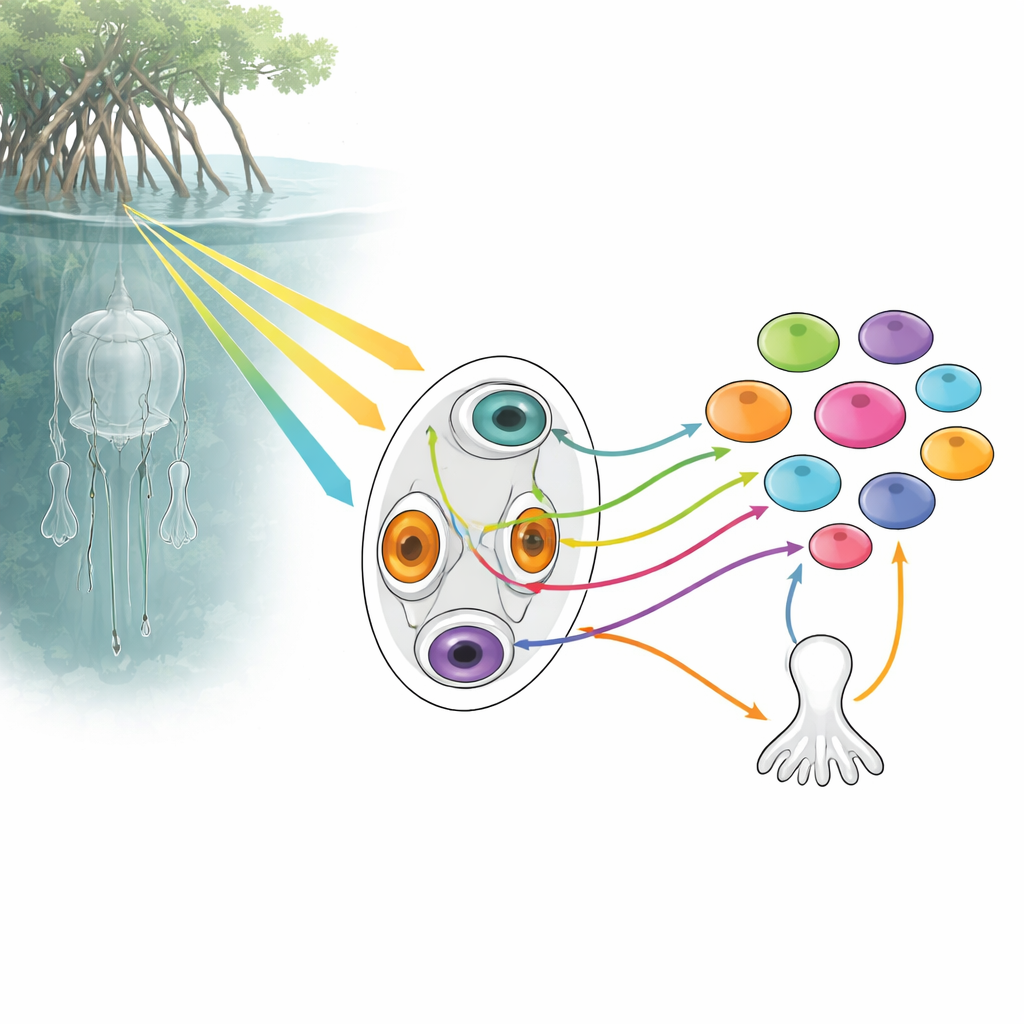
Each box jellyfish has four sensory clubs, and each club carries six eyes: two large lens eyes that form coarse images and two pairs of smaller pit and slit eyes. Earlier work showed that the lens eyes help the animal navigate sunlit mangrove roots and avoid bumping into them, even though the images they produce are blurry and color-blind. Far less has been known about what the pit and slit eyes do, or which light-sensitive pigments they use. At the same time, genetic surveys revealed that T. cystophora has an unusually large collection of opsin genes—the proteins that start visual signaling—raising the puzzle of whether each has a special job or whether many are partly interchangeable.
Hunting for the jellyfish’s light sensors
To track where different opsins are actually used in the animal, the researchers created custom antibodies—molecular tags—against five opsins that had not yet been mapped. They stained adult and juvenile jellyfish tissue to see where these tags would light up, and they cross-checked the results with a sensitive RNA-detection method that marks cells actively making a given opsin. They also sliced the tiny eyes in carefully oriented sections and used a stepwise staining-and-erasing protocol so that several opsins could be visualized in the same physical eye, one after another, without the labeling reactions interfering with each other.
One simple pit eye, many complex slit eyes
The pit eye turned out to be straightforward. One opsin, called Tcop11, consistently appeared only in the light-sensing outer segments of pit-eye photoreceptors in both young and adult animals, and its RNA was detected in the same cells. This strongly suggests that Tcop11 is the main photopigment for this eye type. The slit eye, by contrast, was anything but simple. Three different opsins—Tcop1, Tcop2, and a previously known slit-eye opsin—were all found in the outer segments of slit-eye photoreceptors. Different individuals showed different combinations and degrees of overlap among these opsins, yet the staining remained tightly limited to the relevant light-sensing structures. This argues that the signal is real and that multiple opsins are genuinely used in the same small eye type.
Light sensing beyond the eyes
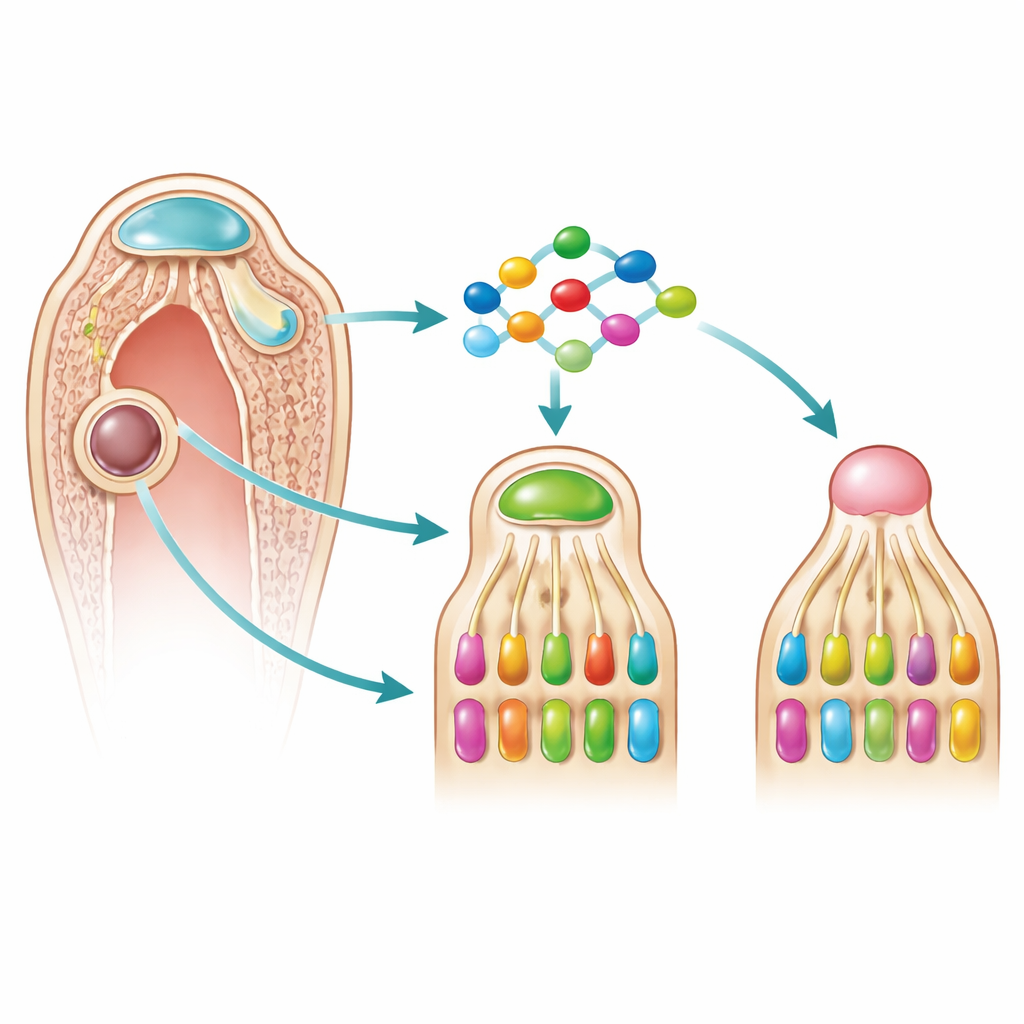
The story does not stop at the eyes. Several of the opsins studied, including some that also appear in pit or slit eyes, were found in cells at the tip of the manubrium—the tubular structure the jellyfish uses to handle food. These cells are not part of any eye, which means the animal likely senses light with parts of its body involved in feeding as well as seeing. Although the exact behaviors controlled by this extraocular light sensing remain unknown, the shared expression patterns again point to opsins being reused in multiple contexts rather than each being locked into a single, narrow task.
Evolution’s backup plans
To see how unusual this situation is, the authors compared opsin sequences from several box jellyfish species. They found that many relatives also carry large families of opsin genes, but not always the same ones; some lineages have lost or gained particular opsins while retaining broadly similar eye structures and lifestyles. The most strongly conserved opsins are tied to essential functions like lens-eye vision or reproduction, while others appear more dispensable and may overlap in what they can do. Together with the expression results, this pattern supports the idea of functional redundancy: for many visual and non-visual light tasks, it may not matter exactly which one of several similar opsins is used, as long as at least one is present.
What this means for how animals see
For a non-specialist, the key message is that vision—and light sensing more broadly—is not always built from a tidy one-to-one mapping between gene and function. In this jellyfish, a small eye can run on several interchangeable light-sensitive proteins, and some of those same proteins are repurposed in other body parts. Evolution seems to have created a toolkit of opsins with overlapping abilities, giving the animal built-in backups and flexibility as its environment and life history change. The pit and slit eyes of box jellyfish therefore offer a window into how complex visual systems can arise not just by adding new parts, but also by reusing and sharing them in clever ways.
Citation: Irwin, A.R., Bielecki, J., Halberg, K.V. et al. Multiple opsin expression in cubozoan ocelli indicates functional redundancy. Sci Rep 16, 14521 (2026). https://doi.org/10.1038/s41598-026-44915-5
Keywords: box jellyfish vision, opsin diversity, cnidarian eyes, light sensing proteins, evolution of sight