Clear Sky Science · en
AI-assisted reliability-based design framework for tunnel concrete linings in weak rocks
Safer Tunnels in Uncertain Ground
Tunnels carry trains, cars, water, and power through mountains and cities, yet they are dug through rock that is never perfectly known. In weak or broken rock, designers must guess how strong the ground really is and how much concrete lining is needed to keep a tunnel from squeezing in. This study shows how combining classic rock mechanics, probability, and modern artificial intelligence can turn that guesswork into a clearer, risk-based design for safer, more economical tunnels in challenging ground.
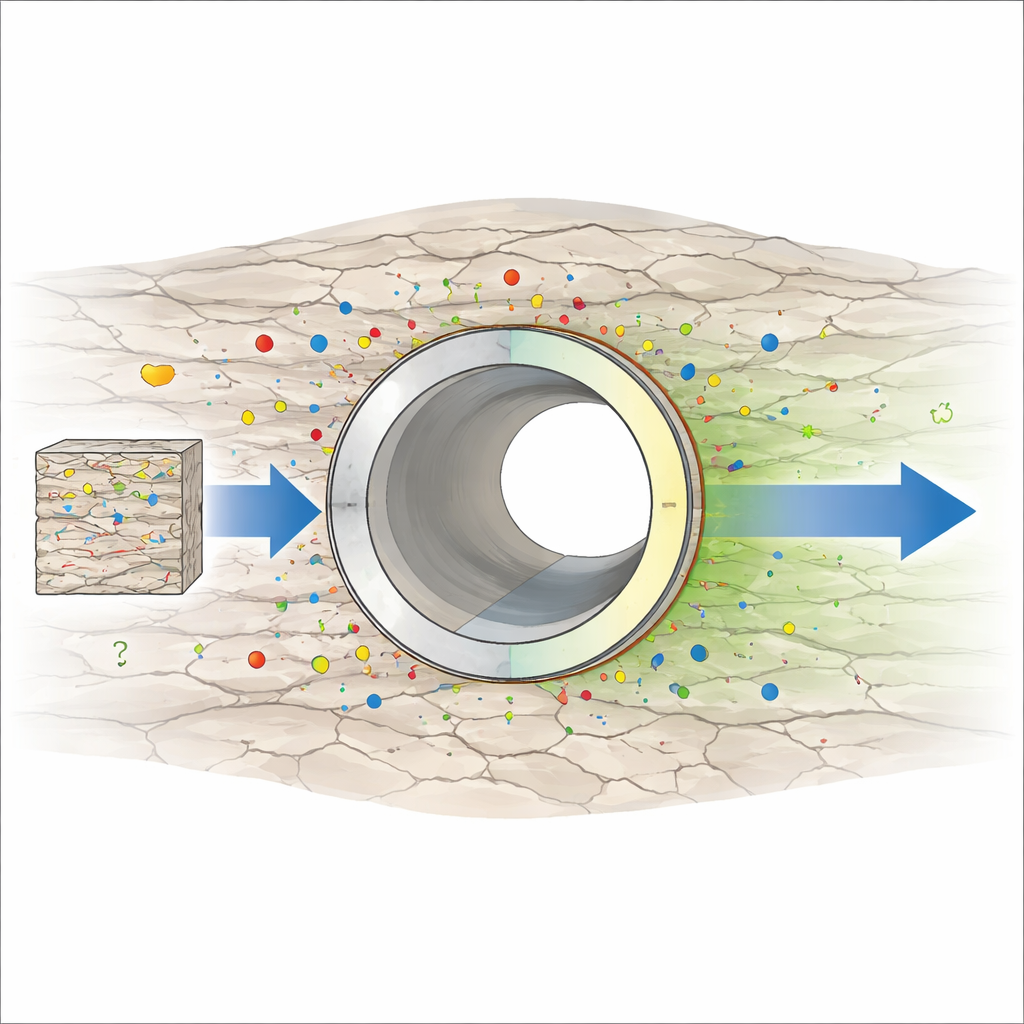
Why Tunnel Design Is So Hard
When engineers design a tunnel, they must decide how thick the concrete lining should be and what quality of concrete to use. Traditional “deterministic” design assumes single best values for rock strength, stress in the ground, and material properties, then checks if the lining is strong enough with a safety factor. But real rock is variable: strength, stiffness, and structure can change meter by meter. Ignoring that variability can make a design either too optimistic (unsafe) or unnecessarily heavy (too expensive). Probabilistic design, in contrast, treats each key property as a range with a likelihood, then estimates the chance that the lining will fail. This paper applies that risk-based thinking specifically to tunnel linings in weak rock, where uncertainty matters most.
Linking Rock, Lining, and Ground Movement
The heart of the framework is a method called convergence–confinement, which connects how the rock around a circular tunnel deforms (convergence) with how strongly the lining pushes back (confinement). The rock is described with a widely used failure rule for fractured rock masses, while the concrete lining is treated as elastic up to its crushing strength. Two curves are built: one shows how the rock reacts as the tunnel opens and relaxes, and the other shows how the lining resists as it is loaded. Their intersection gives the pressure on the lining and a pressure-based safety factor. In this work, every controlling quantity—the in-situ stress, rock strength, rock quality index, tunnel radius, lining stiffness, lining strength, and lining thickness—is modeled as a random variable. Using thousands of Monte Carlo samples and a well-established reliability method (FORM), the authors compute both a safety factor and an explicit probability of failure for each design.
Teaching an AI to Predict Tunnel Safety
Running full probabilistic simulations for many design options can be slow. To overcome this, the authors train an artificial intelligence surrogate using gene expression programming, a form of symbolic regression that produces a closed-form equation instead of a black-box model. They generate large datasets from their spreadsheet-based reliability engine, then evolve a compact formula that predicts the pressure-based safety factor from eight key inputs, including tunnel size, rock properties, and lining properties. The final equation tracks the probabilistic results extremely well, with a correlation above 0.99, and is slightly conservative: it tends to predict a somewhat lower safety factor than the mean from full simulations. That bias is actually helpful in safety-focused design, because it avoids overconfident predictions while giving engineers a fast way to explore many combinations.
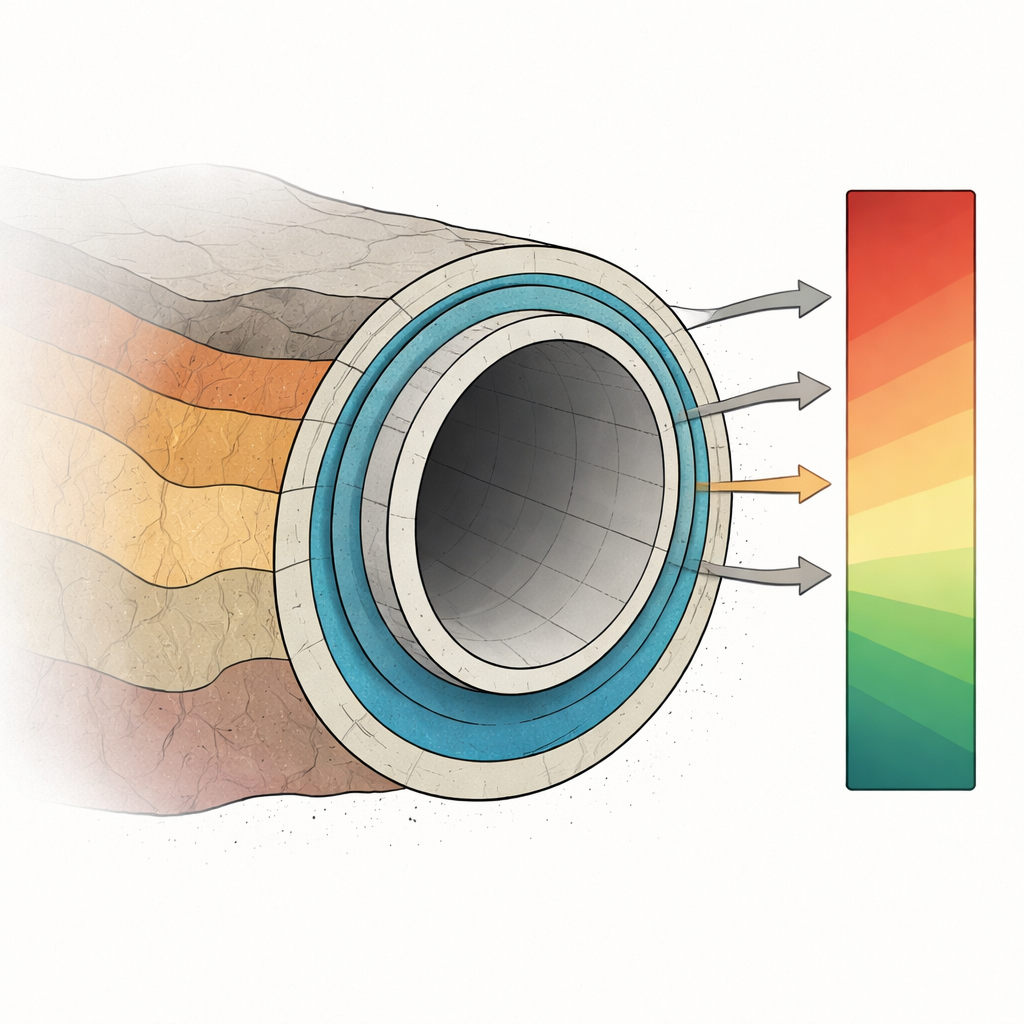
What Thickness and Concrete Quality Really Do
Using this combined framework, the study explores how changes in lining thickness and material quality affect tunnel safety in weak rock. Two concrete types are examined: a conventional concrete with a strength of about 20 MPa, and a much stronger fiber-reinforced reactive powder concrete (FRPC) at about 65 MPa. For low-strength concrete at small thicknesses, the probability of failure can exceed 60 percent; as thickness increases toward 200 mm and beyond, that probability drops toward zero. For the high-strength FRPC, even relatively thin linings achieve very low failure probabilities, and moderate thicknesses are enough to reach stringent target reliability levels. The results are presented as charts and heat maps that link thickness and strength directly to reliability indices and failure probabilities, offering designers clear visual guidance instead of relying on a single fixed safety factor.
Turning Safety Factors into Risk-Based Decisions
To a non-specialist, the main message is that a safety factor alone is not a complete measure of tunnel security. This work shows how to translate between traditional safety factors and explicit chances of failure, and how to pick lining thickness and material quality to hit a chosen risk target rather than a generic rule of thumb. By embedding an interpretable AI model into a transparent reliability engine, the authors demonstrate a practical way to design tunnel linings that are both safer and more economical, especially in weak and unpredictable rock. Instead of guessing and overbuilding, engineers can now quantify how much risk is reduced when they choose a thicker lining, a stronger concrete like FRPC, or both, bringing tunnel design closer to modern, data-informed risk management.
Citation: Khani, J., Nejati, H.R., Goshtasbi, K. et al. AI-assisted reliability-based design framework for tunnel concrete linings in weak rocks. Sci Rep 16, 14270 (2026). https://doi.org/10.1038/s41598-026-44903-9
Keywords: tunnel lining, weak rock, reliability-based design, concrete thickness, artificial intelligence