Clear Sky Science · en
Analytical analysis of the nonlinear fractional order Pochhammer-Chree equation with power-law nonlinearity in elastic materials
Waves That Remember
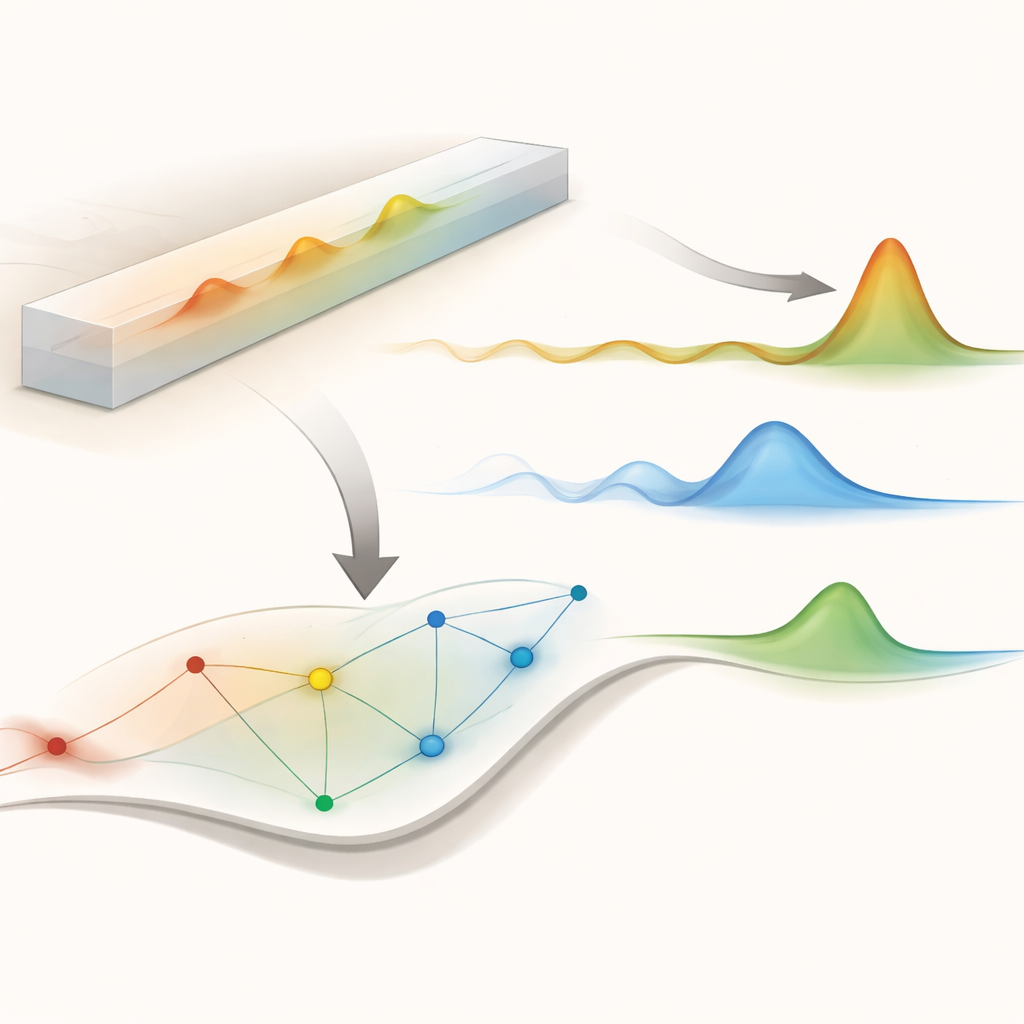
Many materials in nature and technology do not respond instantly when you push, pull, or twist them. Instead, they “remember” past deformations, and this memory changes how waves—like vibrations or stress pulses—move through them. This paper develops and analyzes a mathematical model that captures such memory effects in long, thin elastic objects, and shows how this memory can generate robust, self-sustaining wave patterns called solitons.
Why Ordinary Wave Models Fall Short
Standard wave equations assume that a material’s response depends only on what is happening right now. That approximation works for simple systems, but it breaks down in complex environments such as geological layers, advanced composites, biological tissue, or engineered rods and beams with intricate microstructure. In these cases, past deformations keep influencing present behavior, leading to unusual spreading, slowing, or sharpening of waves. The classical Pochhammer–Chree equation is a well-known tool for describing how longitudinal waves move along cylindrical rods, but in its usual form it ignores this kind of memory and cannot fully explain many experimentally observed wave shapes.
Introducing Memory Into the Wave Equation
To incorporate memory, the authors use a modern idea called a fractional derivative. Instead of taking an ordinary rate of change, they allow the order of differentiation to be a non-integer, which effectively lets the equation blend information from the present with a weighted accumulation of the past. They adopt a particular “conformable” fractional derivative that behaves much like the familiar derivative from calculus but still encodes memory effects. Building on this, they formulate a fractional version of the Pochhammer–Chree equation with a power-law nonlinearity, meaning that the restoring force grows in a nonlinear fashion with the size of the deformation. This combination of nonlinearity and memory creates a rich landscape of possible wave behaviors.
Finding Solitary Waves in a Complex System
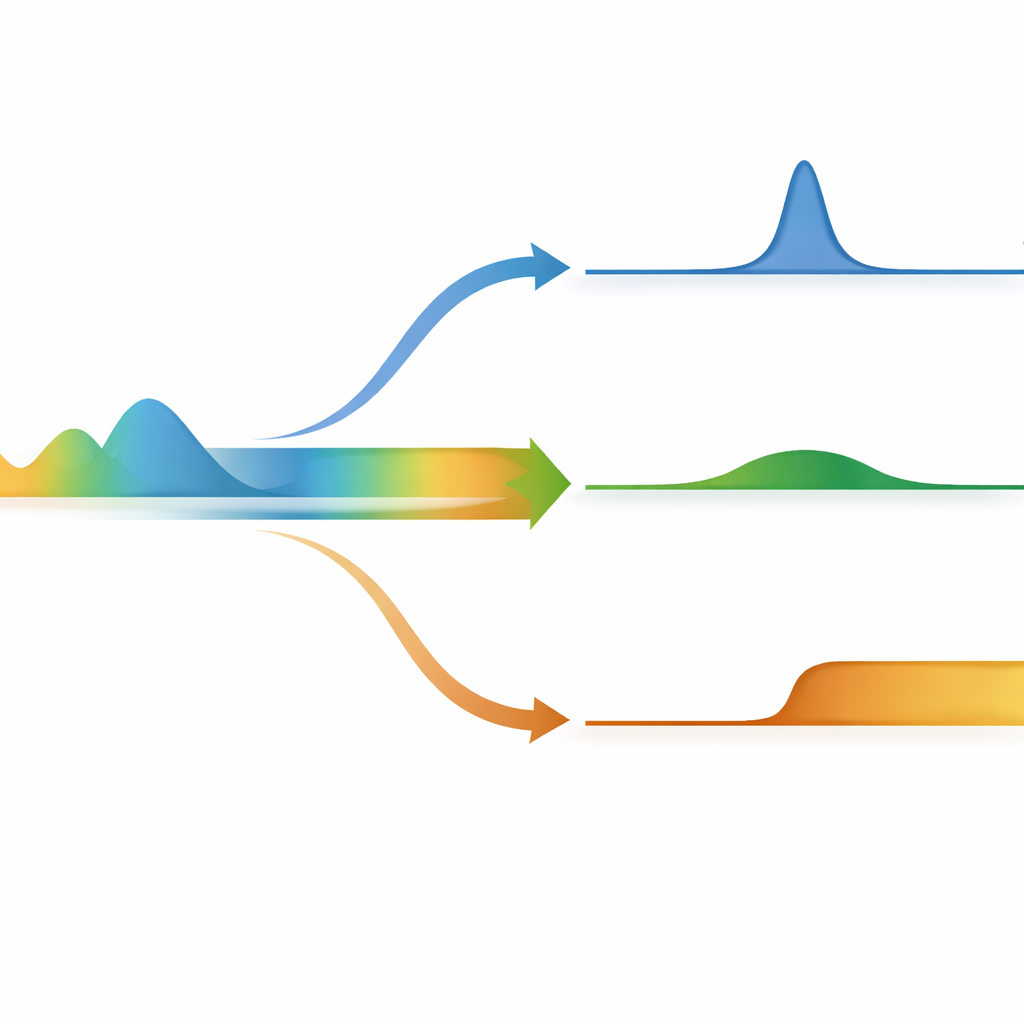
Because such equations are highly intricate, simply simulating them on a computer does not reveal all of their deeper structure. The authors therefore use a systematic analytical technique known as the Kumar–Malik method. First, they transform the original space–time wave equation into a simpler traveling-wave equation, which describes a wave profile moving without changing shape. Then they search for solutions built from special mathematical building blocks—trigonometric functions, hyperbolic functions, and Jacobi elliptic functions. By carefully balancing the highest derivatives against the strongest nonlinear terms, they derive families of exact solitary-wave solutions, including bright solitons (sharp localized peaks), dark solitons (localized dips on a background), kink solitons (smooth steps between two levels), and more intricate periodic or singular waves.
Seeing How Memory Reshapes Waves
To understand what these solutions mean physically, the researchers visualize them using two- and three-dimensional plots and contour maps generated in Mathematica. These graphics show how the fractional “memory” parameter and other model constants change the height, width, and speed of the solitons. Some solutions appear as repeating, needle-like peaks that maintain their form over distance and time, while others look like traveling humps, domain-wall-like kinks, or hybrid patterns that combine periodic repetition with strong localization. Across these cases, the waves remain remarkably stable, resisting the tendency to spread out that would be expected in more conventional systems. The analysis highlights how tuning the fractional order and nonlinear strength can switch the system between different types of solitary motion.
What This Means for Real Materials
Overall, the study shows that adding fractional-order memory and a realistic nonlinear response to the Pochhammer–Chree equation yields a flexible framework for describing a wide variety of solitary waves in elastic media. The Kumar–Malik method proves capable of producing many exact wave shapes, and checks with symbolic computation confirm that these shapes truly satisfy the governing equation. For nonspecialists, the key message is that materials with memory can support robust, particle-like wave packets whose form barely changes as they travel, and that carefully designed mathematics can predict how these packets will look and move. Such insights can inform future work on advanced mechanical structures, wave-based signal transmission, and engineered materials where controlling vibrations and stress waves is crucial.
Citation: Khalid, M., Khalid, N.A., Ceesay, B. et al. Analytical analysis of the nonlinear fractional order Pochhammer-Chree equation with power-law nonlinearity in elastic materials. Sci Rep 16, 14359 (2026). https://doi.org/10.1038/s41598-026-44888-5
Keywords: solitons, fractional calculus, elastic waves, nonlinear dynamics, Pochhammer-Chree equation