Clear Sky Science · en
A novel double defected ground structures and parasitic patches for enhanced MIMO antenna performance
Why this tiny square matters to your Wi‑Fi
Inside every smartphone, router, and future 5G gadget, antennas quietly shuttle torrents of data through the air. As we cram more antennas into ever smaller devices to boost speed and reliability, they start to “talk over” one another, creating interference and wasted power. This paper reports a clever way to carve patterns into the metal under an antenna and add small helper pieces of copper so that a compact four‑antenna module can handle more data with less internal crosstalk, right in the frequency range used by Wi‑Fi and sub‑6 GHz 5G.

Signals that get in each other’s way
Modern wireless systems often use MIMO (multiple‑input, multiple‑output) technology, where several antennas work together to send and receive separate data streams. The catch is that when antennas sit close together on a small circuit board, energy can leak from one into another. This “mutual coupling” upsets the tuning of each antenna, distorts how they radiate, and ultimately reduces speed and reliability. Spacing antennas farther apart would help, but that is not an option in slim phones, wearables, or compact access points. Engineers therefore look for ways to guide currents on the circuit board so that each antenna behaves as independently as possible, even when packed tightly.
Etching smart patterns into the hidden metal
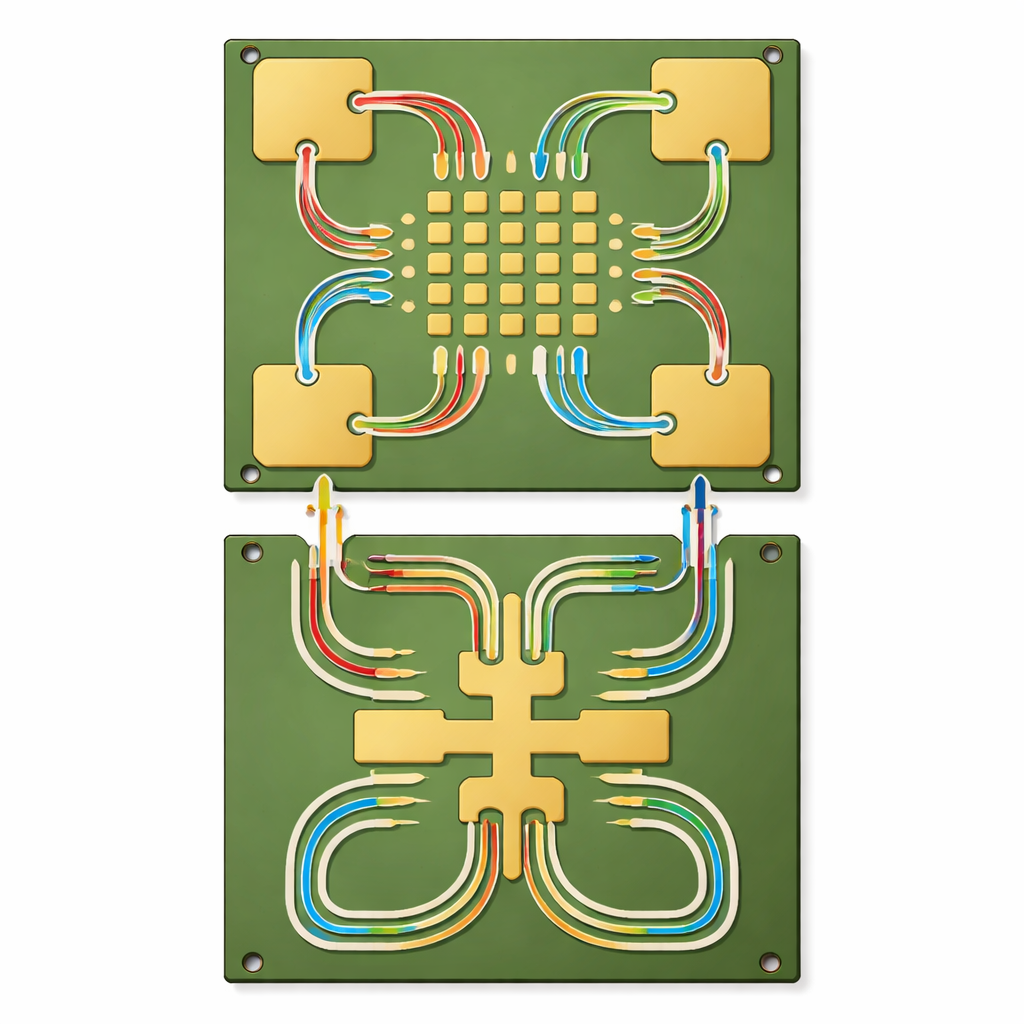
The researchers focus on a popular antenna type built on FR4, the green fiberglass circuit board material used in many gadgets. They design a single small metal patch, then gradually refine its shape by adding stepped cuts and L‑shaped slots so it naturally covers the desired C‑band range from 5.5 to 6.5 GHz. The real innovation, however, lies in the “defected ground structures”: carefully shaped gaps etched into the metal sheet on the underside of the board. One set of three curved slits sits just under each feed line, and a second cross‑shaped pattern lies at the board’s center. Together with a short tuning stub near the feed, these hidden features act like built‑in filters, taming unwanted resonances and widening the range of frequencies over which the antenna can operate efficiently.
Helper patches that quietly block leaks
On the top side of the board, the team arranges four of these patch antennas in a square, each rotated at right angles to its neighbors to form a 2×2 MIMO array. Between them they add a cluster of small “parasitic” patches—metal shapes not directly connected to any electronics. When one antenna is active, it induces currents on these helper patches, which in turn create fields that oppose the stray energy trying to reach neighboring antennas. By carefully optimizing the spacing, the authors ensure the parasitic patches are close enough to cancel most of the leakage without upsetting the tuning. Simulations of surface currents show that these extra pieces act like current blockers, especially between antennas set at right angles to each other.
From simulations to real‑world measurements
After building a prototype about 8 cm on a side, the team measures its performance with precision lab instruments and compares the results with their computer models. The four‑antenna module maintains good matching across a broad 1.05 GHz span, from 5.38 to 6.43 GHz, meaning very little signal is reflected back into the circuitry. Mutual coupling between antenna pairs stays impressively low, between –32 and –52 dB, far better than many earlier designs in the same band. The array also delivers up to 8.7 dBi of gain and radiation efficiencies up to about 86–93%. Advanced MIMO quality indicators—how independent the antennas are and how well they share incoming power—confirm that the elements behave almost like separate “ears” listening to the same wireless environment.
What this means for future wireless gadgets
In simple terms, the authors show that by sculpting the hidden metal under an antenna and adding a few well‑placed passive pieces on top, a compact four‑antenna module can cover a wide slice of C‑band spectrum with high efficiency while its elements barely interfere with one another. This makes it easier to build small devices—such as Wi‑Fi routers, sub‑6 GHz 5G units, and other multi‑antenna platforms—that deliver higher data rates and more reliable links without needing extra space or exotic materials.
Citation: Pramono, S., Nugroho, A.S., Sulistyo, M.E. et al. A novel double defected ground structures and parasitic patches for enhanced MIMO antenna performance. Sci Rep 16, 13383 (2026). https://doi.org/10.1038/s41598-026-44869-8
Keywords: MIMO antennas, wireless communication, C-band, defected ground structure, mutual coupling reduction