Clear Sky Science · en
Enhanced control of continuous stirred tank reactor with two-degree-of-freedom PID driven by Kirchhoff’s law algorithm
Keeping Chemical Reactions on a Safe Track
Chemical plants rely on large stirred tanks where reactions run nonstop to make fuels, medicines, and specialty chemicals. In these tanks, even small slips in temperature can turn smooth production into wasted material or, in extreme cases, hazardous runaways. This paper explores a new way to keep such reactors at just the right temperature by combining a familiar industrial controller with an unusual helper: an algorithm inspired by how electric currents move through a circuit.
Why Reactor Temperature Is So Hard to Tame
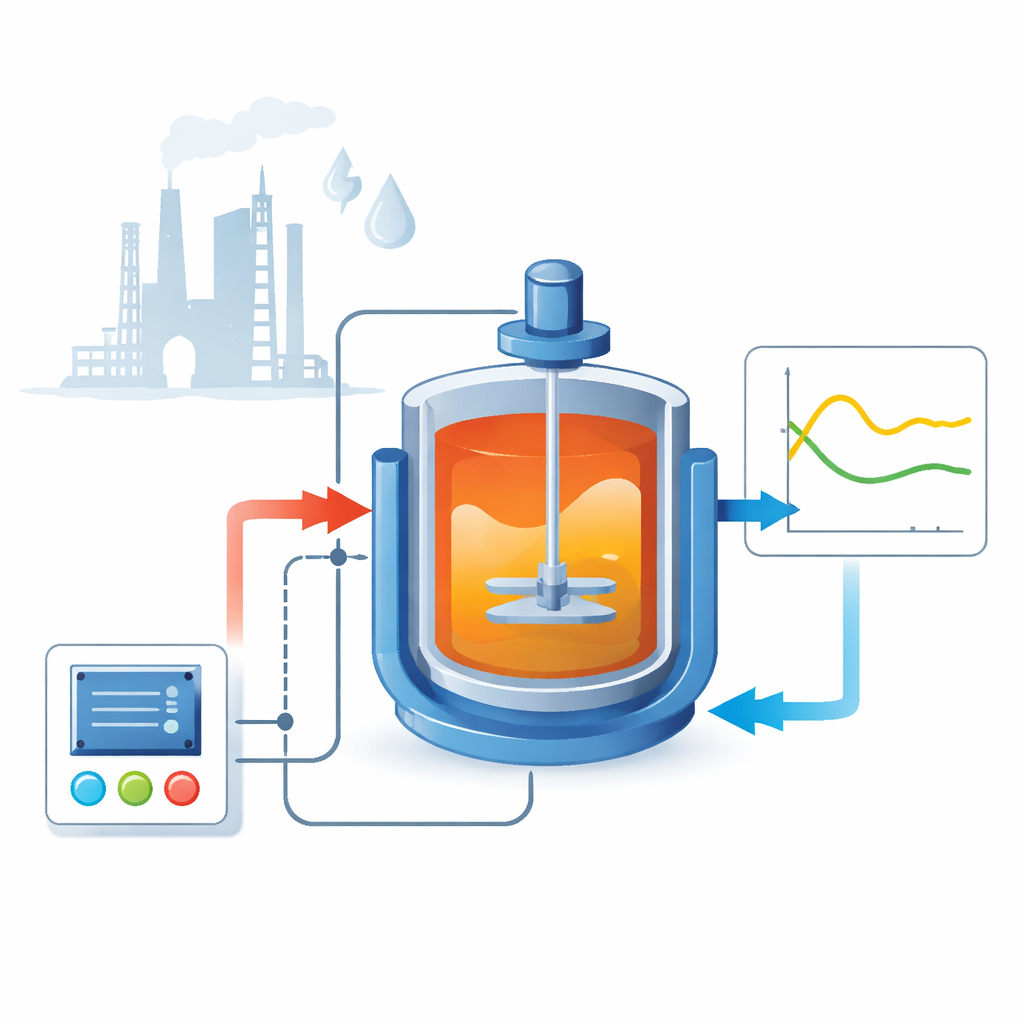
In a continuous stirred tank reactor (CSTR), fresh ingredients constantly flow in while products flow out, all while a mixer stirs and a surrounding jacket adds or removes heat. Because the reaction studied here releases heat, warming the mixture makes the reaction run faster, which creates even more heat. This feedback can cause the reactor to jump between multiple operating states or drift toward dangerous temperatures. Meanwhile, there are delays between adjusting the cooling jacket and seeing the effect in the tank. These features make the reactor strongly nonlinear and difficult to control with traditional tools.
A Smarter Twist on a Classic Controller
Most industrial plants use PID controllers, which adjust a valve or heater based on how far the temperature is from the target, how long it has been off, and how quickly it is changing. A more flexible variant, the two-degree-of-freedom PID (2DOF-PID), lets engineers separately tune how aggressively the system chases a new setpoint and how calmly it rejects disturbances. That extra freedom can yield faster, smoother responses—but also creates a maze of tuning choices. Manually picking all the gain values is impractical when the process is highly nonlinear and delayed, so the authors turn to optimization algorithms to search for the best combination automatically.
Borrowing Ideas from Electric Circuits
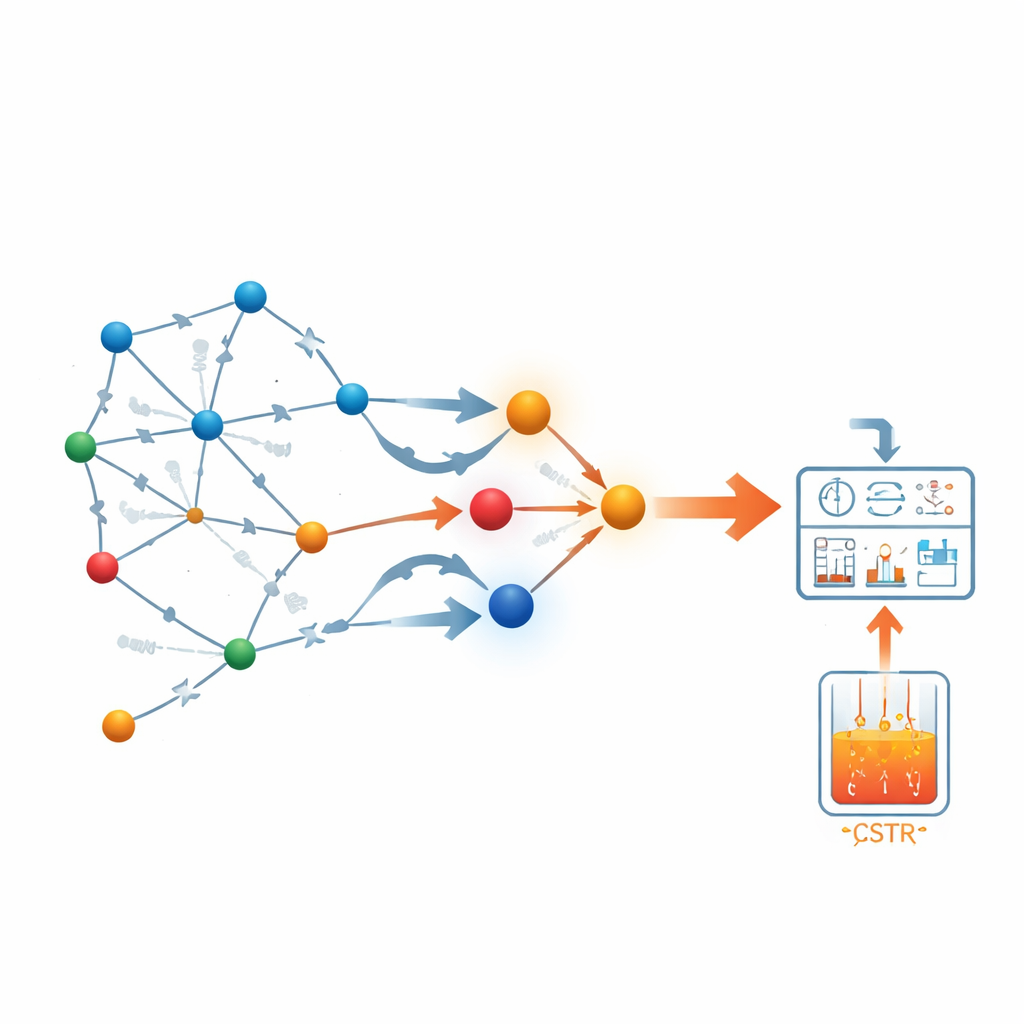
The heart of this work is the Kirchhoff’s law algorithm (KLA), a physics-based search method built on the same rules engineers use to analyze currents at junctions in an electrical circuit. In this analogy, each candidate set of controller settings is treated as a node with a certain "energy level" tied to how well it performs. Links between better-performing nodes act like low electrical resistance, encouraging more "current" to flow there. As the algorithm iterates, virtual currents redistribute themselves so that energy loss is minimized, naturally nudging the population of solutions toward combinations of gains that balance speed and stability. Unlike many popular heuristic optimizers, KLA does not rely on user-chosen tuning constants, which makes it simpler and more repeatable.
Testing Against Other Modern Algorithms
To see whether this circuit-inspired method really helps in practice, the authors tuned 2DOF-PID controllers for their reactor model using KLA and four recent nature-inspired optimizers: animated oat, parrot, coati, and dwarf mongoose algorithms. All methods were given the same amount of computational effort and were run many times to test consistency. For each tuned controller, the team examined how quickly the reactor reached a new temperature, how much it overshot, how long it took to settle, and how closely it held the final target. They also challenged the best KLA-based controller with changing setpoints, sudden jumps in feed temperature, and shifts in key physical parameters, such as heat-transfer rates and reaction sensitivity.
Faster, Smoother, and More Reliable Control
The KLA-tuned controller consistently produced the smallest combined performance score and the tightest spread of results across repeated runs. In simulations, it heated the reactor to a new temperature roughly 7 to 10 times faster than the other methods, while keeping overshoot to about half a percent and essentially eliminating long-term error. When the desired temperature changed over time, the reactor followed smoothly without oscillations or sluggishness. Even when the feed stream temperature jumped up and down or when model parameters were deliberately shifted, the controller held the reactor near its target with only modest, short-lived deviations. These tests suggest that the KLA approach is both robust and practical for real-world operation.
What This Means for Real Plants
For non-specialists, the main takeaway is that the authors have found a way to tune a standard industrial controller using a search process rooted in basic physics rather than ad hoc trial and error. By mimicking how electric currents naturally find low-resistance paths, the Kirchhoff’s law algorithm efficiently discovers controller settings that make a tricky chemical reactor respond quickly yet calmly, without needing expert guesswork or delicate adjustment of algorithm parameters. This could help chemical plants run safer and more energy-efficient processes while relying on familiar control hardware, paving the way for broader use of physics-informed optimization in other complex industrial systems.
Citation: Yüksek, G., Ekinci, S. & Yılmaz, M. Enhanced control of continuous stirred tank reactor with two-degree-of-freedom PID driven by Kirchhoff’s law algorithm. Sci Rep 16, 10912 (2026). https://doi.org/10.1038/s41598-026-44778-w
Keywords: reactor temperature control, continuous stirred tank reactor, PID tuning, physics inspired optimization, process control robustness