Clear Sky Science · en
Research on ultrasonic crystal removal equipment and crystal removal efficiency for tunnel drainage system pipelines
Why keeping tunnel drains clear matters
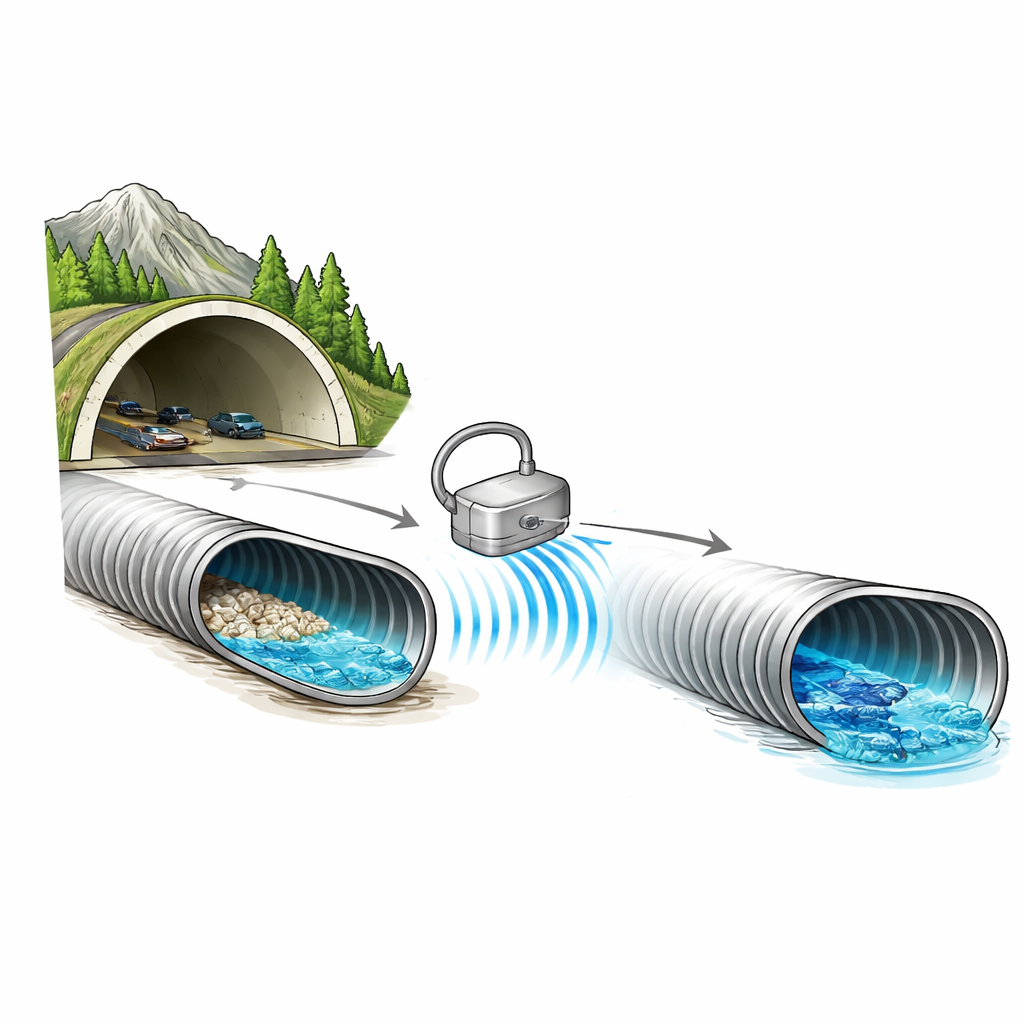
Deep inside mountain highways, hidden pipes quietly carry away water that seeps through the rock. When these pipes slowly clog with mineral crystals, the consequences can be serious: water backs up, concrete linings crack, and leaks threaten the safety and lifespan of the tunnel. This study explores a promising way to clear those hard, rock-like deposits without digging up the tunnel—by using carefully tuned sound waves in the ultrasonic range to shake crystals loose from the inside of drainage pipes.
How stubborn buildup forms in hidden pipes
Tunnel drainage systems are meant to channel groundwater away from the tunnel lining. But in many regions, especially in mountainous western China, that water carries dissolved calcium and magnesium along with silt and gravel. As the water flows through plastic drainage pipes, changes in temperature, flow speed, and chemical balance encourage these dissolved minerals to form solid crystals. Over months and years, they grow into thick crusts on the pipe wall and pile up as loose mounds on the bottom. Once about 40% of the pipe’s cross-section is blocked, earlier research shows that the stress on the tunnel lining rises sharply, greatly increasing the risk of cracking and leaks.
Using sound to fight rock-like deposits
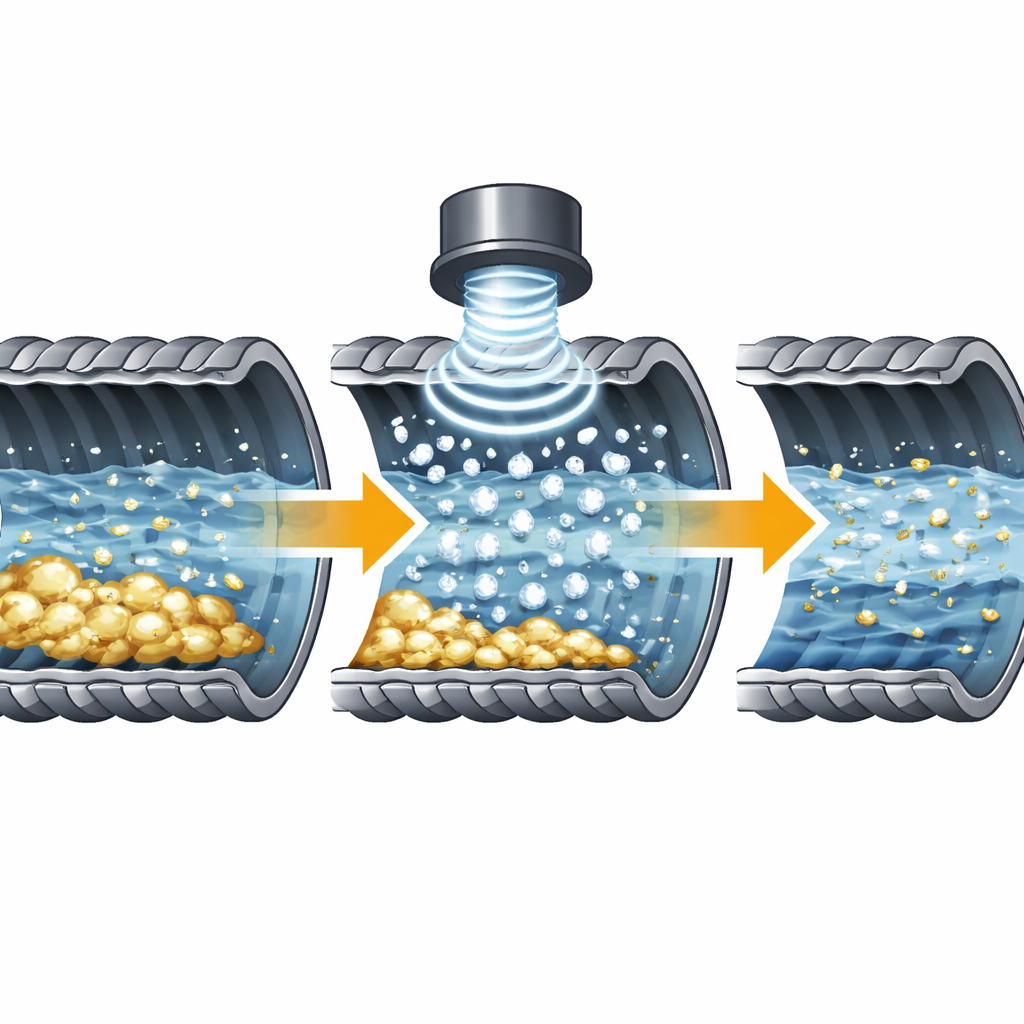
Ultrasonic cleaning is already used to scrub dirt and films from metal tools, glass lenses, and filters. It works by sending very high-frequency sound waves through a liquid, which creates countless microscopic bubbles that rapidly grow and collapse. Each collapse releases tiny but powerful shock waves and jets of water that can chip away at nearby surfaces. The authors asked whether this same “invisible hammer” could be harnessed to break mineral crusts inside tunnel pipes, and if so, which way of mounting the ultrasonic device would work best for the long, corrugated plastic pipes commonly used in drainage systems.
Testing where and how ultrasound works best
First, the team used computer simulations to map how sound pressure would spread inside a one-meter-long water-filled pipe driven by an ultrasonic transducer. They compared four sound frequencies and two ways of mounting the device: straight on, pointing directly across the pipe, or at a 45-degree tilt. The simulations showed that at 40 kilohertz, the sound field along the pipe wall was both strong and relatively even, especially when the device was mounted straight. With that guidance, they built two experimental devices and attached them to real corrugated plastic pipes that had been deliberately coated with calcium carbonate crystals formed in a circulating water loop.
What the experiments revealed
Over a 30-day buildup phase, crystals first formed thin layers on the pipe wall, then filled the corrugations and built a thick bed along the bottom until roughly a third of the pipe opening was clogged. The researchers then ran the ultrasonic devices continuously for 60 days and periodically removed and weighed pipe sections to see how much material had been lost. In all cases, most of the mass came off during the first month, when deposits were looser and easier to dislodge. After that, removal slowed as the remaining crystals became denser and more firmly attached. With the straight-mounted device at 40 kilohertz and 50 watts, the two pipe sections closest to the transducer lost 97–98% of their initial crystal mass, leaving less than 10 grams of residue—almost clean. Sections farther away still improved, but less dramatically, showing that distance along the pipe weakens the effect.
Why mounting angle makes a big difference
The tilted device told a different story. Pipe sections facing the transducer did see strong cleaning, with removal rates up to about 95%. But sections on the “back” side or farther along the pipe kept much of their original buildup, often losing less than half their crystal mass and retaining more than 120 grams of hard deposit. The pattern matched the simulations: when the sound enters at an angle, it concentrates energy on one side and leaves shaded regions with weak sound, especially in a corrugated pipe where the ridges scatter and block waves. In contrast, the straight-mounted setup sends energy more evenly along both directions of the pipe wall, leading to a smoother, more predictable cleaning pattern.
What this means for safer tunnels
For non-specialists, the takeaway is straightforward: strong, carefully tuned sound waves can act as a kind of remote chisel that breaks apart mineral blockages inside plastic drainage pipes. In laboratory tests that mimic real tunnel conditions, a straight-mounted ultrasonic device operating at 40 kilohertz removed nearly all the crystal buildup near the device and greatly reduced it farther away, while a tilted installation left many sections still heavily blocked. Although real tunnels are more complex than a lab rig, these findings suggest that thoughtfully designed ultrasonic stations, spaced along drainage lines and mounted straight onto the pipes, could help keep hidden water channels open for longer, improving tunnel safety and reducing the need for disruptive and costly maintenance.
Citation: Chen, Yh., Rao, Jy., Chen, Cy. et al. Research on ultrasonic crystal removal equipment and crystal removal efficiency for tunnel drainage system pipelines. Sci Rep 16, 14250 (2026). https://doi.org/10.1038/s41598-026-44770-4
Keywords: tunnel drainage, ultrasonic cleaning, pipe scaling, infrastructure maintenance, cavitation