Clear Sky Science · en
Mechanism of coal mass fracture expansion under drilling and pressure relief
Why safer coal mining needs smart drilling
Deep coal mines can suddenly release stored energy, cracking rock and endangering miners. One common safety measure is to drill holes into the coal so it can “breathe” and release pressure. This study asks a simple but vital question: how exactly does drilling change the way coal cracks and fails, and how can we design these holes to reduce danger without weakening the mine tunnels too much?
Listening to coal as it breaks
To explore this, the researchers took blocks of coal from a Chinese mine and subjected them to controlled loading in the laboratory. They pressed on the samples to mimic underground stress, then drilled holes into them while instruments monitored every tiny fracture. A key tool was acoustic emission, which works a bit like a medical heart monitor for rocks: each time the coal cracks, it gives off a brief sound pulse that can be detected by sensors. By tracking when and where these signals occurred, and how strong they were, the team could reconstruct the hidden cracking activity inside the coal as conditions changed. 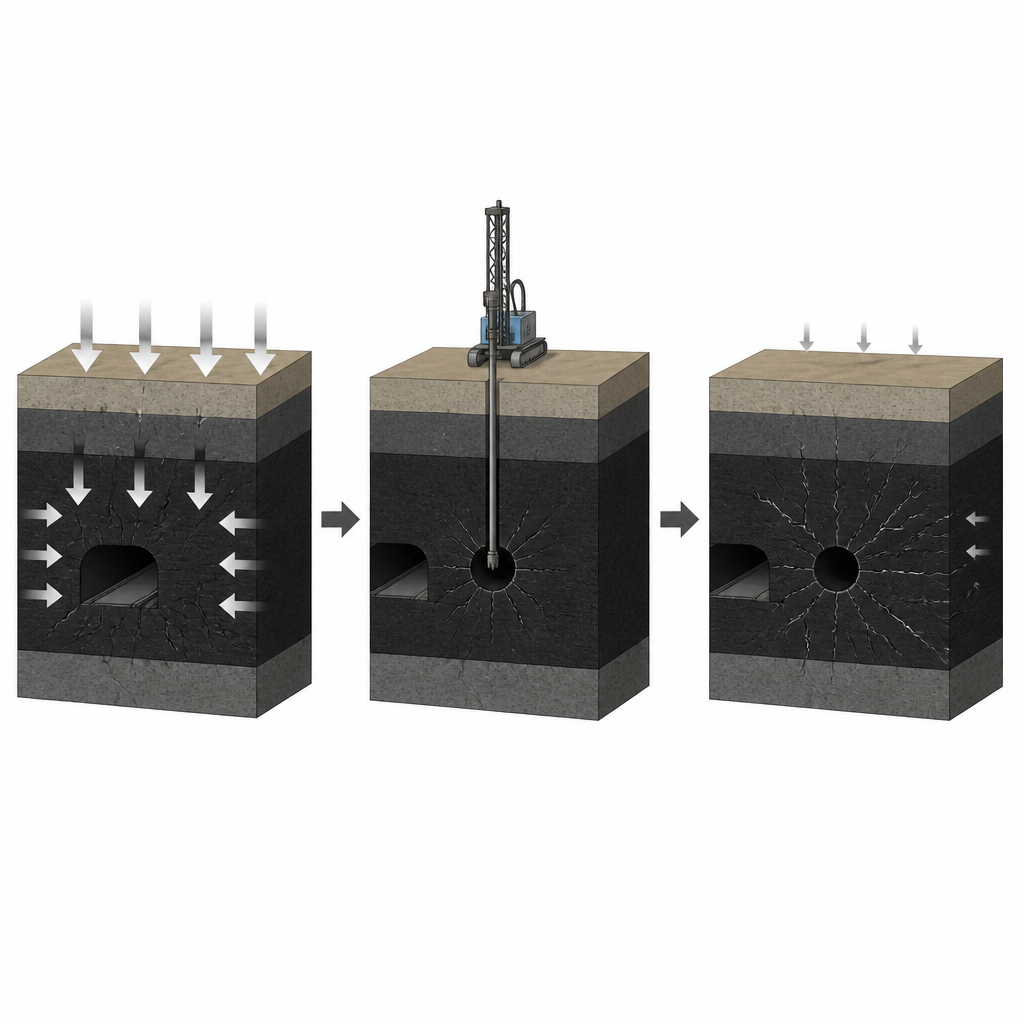
Four stages from quiet strain to sudden break
The tests were carried out in four stages: initial loading, drilling while the load was held constant, a quiet holding period, and then a final round of increased loading until the sample failed. At first, the coal behaved almost elastically, storing energy with only a few weak fracture signals as old flaws closed and tiny cracks formed. During drilling and the holding period, the overall structure stayed largely intact, but the local stress and internal texture around the borehole subtly rearranged. The real drama came in the final loading stage: the number of acoustic events and their energy surged, and cracks rapidly linked up into a dominant fracture zone. The coal shifted from scattered microcracking to a runaway break, showing that earlier drilling had primed it for a later, more organized failure pattern.
How cracks move and stresses rotate
Going beyond simple counts of fracture events, the team used advanced mathematical methods to interpret the signals. By inverting the recorded wave patterns, they classified each event as mainly shear (sliding), tensile (opening), or compressive (squeezing) failure. Across the whole experiment, shear cracking dominated, but tensile events became more common in the final loading stage, when the coal was close to collapse. They also reconstructed how the overall stress field inside the coal evolved. Initially, the main stresses lined up roughly southwest to northeast, favoring shear-type cracking. After drilling and a quiet period, the stress state became more even, as if the coal briefly relaxed. Under renewed loading, the stress directions rotated to a new orientation and shear effects strengthened again, now coupled with tension that encouraged fractures to link up and spread.
Why hole size and ground pressure matter
To connect these lab insights to mine design, the authors built a mechanical model of the coal around a drill hole. They showed that the shape and size of the plastic zone, where the coal has yielded and weakened, depend strongly on the sideways pressure in the rock, the overall stress level, and the borehole diameter. When sideways pressure is low, stress concentrates at the sides of the hole; when it is high, it shifts to the top and bottom. Uniform pressure around the hole gives a more even ring of stressed coal. Changing the hole diameter also transformed the cracking style in experiments: small holes led to scattered microcracks, medium holes produced a few very energetic local bursts that could block further crack growth, and larger holes encouraged a connected crack network and a cascade-like release of stored energy. 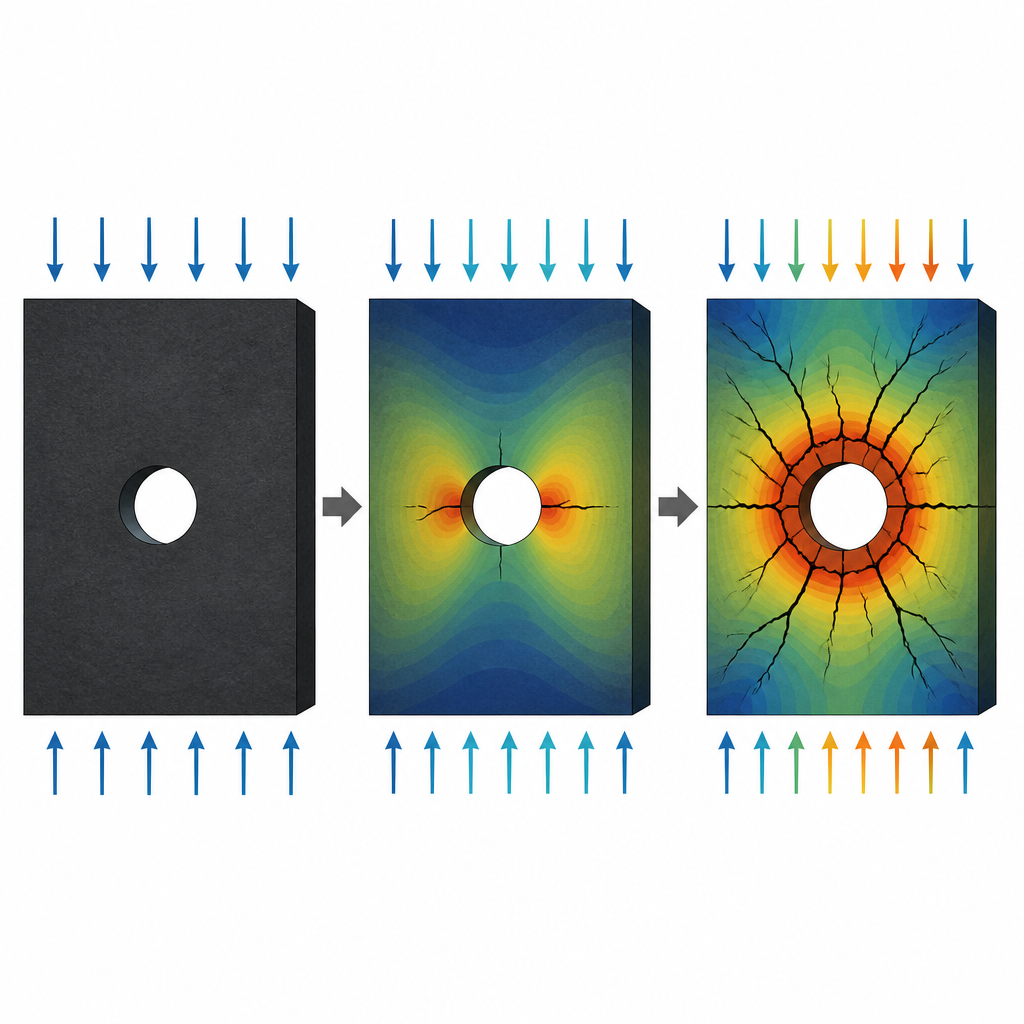
Different sounds for different breaks
Finally, the team examined the frequency content of the acoustic signals. Shear cracks tended to emit short, sharp bursts at higher frequencies, tensile cracks showed mid-frequency energy that spread over a slightly longer time, and compressive processes such as pore closure produced low, steady signals. These spectral “signatures” could help distinguish what kind of cracking is taking place in real time, offering the potential for more sensitive monitoring in operating mines.
What this means for mine safety
In plain terms, the study shows that drilling does not simply “poke a hole” in the coal. It reshapes the hidden stress landscape, quietly seeds new weak zones, and changes how and when stored energy is released later. By understanding how crack patterns and stress fields respond to different hole sizes and stress conditions, engineers can better balance two competing goals: easing dangerous pressure to reduce the risk of sudden rock bursts, while still keeping the rock around tunnels strong enough to hold its shape. This kind of knowledge could guide smarter drilling layouts and real-time monitoring strategies that make deep coal mining safer.
Citation: Liu, K., Liu, Y., Lu, CP. et al. Mechanism of coal mass fracture expansion under drilling and pressure relief. Sci Rep 16, 15138 (2026). https://doi.org/10.1038/s41598-026-44731-x
Keywords: coal fracturing, pressure relief drilling, rockburst safety, acoustic emission, underground mining