Clear Sky Science · en
Impact of formal and informal finance on environmental sustainability in developing countries
Why money matters for a cleaner planet
Many people think of climate change in terms of smokestacks and exhaust pipes, but the flow of money quietly shapes how much carbon dioxide ends up in the air. This study looks at 47 developing countries to see how two kinds of money systems formal finance through banks and institutions, and informal finance through family, friends, and community groups influence carbon pollution and the move toward cleaner energy.
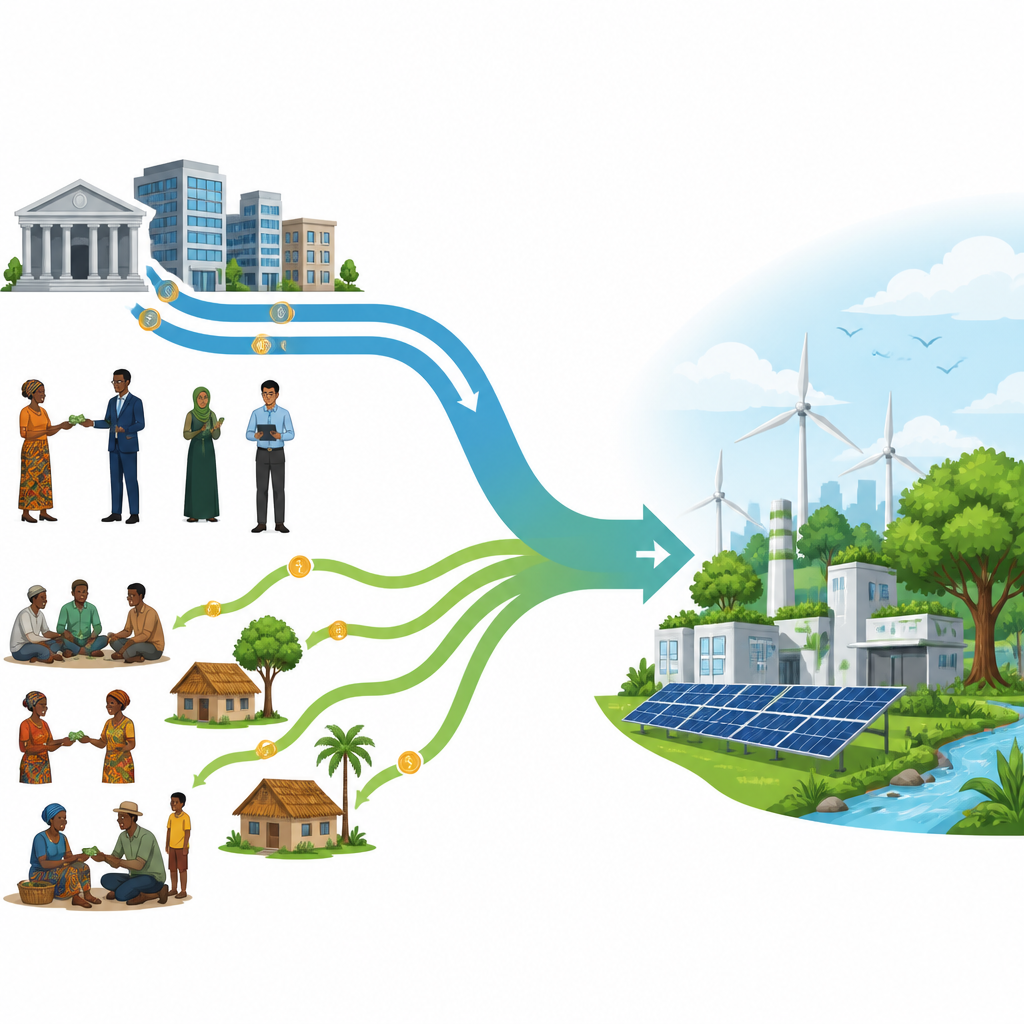
Two different ways people get money
In developing countries, far fewer adults use banks and other formal financial services than people in rich nations. Instead, many rely on borrowing from relatives, neighbors, and local savings clubs. The authors call these two channels formal finance and informal finance. Formal finance includes bank loans, green investment funds, and financial inclusion programs that try to bring more people into the banking system. Informal finance covers unregistered lenders and community networks that lend small sums based on trust rather than paperwork or credit scores.
Rising emissions and the climate challenge
At the same time, carbon dioxide emissions have reached record levels worldwide and are rising quickly in many developing economies. Population growth, fast industrial expansion, and growing cities all push energy demand up, often met by burning coal, oil, and gas. While some richer countries have begun to cut emissions by switching to renewable energy and improving efficiency, many poorer nations still struggle to finance such transitions. This makes it crucial to understand whether expanding access to money helps or harms the climate.
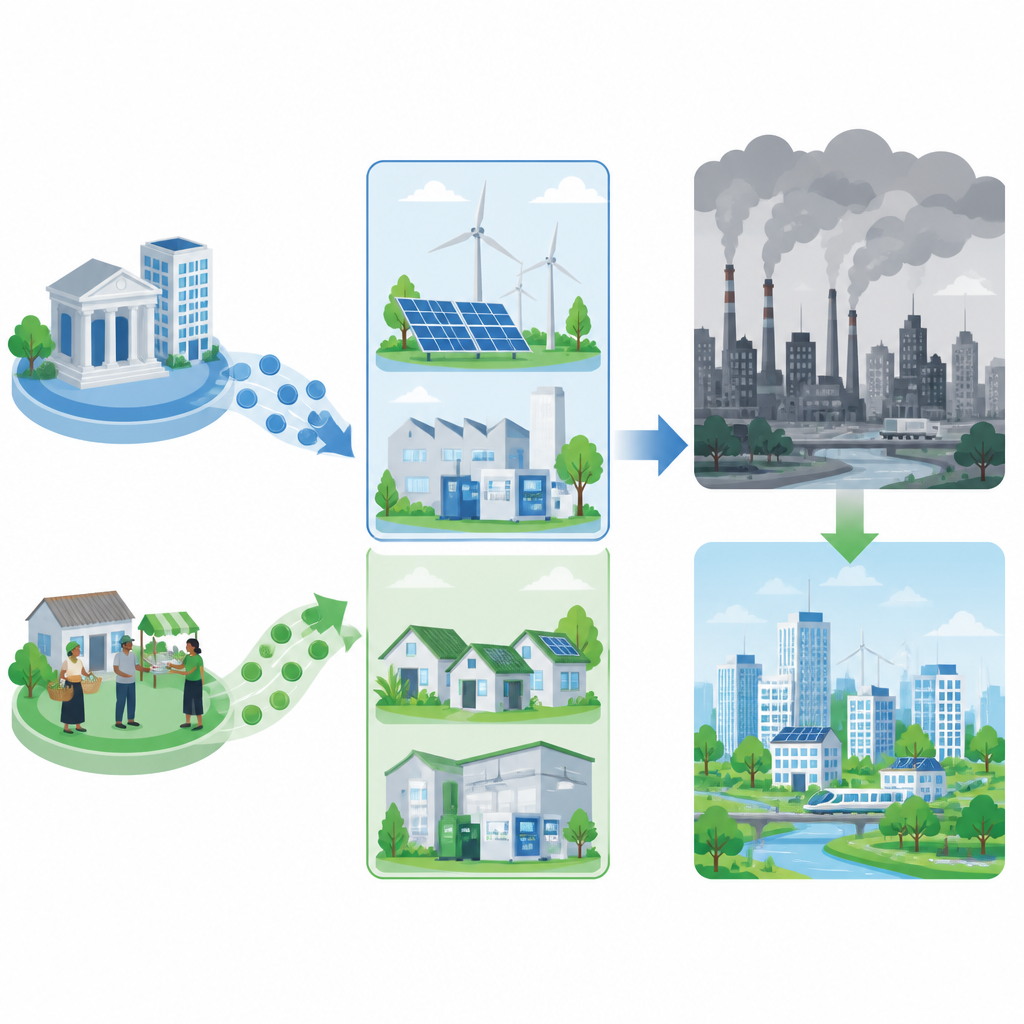
What the data from 47 countries reveal
The researchers combined data from 2014 to 2021 on carbon emissions per person, access to formal and informal finance, use of renewable energy, economic output, and population. They applied several advanced statistical tools designed for comparing many countries over time while filtering out noise and hidden biases. Across different methods, they consistently found that greater use of both formal and informal finance is linked with lower carbon emissions per person. Renewable energy use also lowers emissions, while higher income levels and larger populations are associated with higher emissions.
How money can steer choices toward greener paths
The results suggest that money, when guided in the right direction, can help people and businesses choose cleaner options. Formal finance can support large renewable energy projects, energy efficient factories, and modern infrastructure by providing big, regulated loans at lower cost. Informal finance, although smaller in scale, can help households and small entrepreneurs buy solar panels, efficient cookstoves, or other modest green technologies that fit local needs. Together, these channels create multiple layers of support for cleaner energy use and less wasteful consumption.
What this means for policy and everyday life
The study concludes that expanding access to both formal and informal finance can be part of the solution to climate change in developing countries, as long as money is steered toward clean technologies rather than polluting activities. Governments can encourage banks to offer green loans and bonds, and at the same time recognize and lightly regulate community based lenders so they can safely fund small scale green projects. For ordinary people, better access to fair and reliable finance can make it easier to invest in cleaner homes, transport, and businesses, helping cut carbon emissions while improving quality of life.
Citation: Wu, X., Gao, X. Impact of formal and informal finance on environmental sustainability in developing countries. Sci Rep 16, 14841 (2026). https://doi.org/10.1038/s41598-026-44704-0
Keywords: environmental sustainability, developing countries, formal finance, informal finance, carbon emissions