Clear Sky Science · en
Investigating developmental changes in susceptibility to temporal audiovisual illusions on balance and sensorimotor function in children
How Children Use Their Senses to Stay Upright
Watching a child learn to balance on one leg or hit a moving target shows how tightly linked our senses and movements are. This study asked whether children who combine sight and sound more precisely also have better balance and quicker hand movements. By following how these abilities change from early childhood to the teenage years, the researchers hoped to see if simple lab tests of perception can reveal something about real-world skills like standing steady and moving with control. 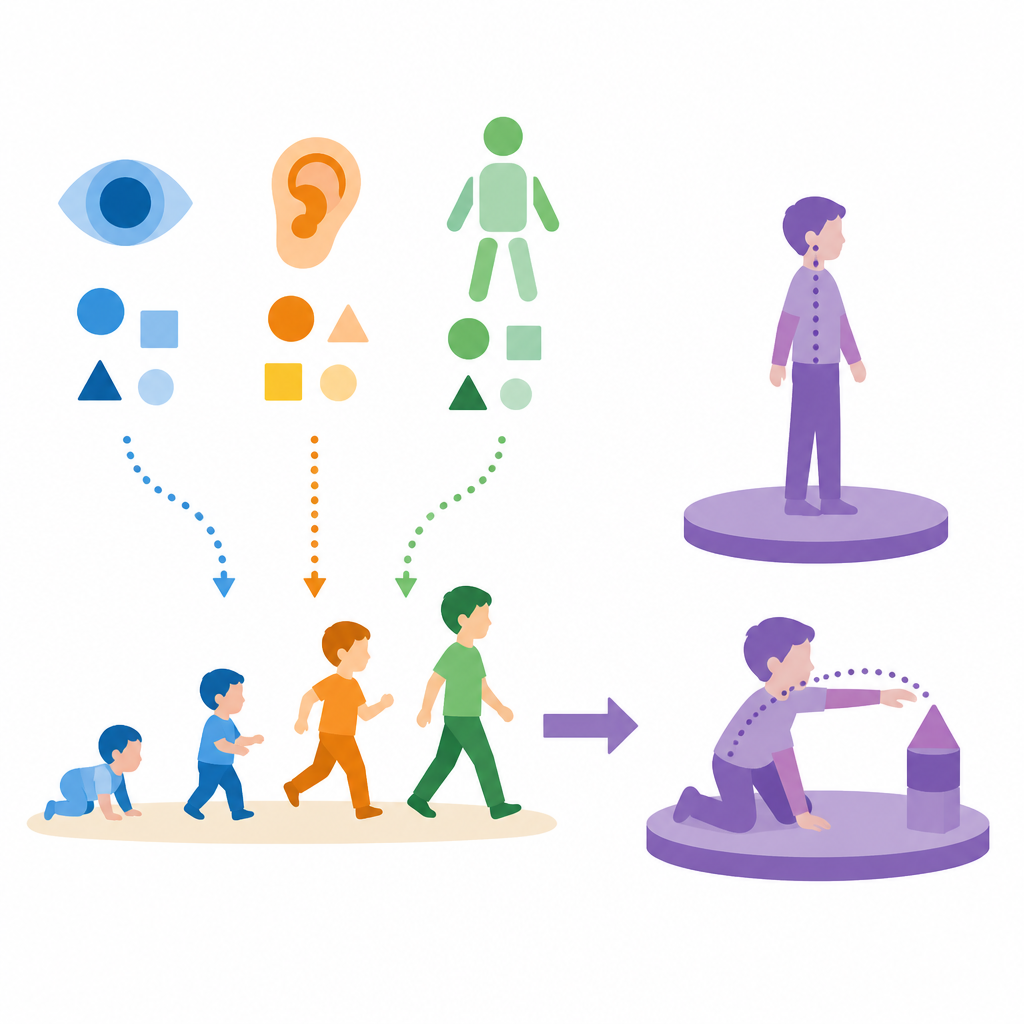
Testing Balance in Everyday Terms
To explore these questions, the team worked with 118 children aged 4 to 17. First, they measured balance using a child-friendly “floor is lava” game. Children stood on their preferred leg, once with eyes open and once with eyes closed, for up to two minutes each time. The difference between these two times showed how much they relied on vision to stay upright. As expected, older children were able to balance for longer and showed a bigger advantage when their eyes were open, suggesting that they learned to use visual cues more effectively to keep their bodies steady.
Measuring Fast Hand and Eye Movements
The second task focused on simple hand control and speed. On a screen, a star appeared at different positions, and children had two minutes to tap or click as many stars as possible. This task did not involve tricky decisions, only quick seeing and moving. The number of hits rose sharply with age, echoing what is known from other work: as children grow, their brains and bodies become better at turning what they see into fast, well-timed actions.
When Beeps Change What We See
The heart of the study was a sound-induced flash illusion. Children watched brief flashes on a dark screen, sometimes paired with two short beeps. When a single flash was paired with two beeps, many people report seeing two flashes instead of one. By varying the time gap between the beeps, the researchers could see over what time span sight and sound were treated as one event, an idea known as a temporal window of integration. Older children were less fooled by the illusion when the beeps were farther apart in time, and their sensitivity improved most at the longer gaps. This pattern suggests that, with age, the brain becomes more precise about when to link sights and sounds and when to keep them separate. 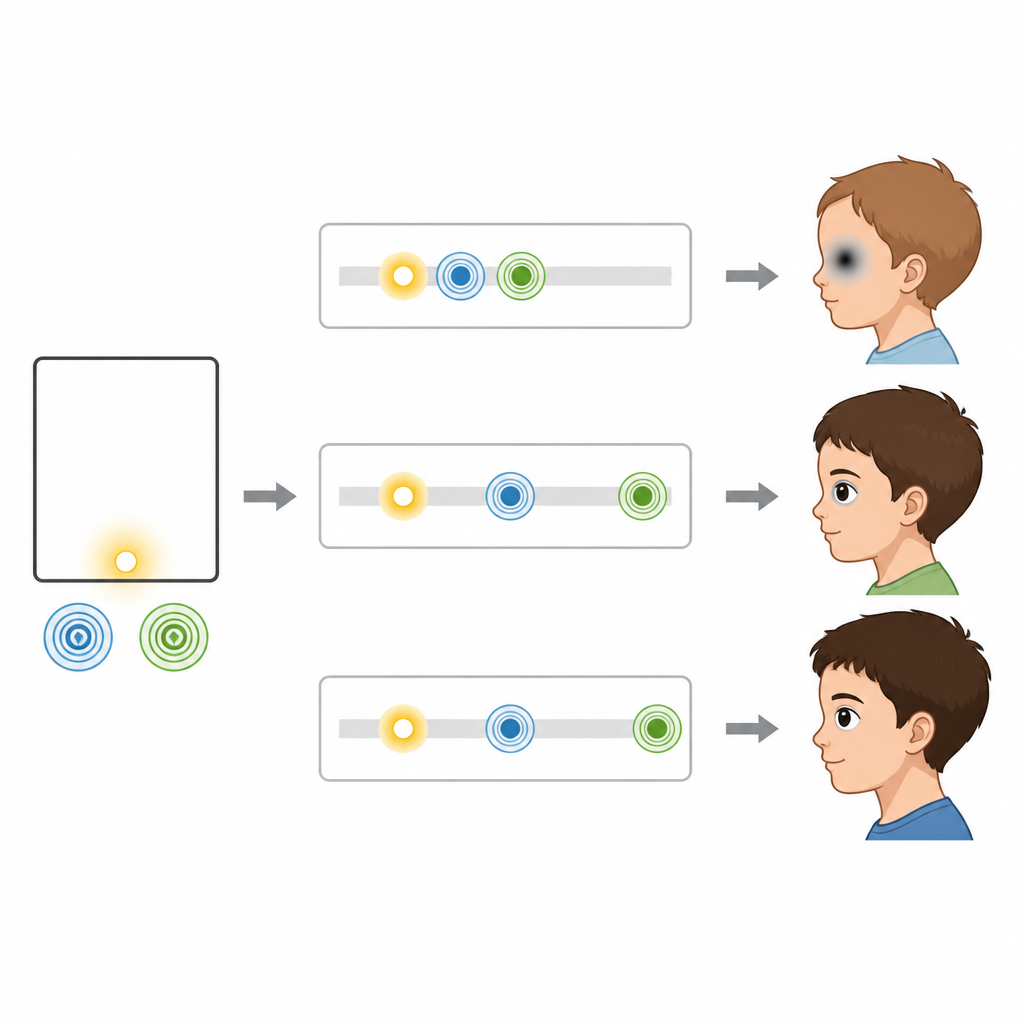
Searching for Links Between Perception and Movement
The key question was whether children who were less susceptible to the illusion also showed better balance or faster hand movements. Using detailed statistical models, the researchers tested whether scores from the illusion task lined up with balance differences or the number of star hits. In contrast to findings in older adults, where poorer integration of sight and sound has been tied to slower walking and greater fall risk, no strong links appeared in this group of children. Age itself mattered for all three abilities, but performance on the illusion task did not reliably track with balance or tapping speed.
What These Findings Mean for Growing Brains
For a general reader, the takeaway is that children clearly become better at standing steady, moving quickly, and separating what they see from what they hear as they grow. However, this study suggests that, in childhood, these improvements may follow partly separate paths. The simple lab measure of how easily a beep can trick the eyes did not mirror a child’s balance or basic motor skill. It may be that the tight links seen in older adults arise later in life or require more fine-grained tests of posture and movement to detect. Understanding when and how these connections appear could eventually help identify children or adults at risk of balance problems, but more sensitive tools and long-term studies will be needed before such perceptual tests can be used in everyday settings.
Citation: Hirst, R.J., McKenna, E., Setti, A. et al. Investigating developmental changes in susceptibility to temporal audiovisual illusions on balance and sensorimotor function in children. Sci Rep 16, 14921 (2026). https://doi.org/10.1038/s41598-026-44660-9
Keywords: multisensory integration, child development, balance, audiovisual illusion, sensorimotor function