Clear Sky Science · en
Application research of image super-resolution reconstruction technology based on diffusion model in 3D digital image correlation
Sharper pictures for better measurements
Many modern engineers rely on cameras to track how materials bend, stretch, or crack, all without touching them. This study shows how smarter image enhancement can rescue useful detail that is normally lost when a single camera is asked to do the job of several, making those measurements cheaper and nearly as accurate as high end lab setups.
How cameras watch things deform
The technique at the heart of this work is called three dimensional digital image correlation, a method that watches a random pattern of tiny speckles painted on an object. By comparing how that speckle pattern shifts between pairs of images, a computer can reconstruct how every point on the surface moves in three dimensions. Traditionally this requires at least two carefully synchronized cameras looking from different angles, which drives up costs and makes experiments with fast events, such as impacts, technically demanding.
Why single camera systems lose detail
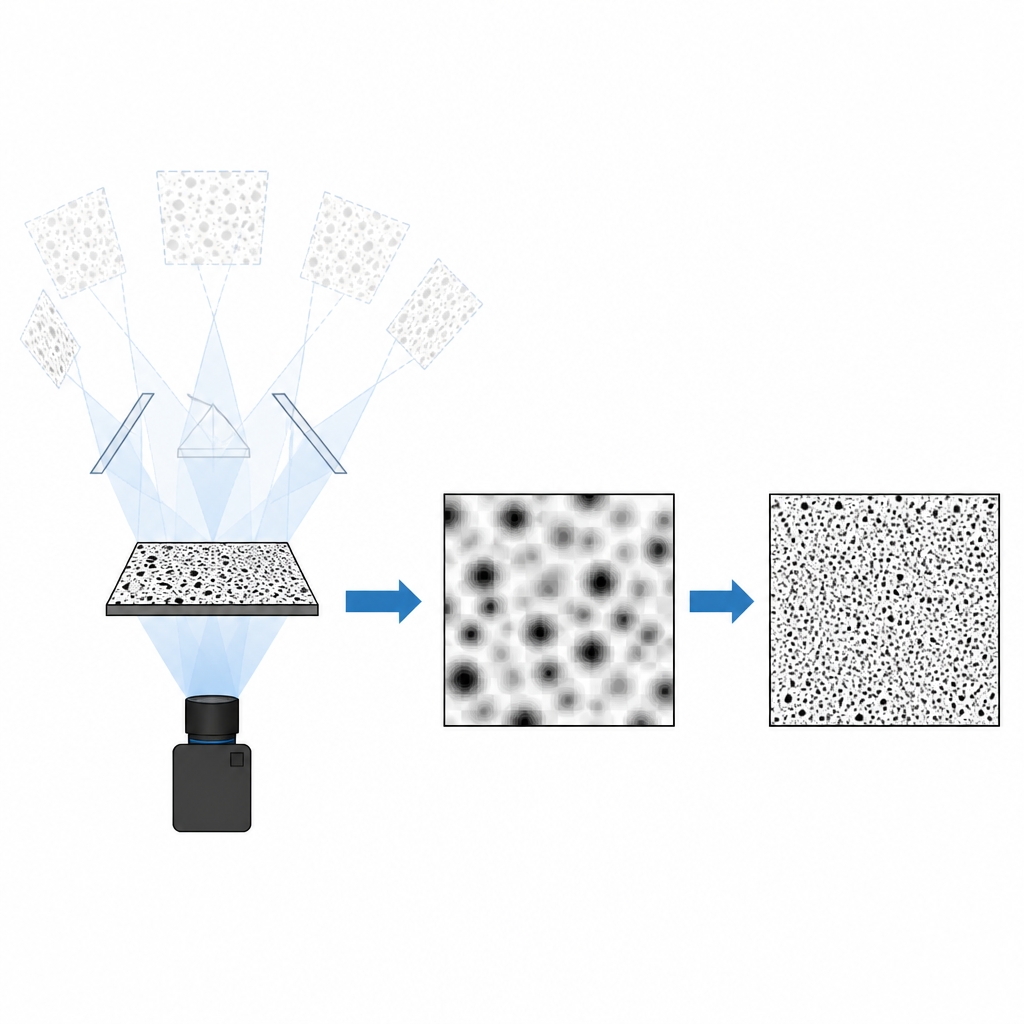
To simplify experiments, researchers have developed optical tricks that let one camera behave as if it were several. Mirrors or prisms split the incoming light so the same camera chip captures multiple views at once. This sidesteps tricky timing issues and removes the need to buy a matching second camera. The trade off is that the camera’s fixed number of pixels must be divided among the virtual views, so each view becomes lower resolution and finer speckle details blur together. That loss of crispness directly reduces how precisely the motion and shape of the object can be measured.
Teaching a model to put the detail back
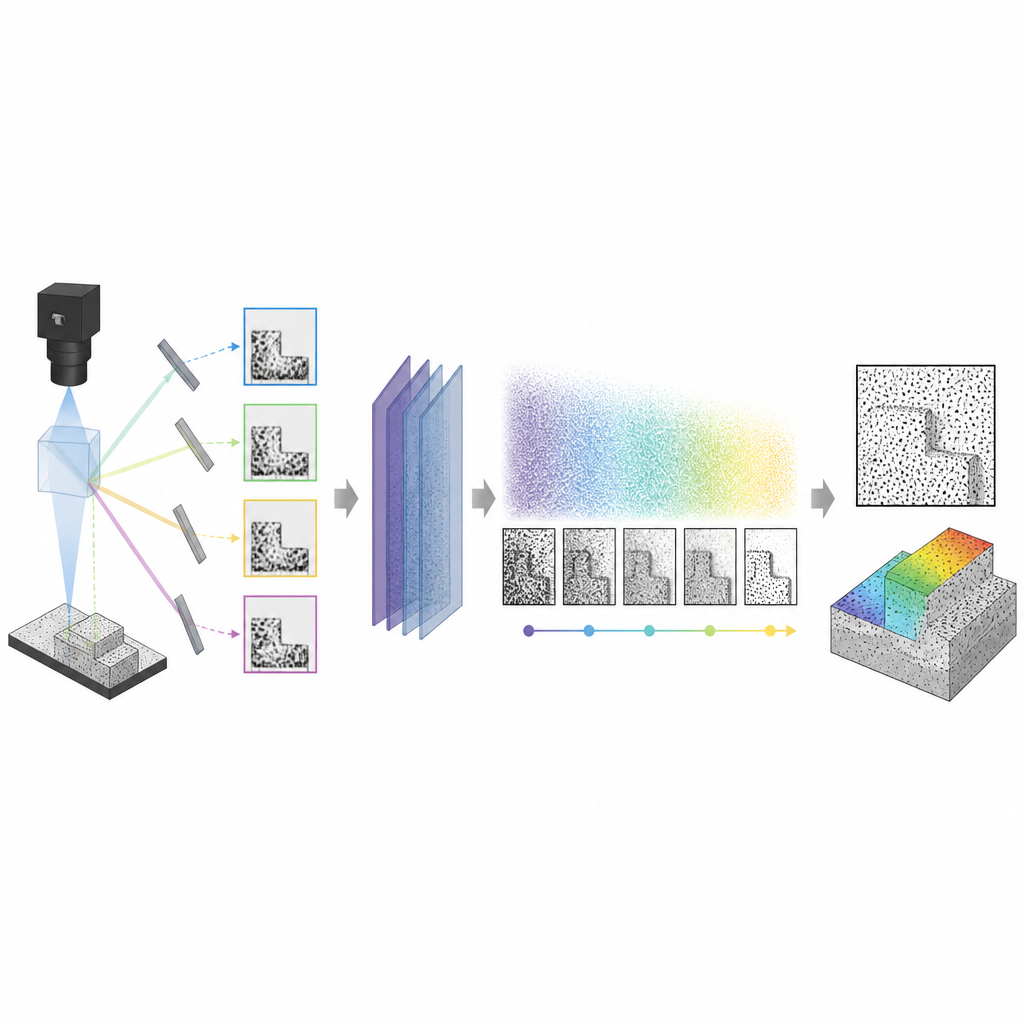
The authors propose a smarter way to rebuild that missing detail after the image is captured. Their method, called LaESR Diff, combines two families of modern image algorithms. First, an improved version of a generative model produces a best guess of what a sharper speckle image should look like. Then a diffusion process gradually refines this guess by adding and removing carefully controlled noise, working backwards from randomness to a clean, high resolution image. The team customized both steps for speckle pictures, whose dense, fine grain structure is very different from everyday photos.
Designing for measurement, not just looks
Most image enhancement tools are tuned to please the human eye or to score well on general quality numbers such as peak signal to noise ratio or structural similarity. For speckle based measurement, tiny shifts of a single pixel matter more than smoothness or contrast. To reflect this, the authors built a math term into their training that favors local similarity in small patches of the speckle pattern, the same kind of comparison used later when measuring motion. They also replaced a common smooth noise schedule with one shaped like a sharp peaked curve so that high frequency textures survive the diffusion process instead of getting washed out.
Testing on shared data and real metal samples
The new method was first checked on a public benchmark for three dimensional image correlation, where ground truth shape and movement of a complex specimen are known. Compared with standard resizing and other advanced super resolution tools, LaESR Diff produced sharper speckle images and, more importantly, cut errors in recovered surface height by more than half at very high magnification. It also reduced displacement errors by about two thirds relative to basic interpolation. In a separate lab test, the team stretched a steel sample while recording it with several stereo setups, including single camera systems using mirrors and prisms, and compared the inferred strain to an independent gauge.
Turning a cheaper setup into a near premium one
In those lab trials, the single camera system with the strongest resolution loss initially showed the largest measurement errors. After its images were enhanced with LaESR Diff, its average error dropped close to that of the traditional two camera system, even at an eight times enlargement. Other enhancement methods either helped less or even hurt accuracy at high magnification. The authors also showed that common image quality scores do not track measurement accuracy well, underlining the need to judge such tools by how they improve actual experimental results.
What this means for future measurements
For non experts, the key outcome is that advanced super resolution can turn compact, lower cost single camera rigs into measurement tools that rival more complex two camera systems. By recovering fine speckle details that optical splitting would normally throw away, the proposed approach preserves the convenience of a single camera without paying the usual penalty in precision. The same strategy of tailoring image enhancement to the needs of a measurement task could extend to many other fields where cameras quietly serve as scientific instruments, from monitoring bridges to inspecting aircraft parts.
Citation: Zhou, D., Li, H., Yao, C. et al. Application research of image super-resolution reconstruction technology based on diffusion model in 3D digital image correlation. Sci Rep 16, 15767 (2026). https://doi.org/10.1038/s41598-026-44638-7
Keywords: image super resolution, digital image correlation, diffusion model, single camera stereo vision, non contact measurement