Clear Sky Science · en
The role of land weathering in carbon consumption and its impact on global carbon cycling since the Last Interglacial period
Why ancient rocks matter for today’s climate
When we think about climate change, we usually picture smokestacks and forests, not the slow crumbling of rocks. Yet the way rainwater and plant roots dissolve the land surface quietly shuttles carbon from the air into rivers and oceans, helping to steady Earth’s climate over tens of thousands of years. This study asks a deceptively simple question: as the planet swung between ice ages and warmer periods over the last 120,000 years, how much did this “rock weathering” really matter for the global carbon cycle and for the rise and fall of atmospheric carbon dioxide (CO2)? 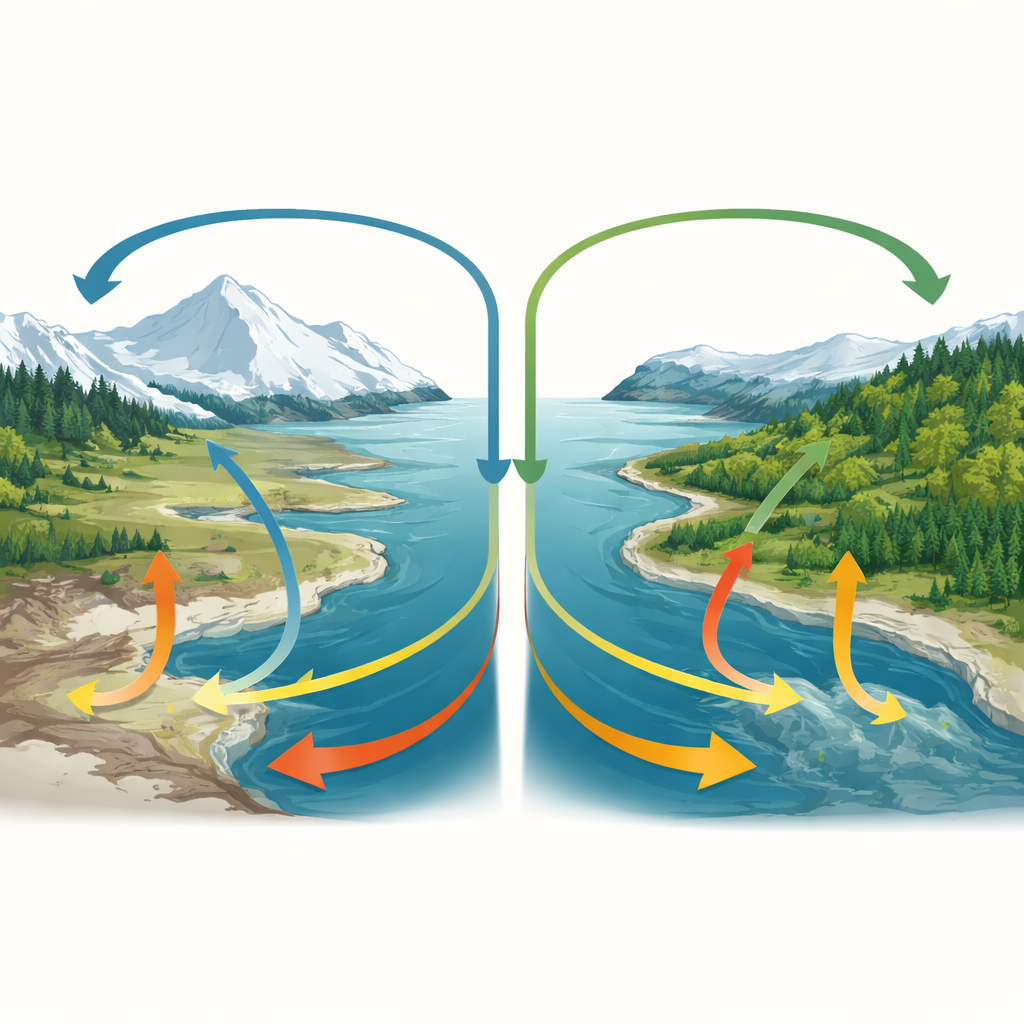
A new way to replay 120,000 years of rock–water interaction
The authors built a new computer framework called the PCM‑weathering model to reconstruct how much CO2 was consumed by rock weathering on land since the Last Interglacial, the warm period before the last ice age. They combined an existing global vegetation and carbon model with detailed maps of rock types and a weathering module that responds to temperature, rainfall, atmospheric CO2, and how much land is exposed above sea level. This allowed them to track, grid cell by grid cell, how forests, soils, and climate worked together to dissolve two major rock groups: silicate rocks (like granite and basalt) and carbonate rocks (like limestone), each with very different consequences for long‑term carbon storage.
Two kinds of rocks, two opposite rhythms
The simulations reveal that silicate and carbonate rocks march to different climatic beats. Silicate weathering, which permanently locks atmospheric CO2 into new marine minerals, was stronger during warm, wet interglacial times and weaker during cold, dry glacial times. Its global carbon uptake shifted between roughly 119 and 163 million tons of carbon per year, with the highest activity in humid tropical regions such as the Amazon, central Africa, South and Southeast Asia, and parts of southern China. In contrast, carbonate weathering, which mostly recycles CO2 back to the air on longer timescales, actually intensified during the ice ages. As sea level fell, vast continental shelves rich in carbonate rock were exposed around the tropics, especially in Southeast Asia, allowing more rain and soil water to dissolve them and boosting carbonate weathering to about 303–320 million tons of carbon per year during glacial maxima, almost double some interglacial values.
Climate, coastlines, and forests as hidden levers
By running sensitivity experiments, the team teased apart which factors drove these changes. For silicate rocks, atmospheric CO2 itself emerged as the main control through most of the last glacial cycle: higher CO2 fostered more vigorous plant growth and higher soil CO2, which in turn sped up rock breakdown. Rainfall further amplified this effect, while lower temperatures tended to slow it. In the more stable Holocene, however, temperature and rainfall became more important than CO2 for silicate weathering. Carbonate weathering told a different story: the dominant lever was how much land was exposed as ice sheets waxed and waned and sea level rose and fell. Newly uncovered shelf areas during glacial lowstands were hotspots of carbonate dissolution, while rising seas during warm periods submerged these platforms and reduced their contribution. 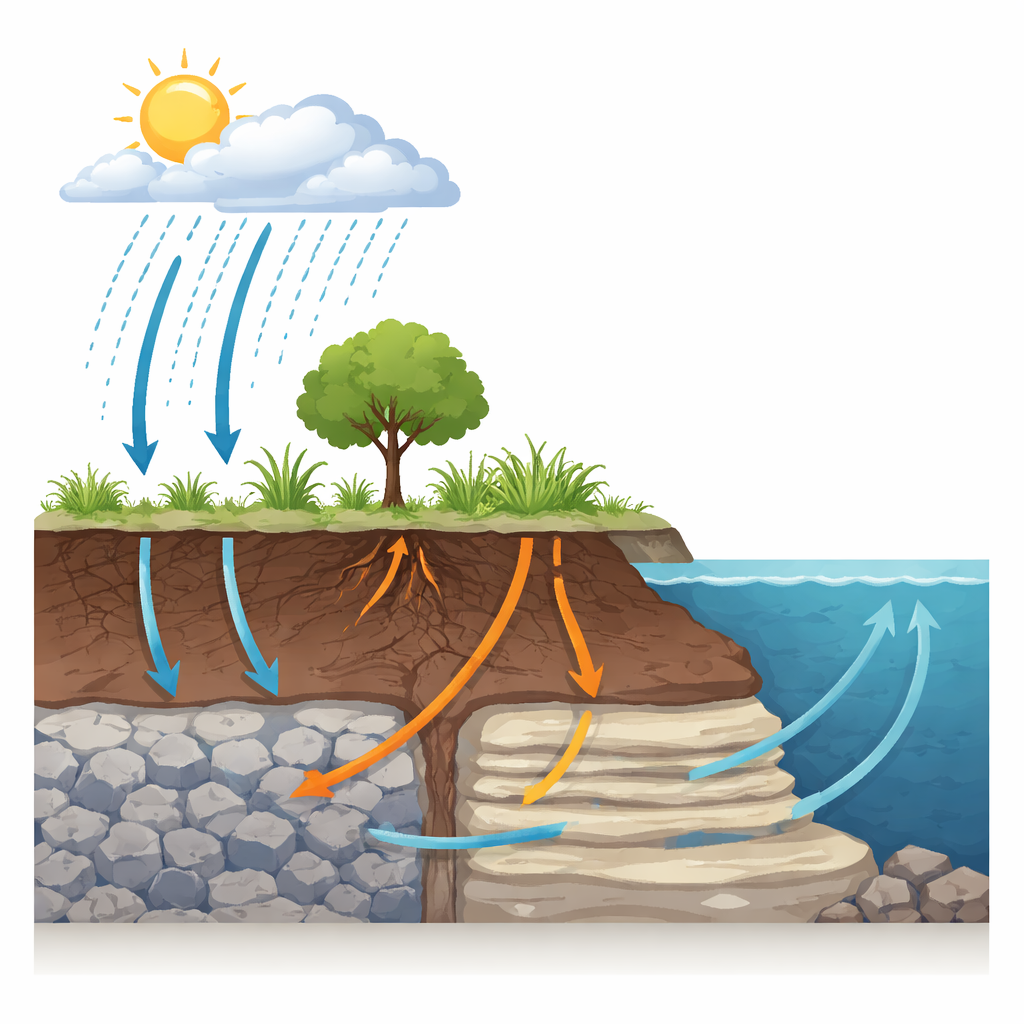
Weathering’s quiet but powerful role in the carbon balance
When the authors added up the numbers over full ice‑age cycles, they found that total carbon consumed by silicate and carbonate weathering far exceeded the net changes in carbon stored in forests, soils, and the oceans. During both the Last Interglacial and the Last Glacial, carbonate weathering removed roughly twice as much carbon as silicate weathering, with particularly large uptakes during glacial times because of expanded shelf exposure. Although much of the CO2 consumed by carbonate weathering ultimately returns to the atmosphere through ocean chemistry, these fluxes still reshape how carbon is partitioned among land, sea, and air over thousands of years. The work also shows that vegetation patterns strongly modulate where and when weathering is most intense, reinforcing the importance of tropical forests as engines of long‑term carbon drawdown.
What this means for our future
Looking ahead, the model suggests that as human‑driven warming boosts plant growth and soil activity, chemical weathering on land will intensify across all future emissions scenarios. Under high‑emission pathways, global silicate and carbonate weathering fluxes could more than double by 2100. This acceleration will not cancel out rapid human CO2 emissions on human timescales, but it will act as a slow, natural brake on atmospheric CO2 over many thousands of years. The study’s main message for non‑specialists is that the planet’s rocky skin is not inert: it is an active, climate‑sensitive system. As ice sheets advance and retreat, coastlines shift, and forests expand or contract, the balance between silicate and carbonate weathering continually reworks Earth’s carbon ledgers, helping to keep the climate within a livable range over deep time.
Citation: Xu, S., Wu, H., Yuan, Y. et al. The role of land weathering in carbon consumption and its impact on global carbon cycling since the Last Interglacial period. Sci Rep 16, 14575 (2026). https://doi.org/10.1038/s41598-026-44594-2
Keywords: chemical weathering, glacial–interglacial cycles, carbon cycle, silicate and carbonate rocks, climate feedbacks