Clear Sky Science · en
Mechanical properties of body-centered tetragonal lattice structures in 316L stainless steel fabricated by SLM
Why metal lattices matter
From lighter airplanes to custom medical implants, engineers are looking for ways to make metal parts that are both strong and light. One promising idea is to build parts out of tiny repeating frameworks, or lattices, instead of solid chunks of metal. This study looks at a particular kind of lattice made from stainless steel using metal 3D printing, and asks a simple question with big engineering consequences: how do small changes in the shape of the lattice affect how strong and stiff it is?
Building strength from repeating patterns
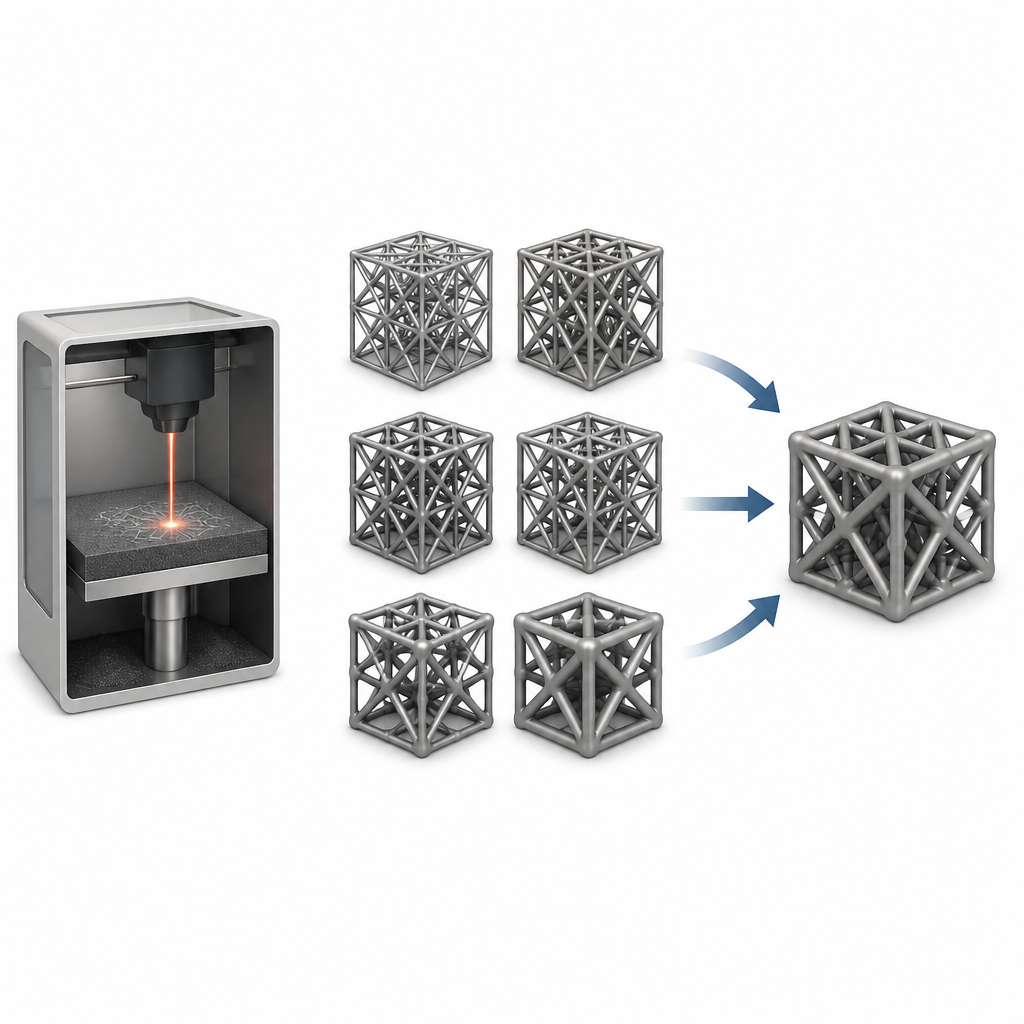
The researchers focused on a body-centered tetragonal, or BCT, lattice. In plain terms, each basic cell of this lattice is a box with rods running from a point in the middle to each of the eight corners, and many such cells are stacked together into a block. These lattices were made from 316L stainless steel using selective laser melting, a form of metal 3D printing where a laser melts thin layers of metal powder to build up a part. BCT lattices are especially attractive because their geometry is highly regular and can support itself during printing, avoiding extra supports that waste time and material.
Testing how shape changes performance
Three simple geometric features of the rods were varied: how long they are, how thick they are, and at what angle they tilt relative to a reference plane. The team first built digital models of the lattice and used computer simulations to compress them and estimate two key measures of performance: yield strength, which tells when permanent deformation begins, and modulus of elasticity, which reflects how stiff the structure is. To keep the number of trials manageable while still exploring combinations of these three variables, they used a statistical design approach called response surface methodology, which systematically samples a small but informative set of designs.
Bringing computer predictions into the real world
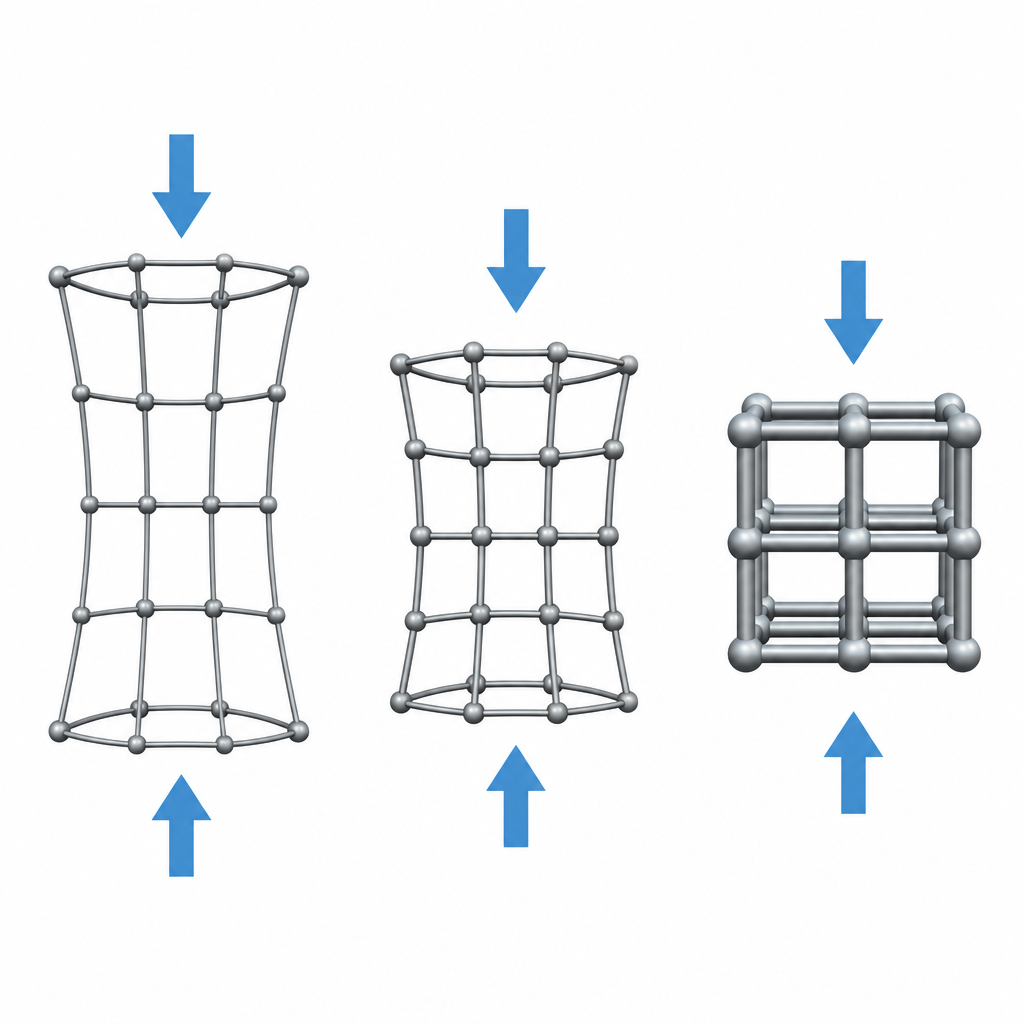
To check that the computer models reflected real behavior, the team printed 17 groups of stainless steel lattice samples with different combinations of rod length, thickness, and angle, then squeezed them in a mechanical testing machine. The machine slowly compressed each sample while recording how force and deformation changed, producing curves that revealed the elastic region, the yield point, and the later compaction stage. Notably, none of the samples actually cracked; instead they progressively bent and compacted as the rods tilted, yielded, and finally packed tightly together. Overall, the measured strengths and stiffnesses lined up well with the simulation results, even though real prints contain tiny flaws such as surface roughness and internal pores.
What makes a lattice strong or weak
The combined simulations and experiments showed clear trends. Thicker rods and larger tilt angles made the lattices both stronger and stiffer, while longer rods had the opposite effect. For example, a design with short, thick rods set at a large angle could be more than a hundred times stronger and stiffer than one with long, thin rods at a smaller angle. The statistical response surface model captured not just the individual effects of each feature, but also how they interact, revealing that there is no single "best" parameter by itself. Instead, the best performance comes from a particular mix of dimensions and angles.
Design recipe for better lightweight parts
By blending computer simulations, careful experiments, and statistical modeling, the researchers pinpointed an especially favorable design: a BCT lattice with rods 4 millimeters long, 1.5 millimeters thick, and tilted at 60 degrees. Within the range they studied, this combination delivered the highest strength and stiffness. For non-specialists, the key message is that the mechanical behavior of 3D-printed metal lattices can be tuned much like adjusting settings on a machine: small geometric tweaks can turn a flexible framework into a robust load-bearing structure. The methods and findings offer a practical design guide for engineers who want to build lighter, stronger components using metal 3D printing.
Citation: Xu, Z., Lin, Z., Wu, Z. et al. Mechanical properties of body-centered tetragonal lattice structures in 316L stainless steel fabricated by SLM. Sci Rep 16, 14860 (2026). https://doi.org/10.1038/s41598-026-44572-8
Keywords: selective laser melting, metal lattice structures, 316L stainless steel, mechanical properties, additive manufacturing design