Clear Sky Science · en
A predictive model for treatment efficacy in RAS wild-type advanced colorectal cancer: development and external validation for EGFR inhibitor plus anti-angiogenic therapy based on a retrospective cohort
Why this matters for people with bowel cancer
Treating advanced colorectal cancer is no longer one size fits all, but doctors still struggle to predict which patients will benefit from certain targeted drug combinations. This study asks a practical question: can everyday clinical information be combined into a simple tool to estimate how long a patient might stay free from cancer worsening when given a specific pair of targeted therapies, and can that tool help guide care in hospitals that lack cutting edge genetic testing?
Targeted drugs and the need for better guidance
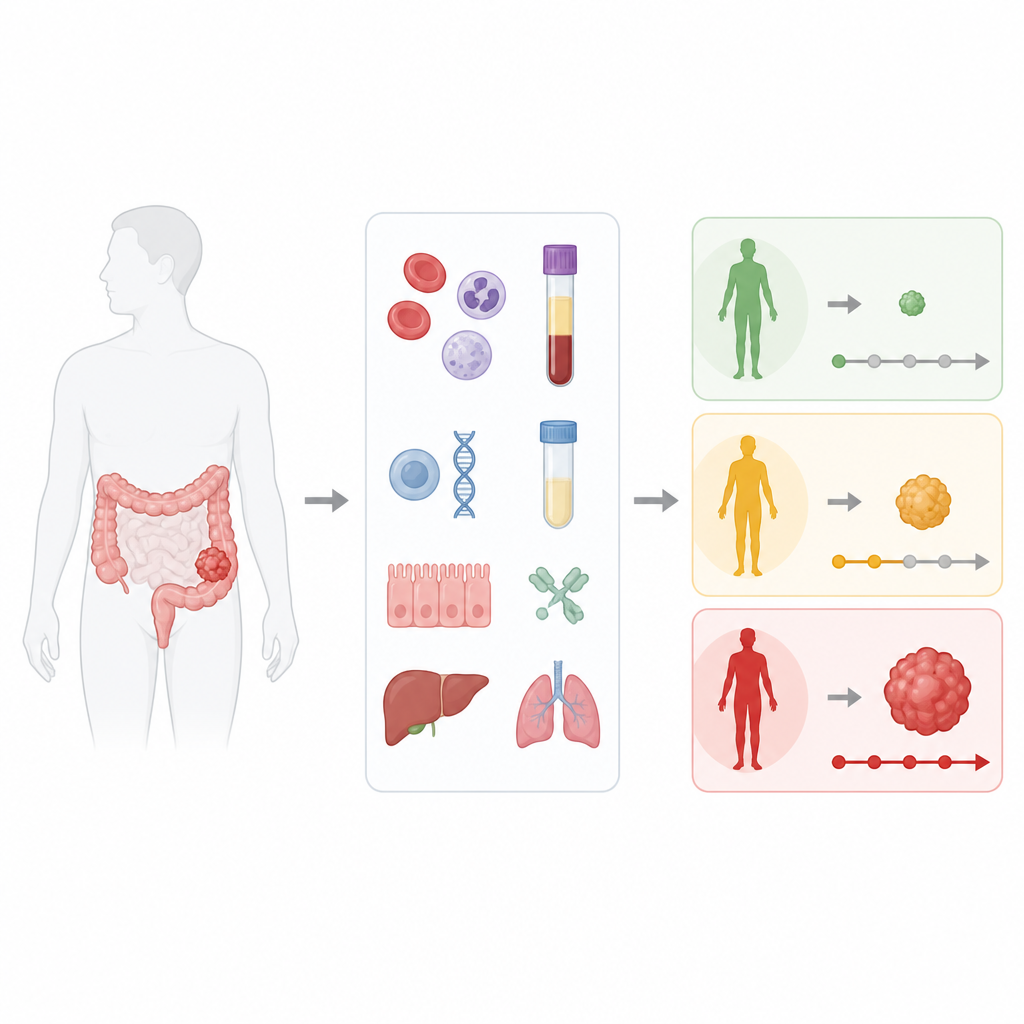
For patients whose tumors carry a normal version of genes in the RAS family, two major types of targeted drugs are commonly used. One group blocks a surface protein called EGFR, and the other starves tumors by cutting off blood vessel growth. In real clinics, these drugs are often given together, sometimes with mild chemotherapy, especially for older or frailer patients who cannot tolerate harsh regimens. Yet many such patients do not respond well, and current treatment guidelines give broad recommendations without a clear way to estimate benefit for an individual person. This gap has driven interest in prediction tools that work with information already collected in routine care.
Building a risk score from routine tests
The researchers looked back at records from 600 people with advanced colorectal cancer treated at three large centers in China between 2018 and 2021. All had RAS wild type tumors and received a combination of an EGFR blocker with an anti blood vessel drug, usually plus standard chemotherapy. From these cases, the team gathered four kinds of information: basic clinical data such as age and general fitness, common blood tests and tumor markers, detailed measurements from CT scans, and a DNA based measure of how many mutations the tumor carried. Using statistical techniques designed to avoid overfitting, they narrowed dozens of candidates down to five core factors and combined them into a visual scoring chart, or nomogram, that estimates the chance of remaining free of disease progression at several time points.
The five simple factors behind the model
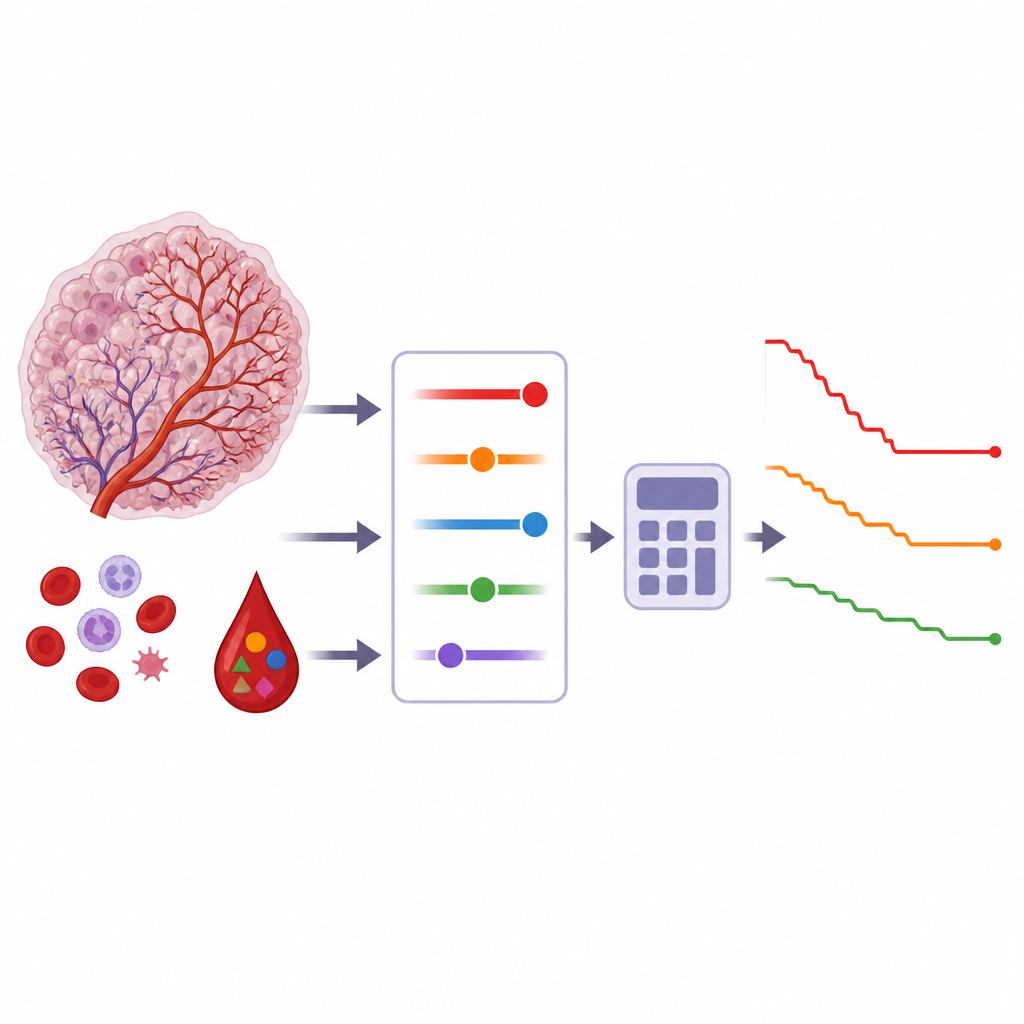
The final tool relies on measurements that most cancer centers can obtain. First is vascular density, a CT based estimate of how densely packed the tiny blood vessels are inside the tumor, reflecting how well it may be fed. Second is the neutrophil to lymphocyte ratio, a simple marker of inflammation derived from a standard blood count. Third is the level of carcinoembryonic antigen, a long used blood marker for colorectal cancer. The last two are how many distant sites the cancer has spread to and the patient’s performance score, which reflects how active and independent they are in daily life. By assigning points to each of these, the nomogram places patients into low, intermediate, or high risk groups for earlier cancer worsening under the combination treatment.
How well the score works in practice
When tested in the original group of 420 patients, the model showed modest ability to tell apart those who would do better from those who would not, and it clearly separated survival curves between risk groups. It was then checked in an independent group of 180 patients from another hospital. There, its power to distinguish outcomes was weaker and only slightly better than simply using two very basic clinical features from current guidelines. However, the predicted chances of staying progression free matched real outcomes reasonably well, especially at six months. High risk patients had shorter progression free and overall survival, and in this group those whose doctors changed treatment appeared to stay stable longer, though this finding could be due to other differences between patients and cannot be taken as proof that switching drugs is best.
Clues from blood vessels and DNA
The study also explored why some patients did better than others on the same drugs. Tumors with denser internal blood vessel networks tended to respond better, possibly because the drugs targeting blood supply and growth signals had more impact. Another factor was tumor mutational burden, a count of how many genetic changes the cancer carries. Patients whose tumors had more mutations generally stayed stable longer, and this held true in both the main and validation groups. Simple combined inflammation scores based on blood counts also tracked with how often tumors shrank on scans, hinting that the body’s broader immune and inflammatory state matters for treatment response.
What this means for patients and doctors
In the end, the authors conclude that their model is not strong enough to decide who should or should not receive the drug combination, nor to dictate when to change regimens. Instead, it offers an early step toward more personalized care by using common tests to flag patients at higher risk of rapid progression, especially in settings without access to advanced molecular profiling. For now, it is best viewed as an extra lens rather than a replacement for clinical judgment, and it will need further refinement, added dynamic markers, and testing in future prospective studies before it can meaningfully change how individual treatment choices are made.
Citation: Jin, Y., Gong, L. & Tang, S. A predictive model for treatment efficacy in RAS wild-type advanced colorectal cancer: development and external validation for EGFR inhibitor plus anti-angiogenic therapy based on a retrospective cohort. Sci Rep 16, 14890 (2026). https://doi.org/10.1038/s41598-026-44562-w
Keywords: colorectal cancer, targeted therapy, prediction model, risk stratification, tumor biomarkers