Clear Sky Science · en
PSD-LW-DCN: a generalizable power spectral density based lightweight deep convolutional neural network for seizure detection
Smarter Seizure Watching Made Practical
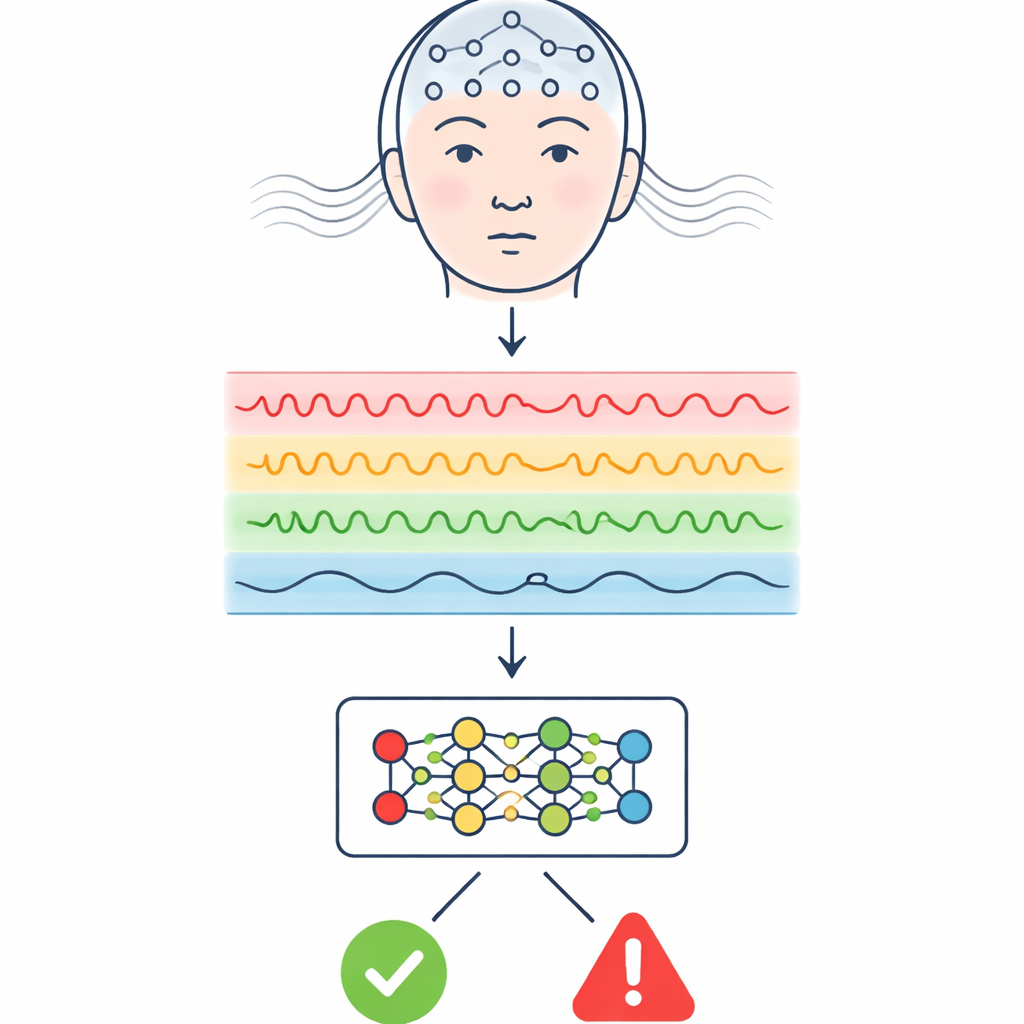
For people living with epilepsy, the fear of an unexpected seizure never really goes away. Doctors use brainwave tests, called EEGs, to spot seizures, but combing through hours of squiggly lines by eye is slow, tiring work. This study introduces a compact computer model that can automatically flag seizures from EEG recordings in near real time, even when it is used on patients it has never seen before, and is lightweight enough to run on everyday electronics and future wearable devices.
Why Reading Brainwaves Is So Hard
EEG measures tiny electrical signals from the scalp as the brain’s cells fire. During a seizure, these signals change in complex ways that vary from person to person, from one seizure type to another, and even over time in the same patient. Traditionally, experts look for subtle patterns by hand, a process that is slow, subjective, and hard to reproduce. Many computer programs have been proposed to help, but they often struggle when tested on new patients whose brain activity differs from the people used to train the system. Others are so large and power-hungry that they are impractical for continuous monitoring outside the hospital.
Listening to the Brain in Different Pitches
Instead of feeding raw EEG signals straight into a huge neural network, the authors use a classic idea from signal processing: looking at how the signal’s energy is spread across different “pitches,” or frequency bands. They split each EEG segment into five well-known ranges, from slow waves up to faster rhythms. For each band, they compute how much energy the brain activity has at each frequency using a careful averaging method that reduces random noise. Then they average these energy values across all recording channels, turning many separate squiggles into a single, cleaner profile that highlights how the overall brain activity shifts between normal and seizure states.
A Small but Clever Neural Network
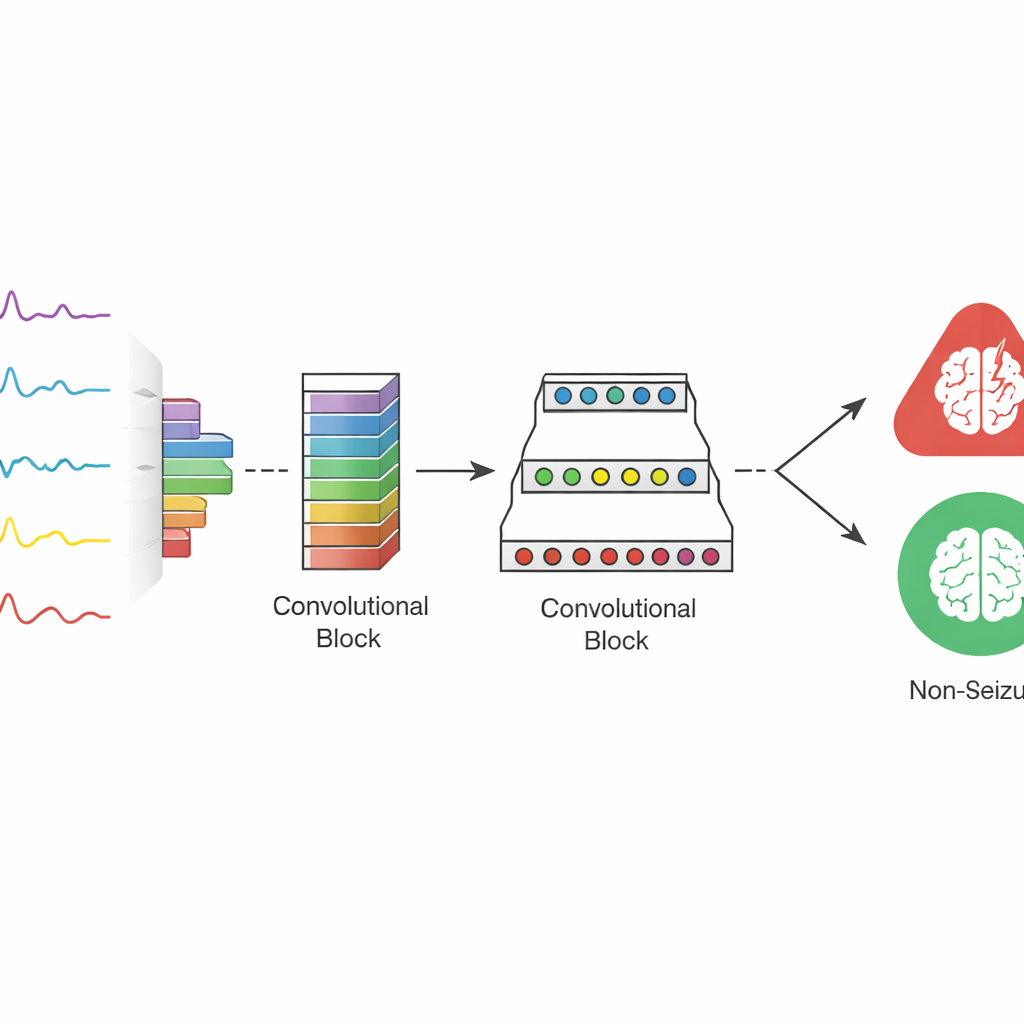
These compact energy profiles are then passed into a specially designed deep learning model the authors call PSD-LW-DCN. Unlike many deep networks with dozens of layers and millions of adjustable weights, this model uses only two streamlined stages of convolutional processing followed by simple decision layers, totaling about sixty thousand parameters. The first stage looks for detailed patterns in the energy profiles; the second stage condenses them into lower-dimensional summaries that still preserve the key differences between seizure and non-seizure periods. By operating on already simplified inputs and avoiding complex spatial wiring across electrodes, the network stays small, fast, and easier to deploy on modest hardware.
How Well Does It Work in Real Patients?
The team tested their approach on two of the largest public EEG collections for epilepsy, each containing recordings from many different patients and thousands of seizures. They trained the model using a leave-one-person-out strategy: in each round, all but one subject were used for learning, and the held-out subject was used to test how well the method generalizes to new people. Across both datasets, the model correctly labeled roughly four out of five EEG segments and kept the rate of false alarms low, often below one spurious alert per hour in long monitoring sessions. When compared head-to-head with a range of modern deep learning methods, including attention-based networks and transformer models, this compact design matched or exceeded their accuracy while running several times faster and using a fraction of the memory.
What the Energy Patterns Reveal
To check whether the model was picking up meaningful brain changes rather than just memorizing the data, the researchers examined how energy in different frequency bands behaved for patients with good and poor detection performance. In many well-detected cases, seizure periods showed clear surges of energy in particular bands, especially the so-called theta range, compared with quiet periods between seizures. In more difficult cases, these energy differences were weaker or even reversed, helping to explain why some individuals remain challenging for any automated system. Additional tests showed that combining several frequency bands together produced better results than using any single band alone, underscoring the value of looking at the full spectrum of brain rhythms.
Bringing Continuous Monitoring Closer to Daily Life
Overall, this work shows that a carefully crafted, lightweight model can reliably spot seizures in EEG recordings from many different people while running quickly enough for real-time use on low-power devices. By first converting complex brain signals into compact energy fingerprints and then analyzing them with a modest neural network, the approach strikes a balance between accuracy, speed, and simplicity. For patients and clinicians, this brings the prospect of more dependable, less intrusive seizure monitoring—potentially through bedside units or wearable systems—one step closer to everyday reality.
Citation: Gu, P., Zhang, M., Xu, M. et al. PSD-LW-DCN: a generalizable power spectral density based lightweight deep convolutional neural network for seizure detection. Sci Rep 16, 14073 (2026). https://doi.org/10.1038/s41598-026-44536-y
Keywords: epilepsy, EEG, seizure detection, deep learning, wearable monitoring