Clear Sky Science · en
Optimization of diffractive optical elements for automotive adaptive front-lighting systems: compliance with ECE-R123
Why thinner, smarter headlights matter
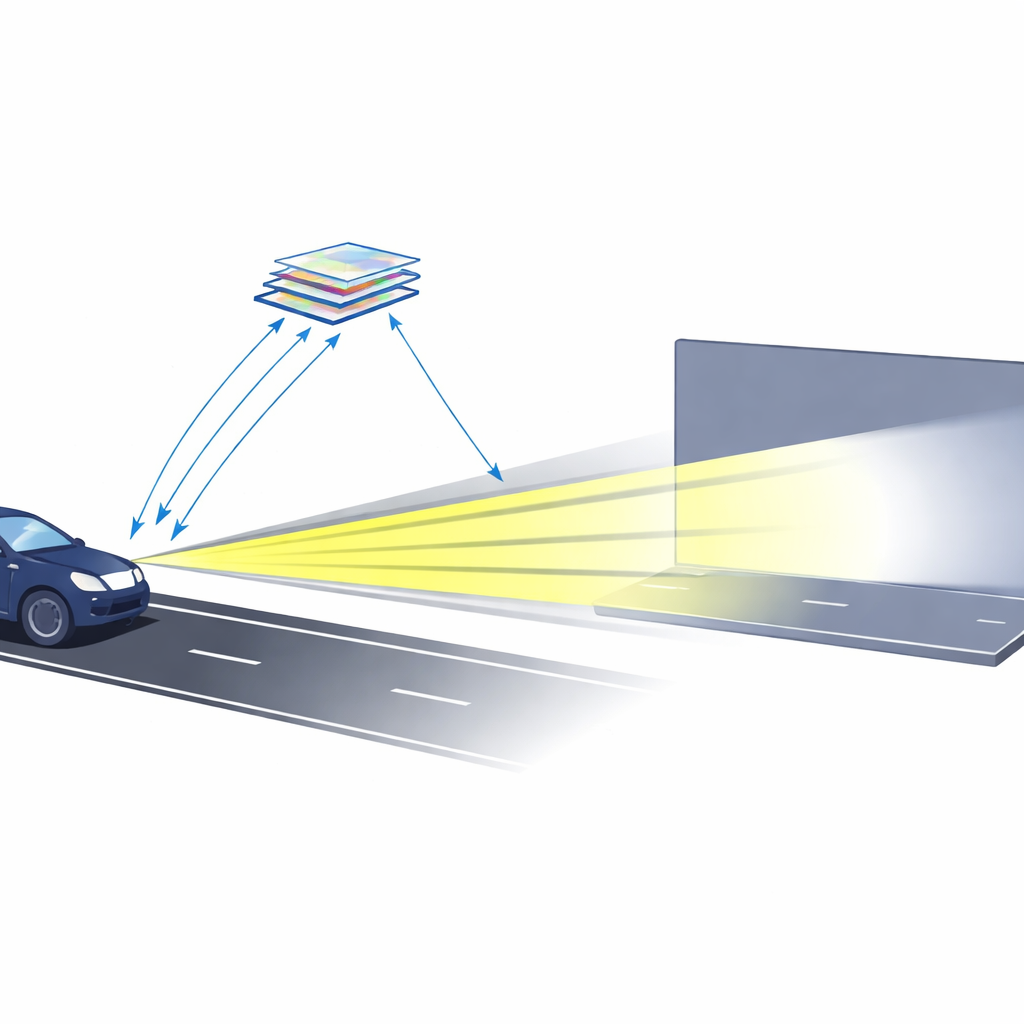
Modern cars are packed with sensors and electronics, yet the humble headlight still struggles with a basic trade-off: light the road well for the driver without blinding everyone else. Traditional advanced headlights that can shape their beams to road and traffic conditions often rely on bulky lenses and moving parts that add cost, weight, and points of failure. This paper explores a different path, using wafer-thin diffractive optical elements—essentially microscopic light-sculpting surfaces—to build compact headlights that still meet strict European safety rules.
From heavy glass to paper-thin light shapers
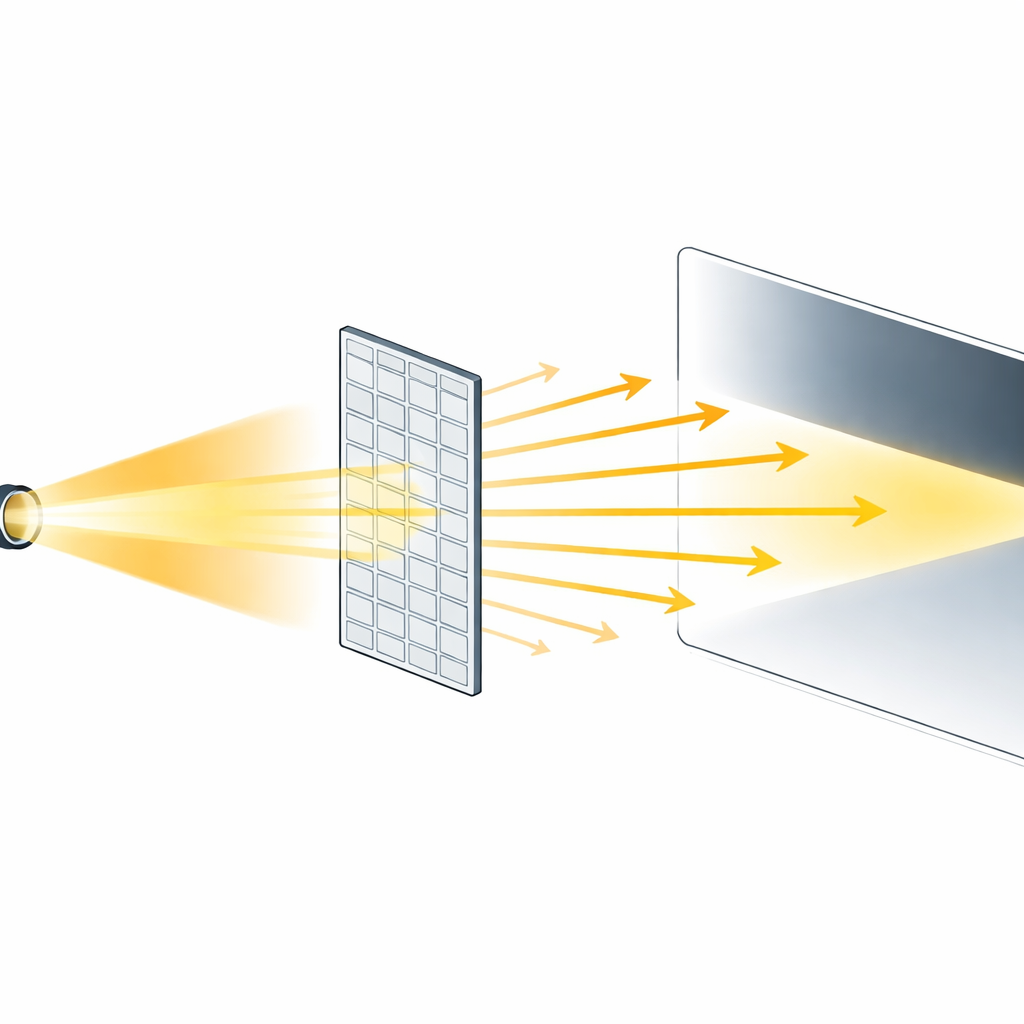
Conventional adaptive front-lighting systems work by mechanically steering beams or switching many small light sources on and off. That approach can give good control, but it demands space for large lenses, motors, and complex assemblies, all of which are vulnerable to vibration and wear in real-world driving. The researchers instead turn to diffractive optical elements, or DOEs. These are flat pieces of transparent material etched with tiny steps only a fraction of a micrometer high. When light hits these microscopic structures, it spreads and interferes in a carefully designed way, allowing the beam to be sculpted in detail using a single thin plate instead of a stack of bulky optics.
Designing a beam to match real-world rules
The team did not just aim for a pretty pattern on a lab screen. They started from the European ECE‑R123 regulation that defines exactly how bright a headlight should be at specific points in front of a car. Some zones, such as the region in front of the driver, must be strongly lit to reveal the road, while other critical spots aligned with an oncoming driver’s eyes must be kept dim to avoid glare. The authors converted these legal brightness limits into a grayscale target image, then used computer simulations to determine what microscopic pattern on the DOE would bend and redirect the light into exactly that distribution. By adjusting the size of each tiny pixel and the depth of each step in the glass, they pushed the design toward both high efficiency—most of the light going where it should—and a sharp “cut-off” line where brightness drops quickly above the main beam.
Turning a digital pattern into real glass
Once the virtual design met the regulatory targets in simulation, the researchers fabricated the DOE on a small square of quartz, a material that stays stable under heat and transmits light efficiently. Using advanced lithography and plasma etching similar to that used in semiconductor manufacturing, they carved a four-level staircase structure into the surface, with each level precisely tuned to shift the light’s phase. Microscopy images showed that the etched pattern closely matched the design, and statistical comparisons confirmed that most of the intended fine structure was preserved despite tiny depth errors and fabrication noise. The finished DOE was only about 3 millimeters on a side, yet it replaced the work of a much larger and more complex lens system.
Putting the thin headlight to the test
To find out whether this tiny element could handle real-world demands, the team paired it with a green laser diode chosen to match the design wavelength and measured the resulting beam using a high-precision robotic goniophotometer. This instrument sweeps a light sensor through space to record brightness as a function of angle, directly mirroring how regulations specify performance. At every key test point—including those representing the oncoming driver’s eyes and the main field of view ahead—the measured intensities fell within the allowed ranges. The crucial glare-sensitive region stayed dim, while the primary forward-looking zone was illuminated more strongly than the minimum requirement. The measured beam pattern, including the sharp cut-off edge that separates lit and dark regions, closely followed the simulated predictions.
What this means for future car lights
In simple terms, the study shows that a tiny patterned plate can steer headlight beams with the precision needed to satisfy strict safety rules, without relying on bulky glass optics or moving parts. The authors demonstrate a full path from regulation text to digital design, to fabricated hardware, and finally to measurements that confirm compliance. While this prototype uses a single color of light in the lab, the same approach could be extended to multiple colors and more advanced adaptive patterns. If developed further, DOE-based headlights could help car makers build slimmer, lighter, and more reliable front lighting systems that still keep roads bright for drivers and dark where it matters for everyone else.
Citation: Shin, S.U., Noh, M.J., Min, K. et al. Optimization of diffractive optical elements for automotive adaptive front-lighting systems: compliance with ECE-R123. Sci Rep 16, 13808 (2026). https://doi.org/10.1038/s41598-026-44526-0
Keywords: automotive headlights, adaptive lighting, diffractive optics, road safety, light beam shaping