Clear Sky Science · en
Impact of bed roughness and submergence on velocity profiles and flow structures in hydraulic jumps
Why violent water matters to rivers and dams
Where fast water from a dam spillway slams into a slower river below, it often erupts into a boiling, foaming feature called a hydraulic jump. These jumps are nature’s way of bleeding off excess energy, but they can also gouge riverbeds, damage concrete, and threaten the safety of dams and bridges. This study asks a practical question with big implications for infrastructure: how do the shape and roughness of the riverbed, and the depth of water downstream, change what happens inside a hydraulic jump—and how can engineers use that knowledge to better protect waterways and structures? 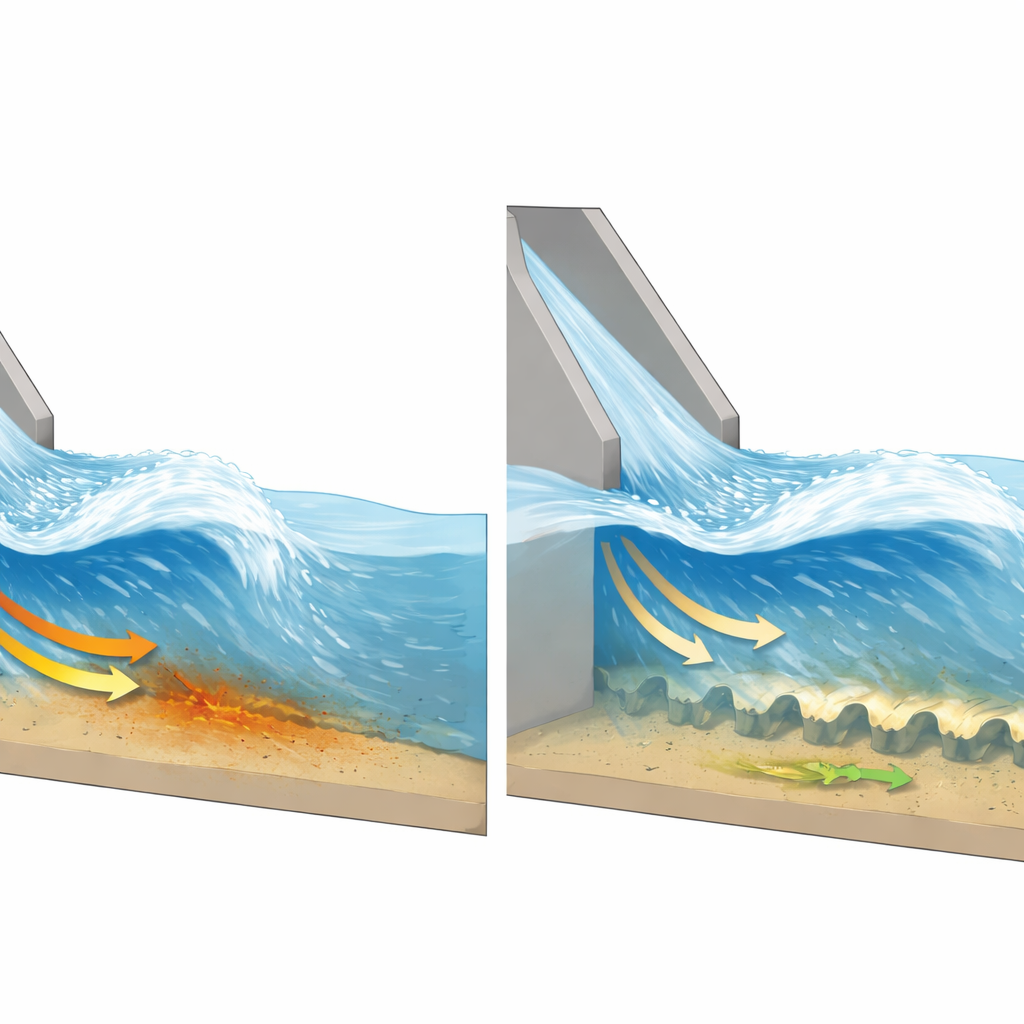
What happens when fast water hits slow water
When water rushes down a spillway, it is shallow and fast, carrying a lot of kinetic energy. As it meets deeper, slower water downstream, it suddenly thickens and slows, forming a hydraulic jump. Inside this jump, water near the bed can move faster than water at the surface, and swirling rollers of recirculating flow churn air and water together. High speeds close to the bed can peel away concrete, trigger cavitation (the formation and collapse of vapor bubbles), and scour away sediment, undermining structures. Engineers try to manage this chaos in stilling basins—engineered stretches of channel below spillways—by adjusting bed roughness and tailwater depth, but until now the fine details of how these factors shape turbulence and vortices have been only partly understood.
Building a controlled river in the lab
The authors built a 5.5‑meter‑long glass-walled flume to mimic a spillway and its stilling basin. They tested two beds: a perfectly smooth slab and a corrugated slab with gentle sinusoidal ridges and troughs, similar to large ripples on a riverbed. Using carefully controlled flows, they created both “free” jumps (where the downstream water level is just high enough to form a jump) and “submerged” jumps (where deeper tailwater partially buries the jump). They measured water depths and detailed velocity profiles from the bed up to the surface at many points, and then complemented these experiments with three-dimensional computer simulations. The simulations, run with a widely used turbulence model, allowed them to see how turbulent kinetic energy, its dissipation, and swirling vortex structures evolve throughout the jump. 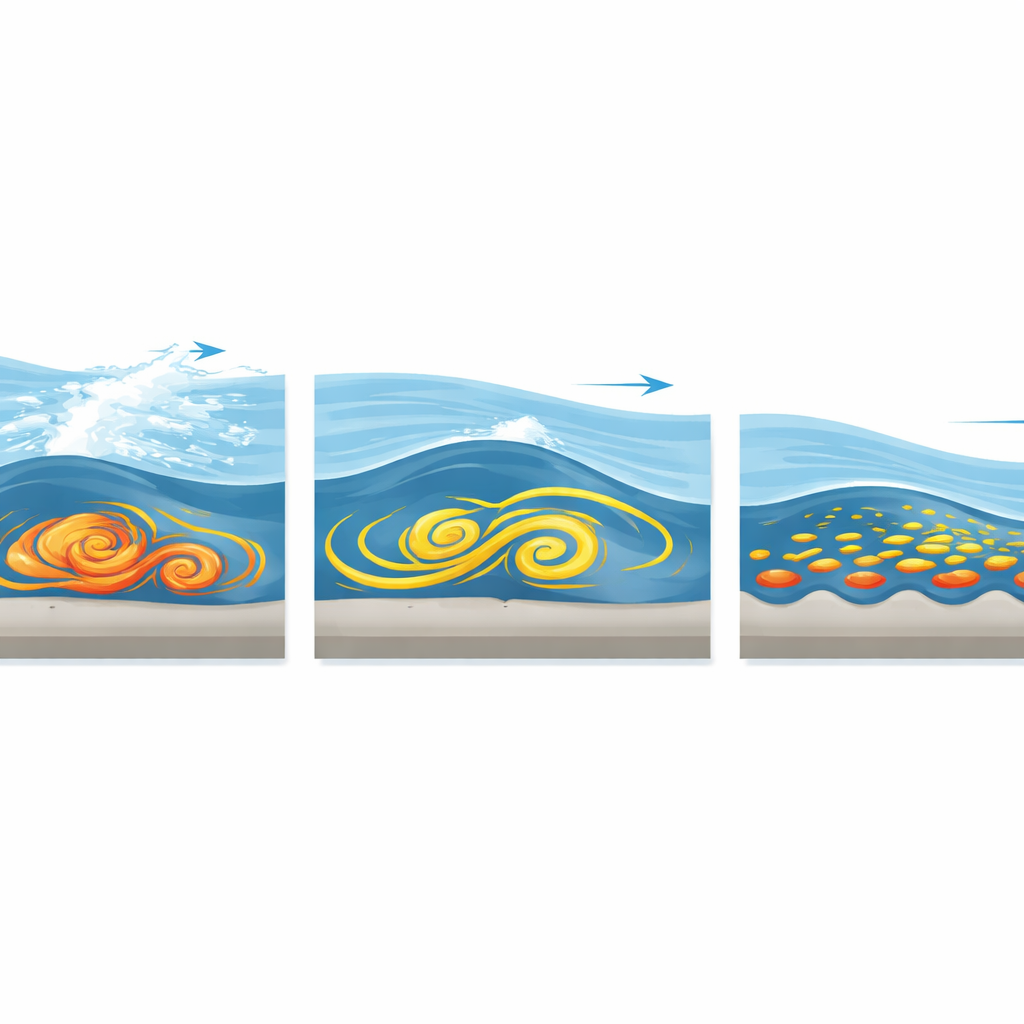
How roughness and depth reshape the turmoil
The study shows that corrugated beds dramatically change where and how the water moves. Over a smooth bed, the fastest flow hugs the bottom, and the zone of intense recirculation—the roller—extends relatively far downstream. Adding corrugations pushes the peak velocity up away from the bed, thickens the near-bed shear layer, and shortens the roller. In other words, the rough bed “grabs” the flow, breaks large eddies into smaller ones more quickly, and spreads momentum more evenly over the depth. Submerging the jump by raising the tailwater depth has a different effect: it lengthens the roller, shifts the core of turbulence downstream, and slows the rate at which energy is lost, because air entrainment and surface mixing are suppressed. Yet even under these submerged conditions, the corrugated bed continues to confine strong vortices close to the floor and lowers near‑bed speeds compared with a smooth bed.
Peering inside the hidden swirls
The computer simulations reveal the internal structure of the jump in detail. They show high turbulent kinetic energy near the spillway toe, where the fast jet first meets deeper water, and track how this energy decays downstream. On smooth beds with strong submergence, energetic vortices persist to the end of the stilling basin, suggesting a higher risk of scour further downstream. On corrugated beds, the same inflow breaks into many smaller, weaker eddies that die out sooner, indicating more effective local energy dissipation. By examining regions where rotation dominates over stretching—the so‑called vortex cores—the authors visualize how large coherent whirlpools over smooth beds are shredded into smaller structures over rough beds. Energy profiles confirm this picture: corrugated beds consistently remove more of the incoming energy (up to nearly half) than smooth beds do, and this advantage grows as submergence increases.
What this means for protecting rivers and structures
For non-specialists, the key result is that thoughtfully roughening the stilling basin floor below a spillway can make hydraulic jumps safer and more compact. Corrugated beds reduce the most damaging near-bed velocities, shorten the length of the churning roller, and force turbulent energy to be spent within the basin instead of exported downstream. While deep tailwater—common below gates and in flood conditions—tends to stretch the jump and delay energy loss, adding corrugations counteracts much of this effect. These findings give designers a clearer, physics-based toolkit for shaping beds and setting basin lengths so that violent jumps do their job of energy dissipation while minimizing the risk of cavitation damage and riverbed scour.
Citation: Agrawal, N., Padhi, E., Larrarte, F. et al. Impact of bed roughness and submergence on velocity profiles and flow structures in hydraulic jumps. Sci Rep 16, 11676 (2026). https://doi.org/10.1038/s41598-026-44480-x
Keywords: hydraulic jump, spillway design, bed roughness, turbulence, scour protection