Clear Sky Science · en
Decoupling in a joint communication and sensing system with metasurface
Why smarter wireless devices need quieter neighbors
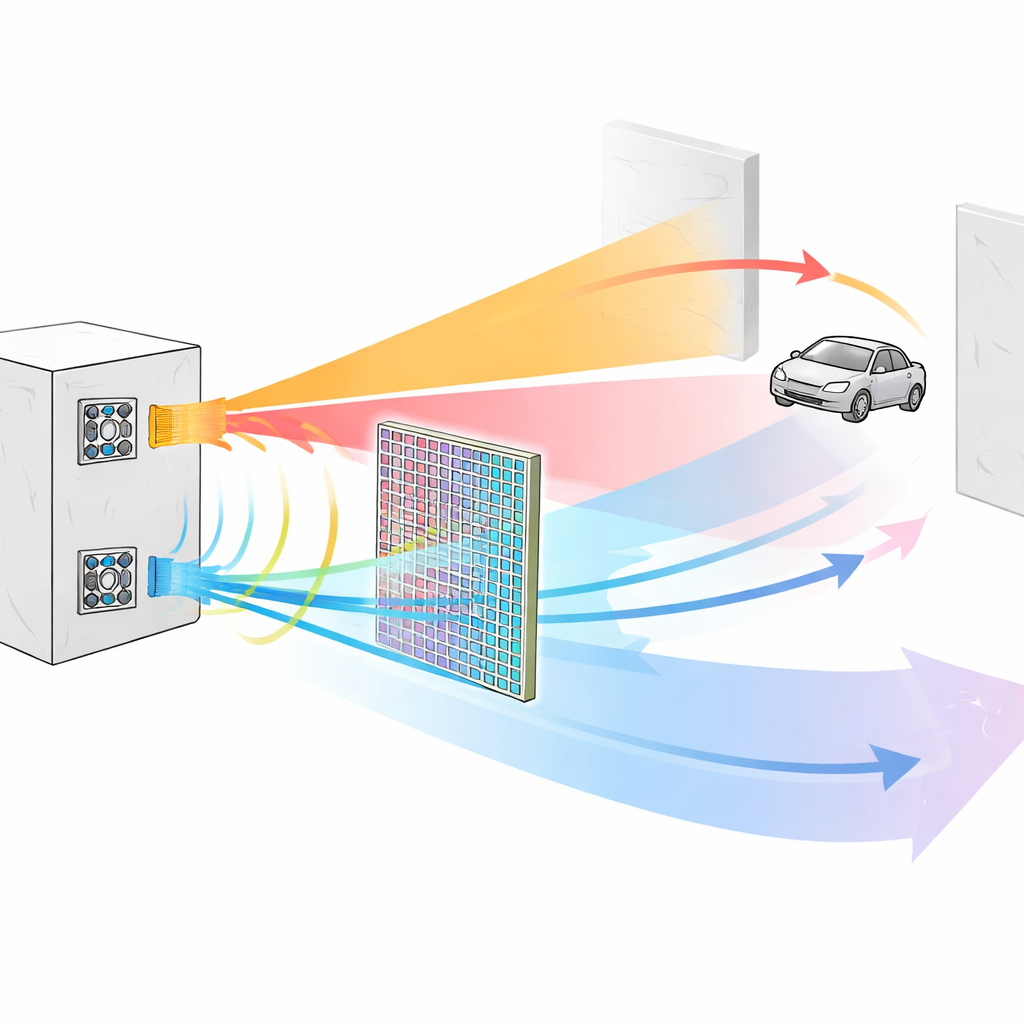
Our phones, cars, and smart homes increasingly rely on antennas that must do two jobs at once: talk to other devices and sense the surrounding world, much like radar. Packing these functions into a single compact box creates a serious problem—strong unwanted signals from the transmitter can drown out the faint echoes the receiver is trying to hear. This paper explores a new way to quiet that self-made noise using a carefully patterned "metasurface" so joint communication-and-sensing systems can operate more cleanly and reliably.
The challenge of talking and listening at the same time
Joint Communication and Sensing (JCAS) systems aim to merge high-speed data links with radar-like awareness in one shared set of antennas. That vision is attractive for applications such as autonomous driving, smart infrastructure, and indoor monitoring, where space and cost are limited. But when transmitting and receiving antennas sit very close together, as in compact multiple-antenna (MIMO) arrays, powerful outgoing signals leak directly into the receiver. This self-interference does not just lower data quality; it also distorts the subtle reflections that sensing depends on. Software-based cancellation methods can help, but over wide frequency ranges they become mathematically heavy and can accidentally distort the useful signals as well.
A patterned surface that tames stray waves
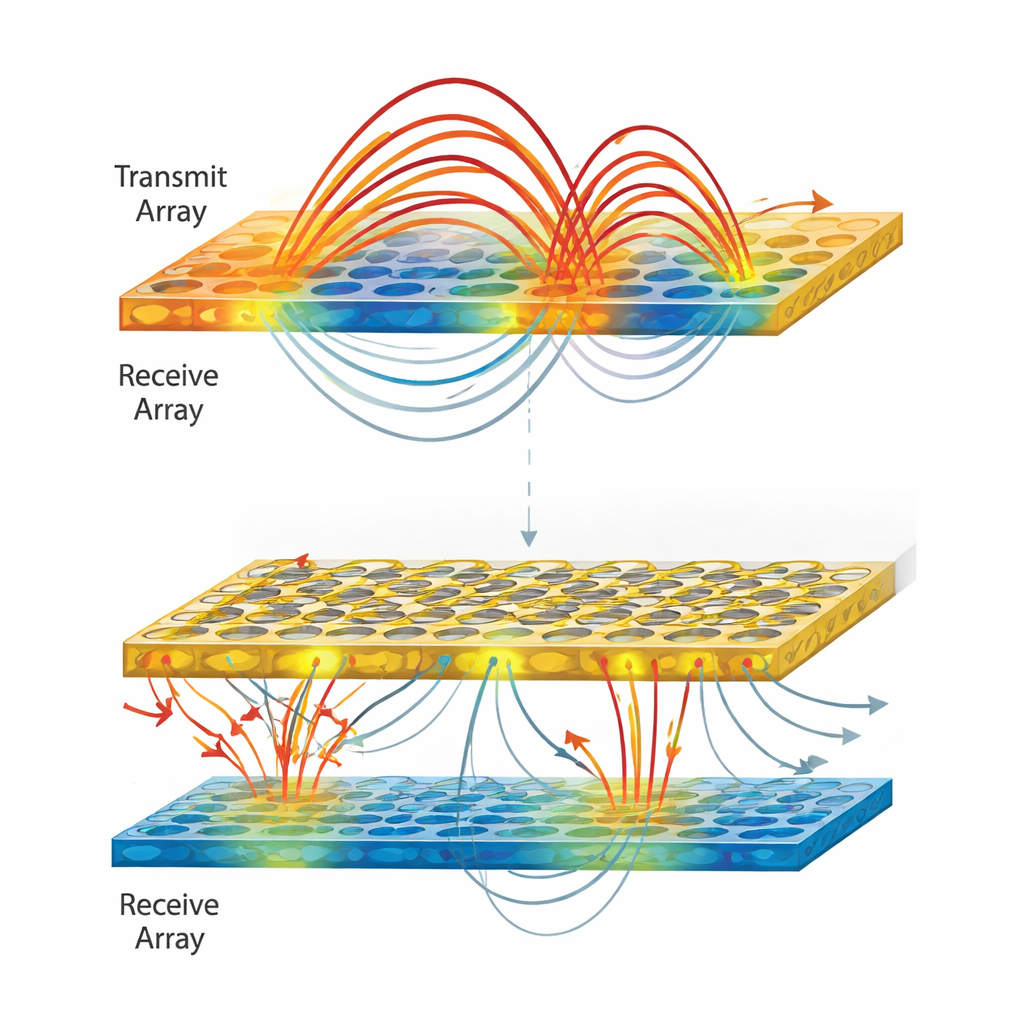
To attack the problem at its root, the authors design a special metasurface that reshapes how electromagnetic energy flows between the transmit and receive arrays. The building blocks of this surface are modified split-ring resonators (MSRRs)—tiny metallic loops with gaps that naturally resonate at chosen microwave frequencies. When waves hit these rings, they set up circulating currents and intense electric fields at the gaps, which rearrange surface currents on the nearby antenna structure. By carefully tuning ring sizes, gap positions, and spacing, the metasurface suppresses the surface waves and near-field “corridors” through which most of the unwanted energy leaks, while leaving the main radiation toward the environment largely intact.
Combining smart hardware with smart beam steering
The work does not stop at the physical structure. The team also pairs the metasurface with a beamforming strategy that further reduces interference. In their JCAS setup, two antennas transmit and two receive, operating continuously in the same 9–10 GHz band. A digital algorithm shapes the outgoing beam so that it both carries data and scans the scene, while also projecting parts of the transmit pattern into directions that naturally cancel the remaining leakage—this is known as null-space projection. Instead of trying to remove interference after the fact, the system is co-designed so that the hardware weakens the coupling channel and the beamforming places deep “holes” in the directions where leakage would still appear.
Putting the design to the test
As a proof of concept, the authors built a 2 × 2 patch antenna array on a common circuit board and mounted a 2 × 3 MSRR metasurface layer just above it. They measured how much power leaked from the transmit ports to the receive ports across frequency and angle, and compared cases with and without the metasurface, and with different beamforming settings. The metasurface alone consistently reduced coupling by several to more than ten decibels across the band, with especially deep notches near certain resonant frequencies. When combined with the tailored beamforming, the effective leakage dropped even further, in some conditions by over twenty decibels, and the resulting signal-to-interference-plus-noise ratio rose by about 10–14 decibels over a wide range of sensing directions. Importantly, the added layer did not spoil the antenna’s basic radiation pattern or diversity performance.
What this means for future smart wireless systems
In simple terms, the study shows that a thin, carefully patterned surface can act as a quieting shield inside compact radios that must talk and listen at the same time. By steering currents and waves at the centimeter scale, the metasurface makes it much harder for the transmitter to overwhelm the receiver, while a coordinated beamforming algorithm exploits this improved channel to squeeze out even more interference. Although the demonstration targets a specific microwave band, the same design principles can be retuned for other frequencies, including future millimeter-wave systems in vehicles and buildings. This hardware–algorithm partnership offers a practical route toward more reliable, interference-resilient devices that seamlessly blend communication and sensing in everyday environments.
Citation: Zhang, Z., Zhang, Z., Ren, Z. et al. Decoupling in a joint communication and sensing system with metasurface. Sci Rep 16, 14526 (2026). https://doi.org/10.1038/s41598-026-44469-6
Keywords: joint communication and sensing, metasurface, MIMO antennas, self-interference reduction, wireless sensing