Clear Sky Science · en
Effects of parasitic capacitance on switching transients and thermal performance in a single-phase SiC power MOSFET inverter
Why tiny electrical quirks matter for clean power
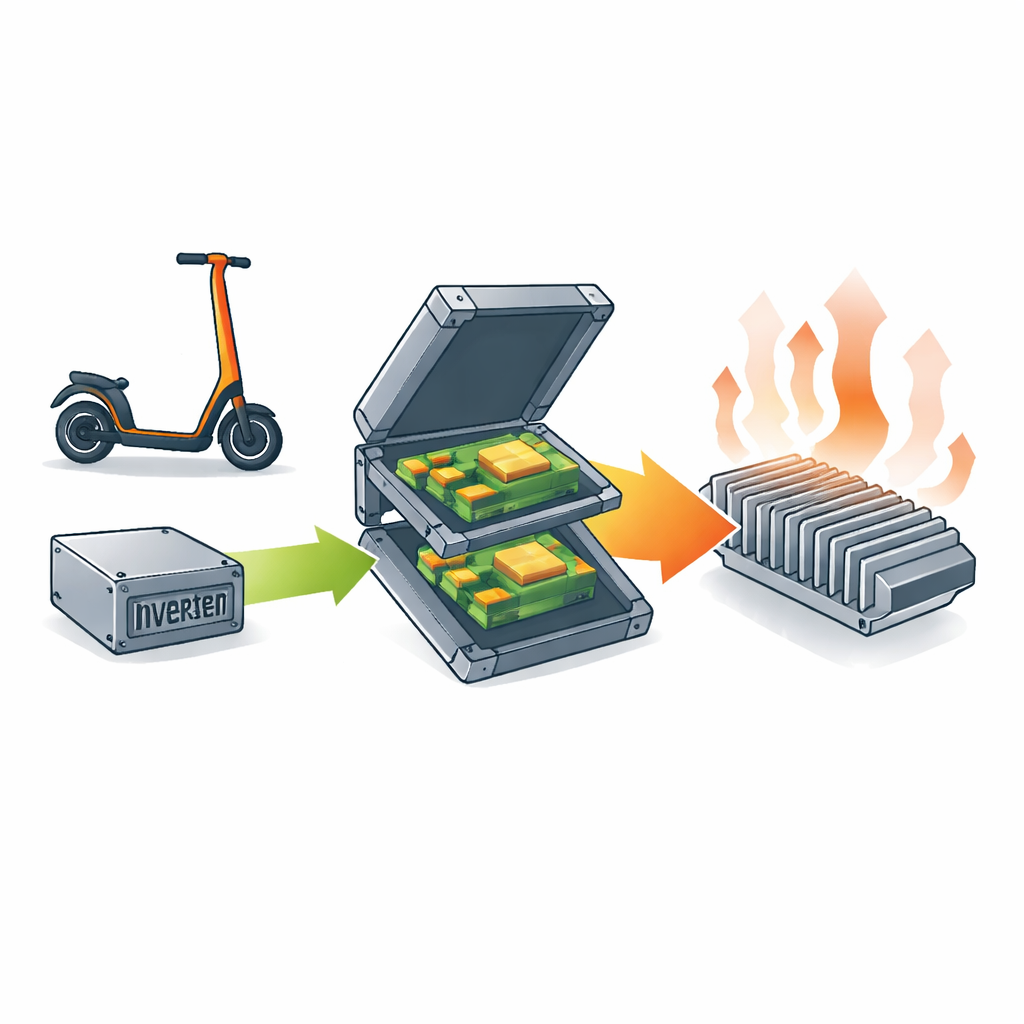
Every electric vehicle, solar inverter, or fast charger quietly relies on power electronics that shuffle energy from one form to another. As engineers push these systems to be smaller, cooler, and more efficient, they increasingly turn to silicon carbide (SiC) switches, which handle high voltages and temperatures better than traditional silicon parts. This study looks at something surprisingly subtle but important inside those SiC switches: hidden capacitances that store and release tiny packets of charge during every on–off event. The work shows how these “parasitic” effects can shape efficiency, electrical noise, and heat, and offers a roadmap for designing more reliable, compact power systems such as electric scooter drives.
New switches for a smaller, cooler future
Modern power systems demand higher switching speeds and compact designs, and SiC transistors have become a key ingredient. Compared with older silicon devices or insulated gate bipolar transistors, SiC switches can turn on and off faster, carry higher voltages, and run at hotter temperatures with lower electrical resistance. That allows smaller cooling systems and filters, which is attractive for applications from solar micro‑inverters to industrial motor drives and light electric vehicles. Yet these advantages come with a trade‑off: when switches operate very quickly, small internal capacitances—regions that momentarily store electric charge—start to dominate behavior, affecting both the quality of the switching waveforms and how much heat is generated inside the module.
Hidden charge and its side effects
Inside each SiC transistor module, three key capacitances play a role: one at the input gate, one between the main terminals, and one that couples the gate and drain together. During each switching event, these capacitances charge and discharge rapidly. If they are not modeled correctly, voltage and current waveforms can overshoot, ring, or linger in inefficient states, increasing both electrical noise and energy loss. The twist is that these capacitances are not fixed: their values change strongly with voltage. Traditional simulations often treat them as constants, which the authors show can dramatically misjudge how much energy is lost during switching and how hot the chip becomes during real‑world operation.
Digital twins for electricity and heat
To tackle this, the researchers built an integrated “digital twin” of a commercial SiC power module and a full single‑phase inverter based on two such modules arranged in an H‑bridge, similar to what might drive an electric scooter motor. Their framework combines a three‑dimensional electromagnetic model of the module’s copper paths and wiring, an equivalent circuit that includes parasitic inductances and capacitances, and a device model that captures how the SiC transistors behave with temperature and voltage. They validated the electrical side using a standard double‑pulse test, which measures real switching waveforms, and the thermal side using a specialized tester that tracks how heat flows from the chip to the case. In both cases, simulated and measured results matched closely, confirming that the model could reliably predict both electrical transients and temperature rise.
Which tiny effect matters most?
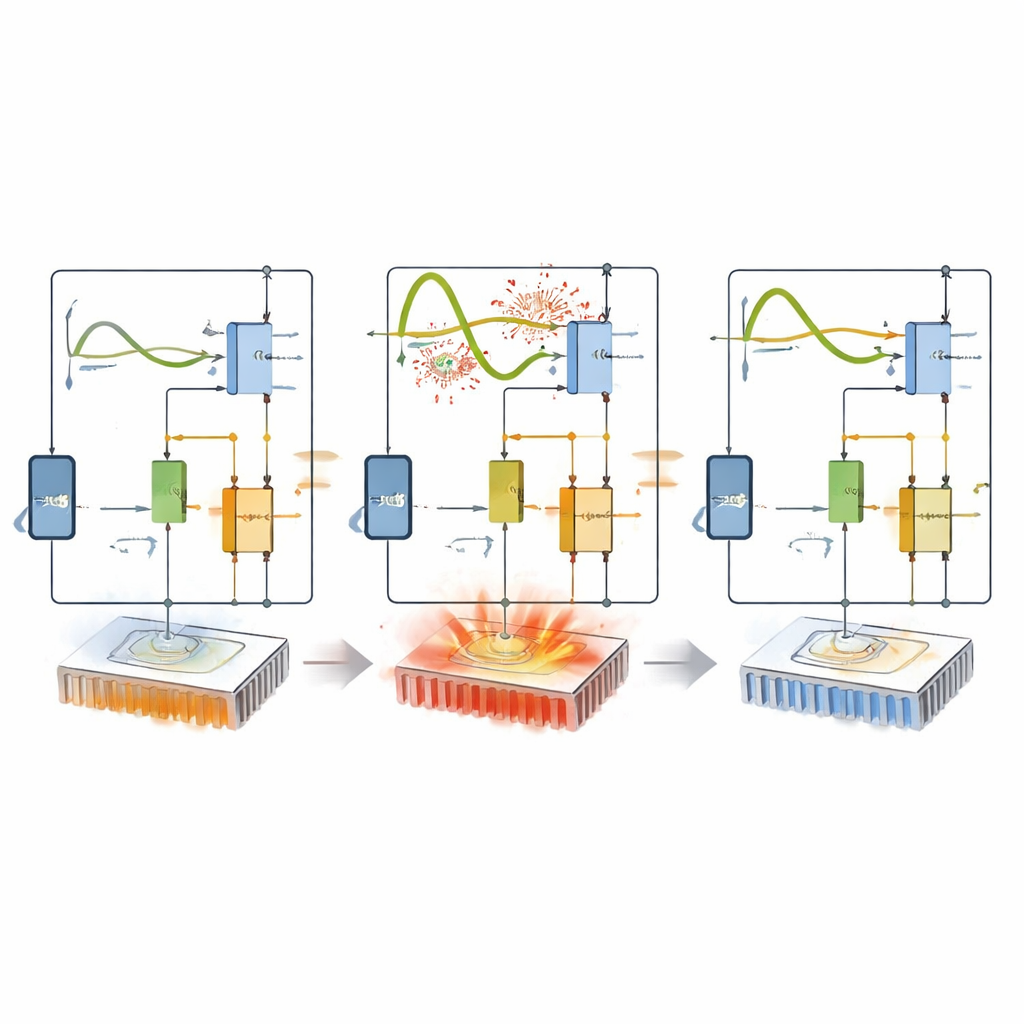
With the validated model in hand, the team explored how changing each parasitic capacitance affects switching and heat in the inverter. They found that the capacitance linking gate and drain has the strongest influence: increasing it stretches a critical “plateau” in the gate voltage where the device carries high current and voltage at the same time, directly raising switching losses and chip temperature. The input capacitance mainly shifts when switching begins and ends, slightly slowing or speeding the edges, while the output capacitance mostly changes the frequency of oscillations without greatly altering total energy loss. At the system level, they also examined the impact of gate resistance, switching frequency, and DC bus voltage, showing how faster operation and higher voltage quickly push switching and diode‑related losses to dominate over simple conduction losses. Thermal simulations revealed that airflow over the heatsink can lower the maximum chip temperature by more than 10 degrees Celsius, underscoring the importance of cooling design.
Design lessons for future electric drives
For non‑specialists, the main message is that in high‑performance power electronics, very small internal effects can have large real‑world consequences. By accurately capturing how hidden capacitances behave as voltage changes, engineers can better predict how much energy is wasted in each switching event and how hot the chips will run over time. This study shows that paying special attention to the gate‑drain coupling capacitance, along with smart choices in switching speed, voltage, and cooling, can significantly improve the efficiency and reliability of SiC‑based inverters. Those improvements ultimately translate into more compact, longer‑lasting power converters for applications like electric scooters, renewable energy systems, and industrial drives.
Citation: Cheng, HC., Jhu, WY., Liu, YC. et al. Effects of parasitic capacitance on switching transients and thermal performance in a single-phase SiC power MOSFET inverter. Sci Rep 16, 13537 (2026). https://doi.org/10.1038/s41598-026-44458-9
Keywords: silicon carbide inverter, power electronics thermal, parasitic capacitance, high frequency switching, electric vehicle drive