Clear Sky Science · en
A multifunctional bi-anisotropic metasurface with reflection-transmission polarization conversion and narrow bandpass transmission characteristics
Shaping Radio Waves on a Sheet
As our world fills with wireless devices, engineers need new ways to steer, filter, and quiet radio waves without bulky hardware. This paper presents an ultra-thin engineered surface—a “metasurface” only a few millimeters thick—that can both pick out a narrow slice of frequencies to let through and twist the polarization of unwanted signals. Such control can help antennas talk more clearly while making them less visible to radar.
A Smart Wallpaper for Microwaves
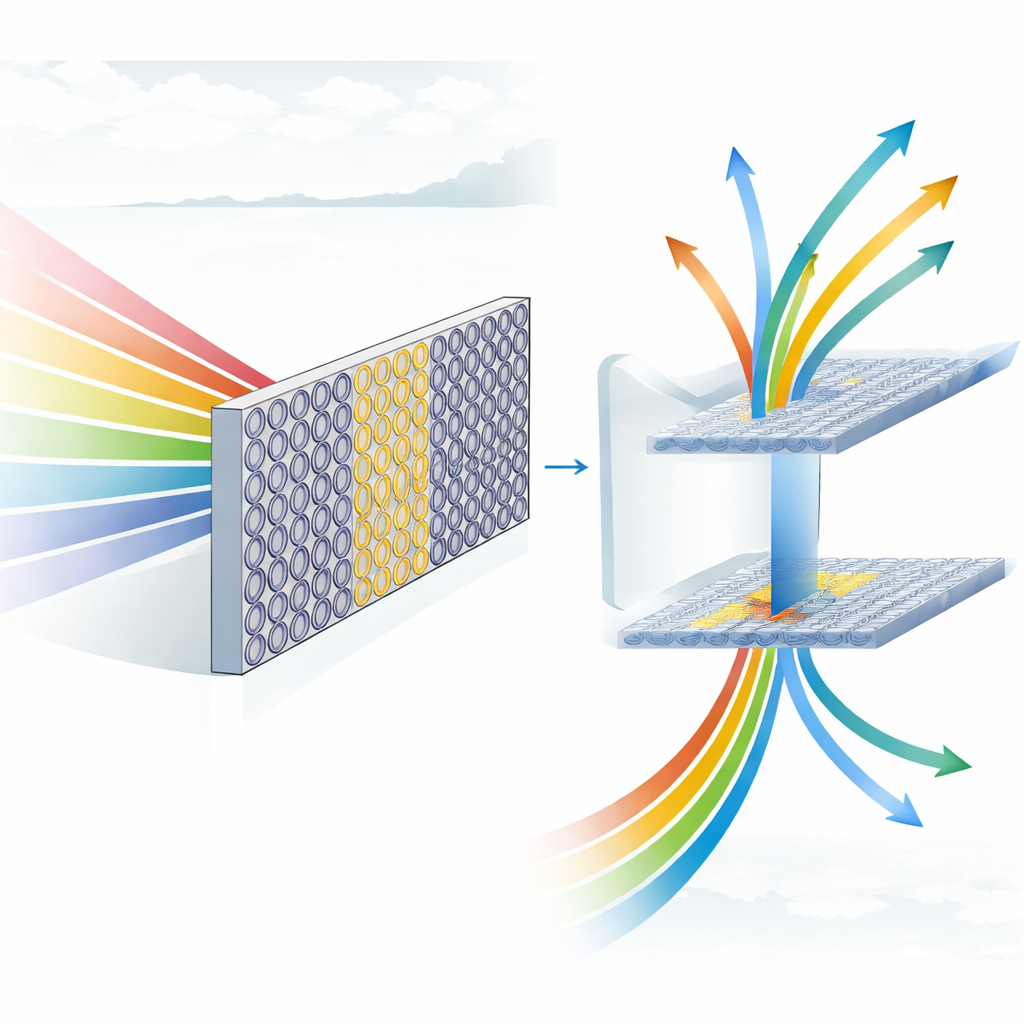
The authors design a special patterned metal-and-dielectric sheet that acts like smart wallpaper for microwaves. Instead of relying on traditional, three-dimensional components, they arrange tiny repeating shapes on flat circuit-board material. When a radio wave hits this patterned surface, the detailed geometry of rings, crosses, and gaps determines which frequencies are passed, which are reflected, and how the wave’s polarization—its direction of electric-field vibration—is rotated. The goal is to combine several functions that usually need multiple devices: a clean frequency “window” for desired signals, strong rejection outside that window, and controlled changes in polarization that can reduce interference and scattering.
Combining Two Clever Layers
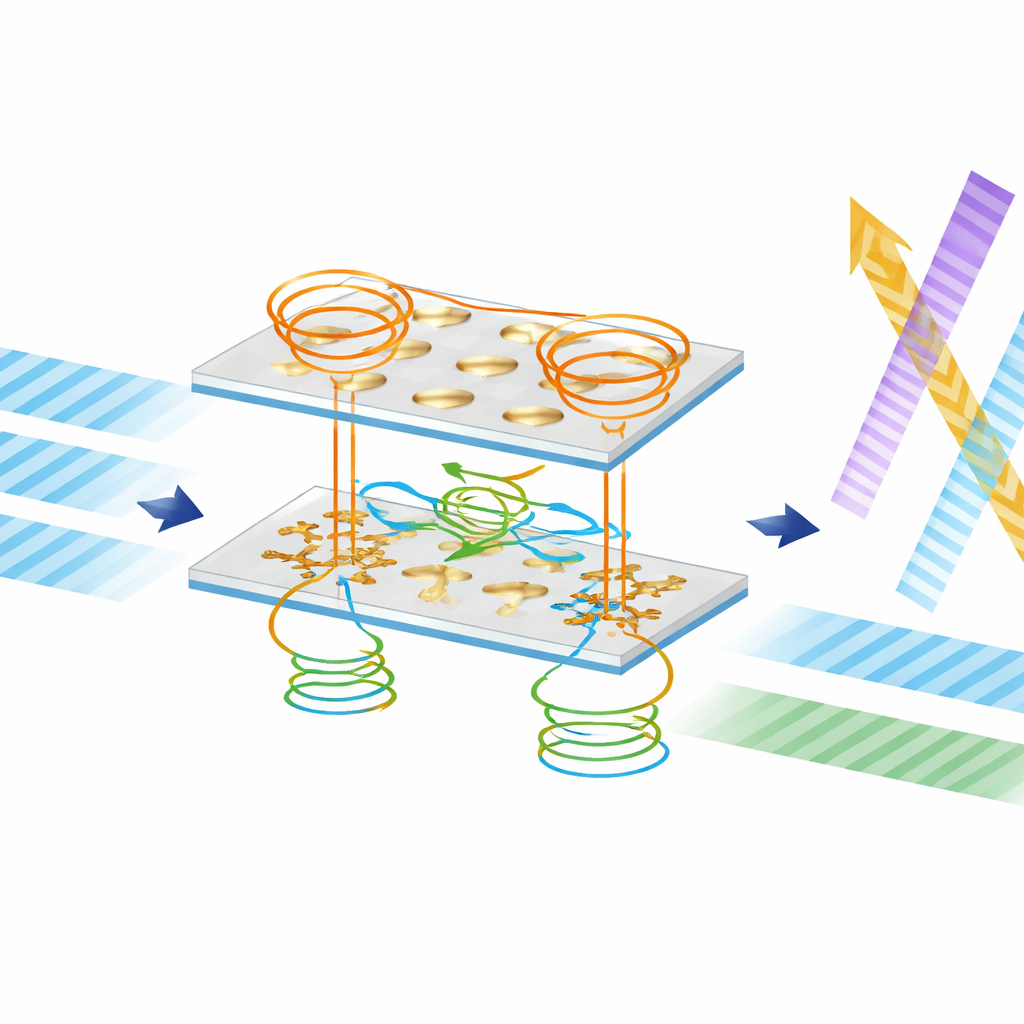
The metasurface is built from two cooperating layers. The top layer is a polarization-converting pattern made of square and circular rings with small diagonal cuts and an angled metal strip. This layer is designed so that, over a wide range of frequencies, incoming linearly polarized waves are reflected with their polarization direction rotated by ninety degrees, or even converted into circular polarization at certain bands. The bottom layer, etched into what would normally be a solid metal ground, is a cross-shaped structure that behaves like a bandpass filter: it strongly reflects most frequencies but allows a narrow band around 15.5 GHz to pass with very little loss. By stacking these layers at a carefully chosen spacing, the structure can both filter and reshape waves in a coordinated way.
Different Behavior from Each Side
One striking feature is that the surface behaves differently depending on which side the wave comes from, while keeping the transmitted signal essentially the same. For waves arriving from the “front” side, the surface reflects two broad frequency bands as waves with rotated or circular polarization, while a narrow band in between slips through almost unaffected. The authors also observe partial cross-polarized transmission at two nearby frequencies, a result of a cavity-like interaction between the layers. When waves arrive from the “back” side, the surface still provides the same narrow transmission window and partial cross-polarized transmission, but now behaves mainly as a simple partial reflector outside that window, with little polarization twisting. This asymmetric reflection yet symmetric transmission is a hallmark of what physicists call a bi-anisotropic omega surface.
From Computer Model to Real Hardware
To verify that the concept works beyond simulation, the team built a prototype panel made of 17 by 29 repeating cells on standard low-loss circuit material. In an anechoic chamber, they illuminated this metasurface with horn antennas and measured how much of the signal was reflected and transmitted, and in which polarization state, for both front and back illumination. The measurements matched the computer predictions closely: a narrow, low-loss transmission band appeared between two strong polarization-converting reflection bands from the front, and the same transmission window with simple partial reflection from the back. They also explored what happens when waves strike at an angle and found that performance remains good near normal incidence but gradually degrades at higher angles, suggesting a future path to improve angular robustness through further miniaturization.
Why This Matters for Future Antennas
In plain terms, this metasurface acts like a very thin, passive gatekeeper that treats in-band and out-of-band signals differently in both direction and polarization, without resorting to active electronics or power-hungry resistive layers. It can let a desired channel pass to an antenna while flipping or reflecting unwanted frequencies in ways that reduce interference and radar visibility. Because it packs multiple roles—filtering, polarization conversion, and partial reflection—into a single compact sheet, it offers a promising building block for next-generation communication systems, radar radomes, and platforms where many antennas must coexist without disturbing each other.
Citation: Nasir, M., Koziel, S. & Pietrenko-Dabrowska, A. A multifunctional bi-anisotropic metasurface with reflection-transmission polarization conversion and narrow bandpass transmission characteristics. Sci Rep 16, 13838 (2026). https://doi.org/10.1038/s41598-026-44437-0
Keywords: metasurface, polarization conversion, bandpass filter, frequency selective surface, radar cross section reduction