Clear Sky Science · en
Replicated urban mosaics reveal trait- and species-specific shifts in carotenoid and structural plumage colouration of two passerines
City Life and Bird Colors
City parks and forest edges may look full of familiar birds, but a closer look reveals that urban living can subtly change their feathers. This study asked a simple question with far-reaching implications: do cities change how brightly common songbirds are colored, and does this happen in the same way for different species and different types of feather color? Because plumage is important for staying warm, hiding from predators, and attracting mates, even small shifts in color can reshape how birds survive and reproduce in our increasingly urban world.
Two Common Birds, Many Kinds of Color
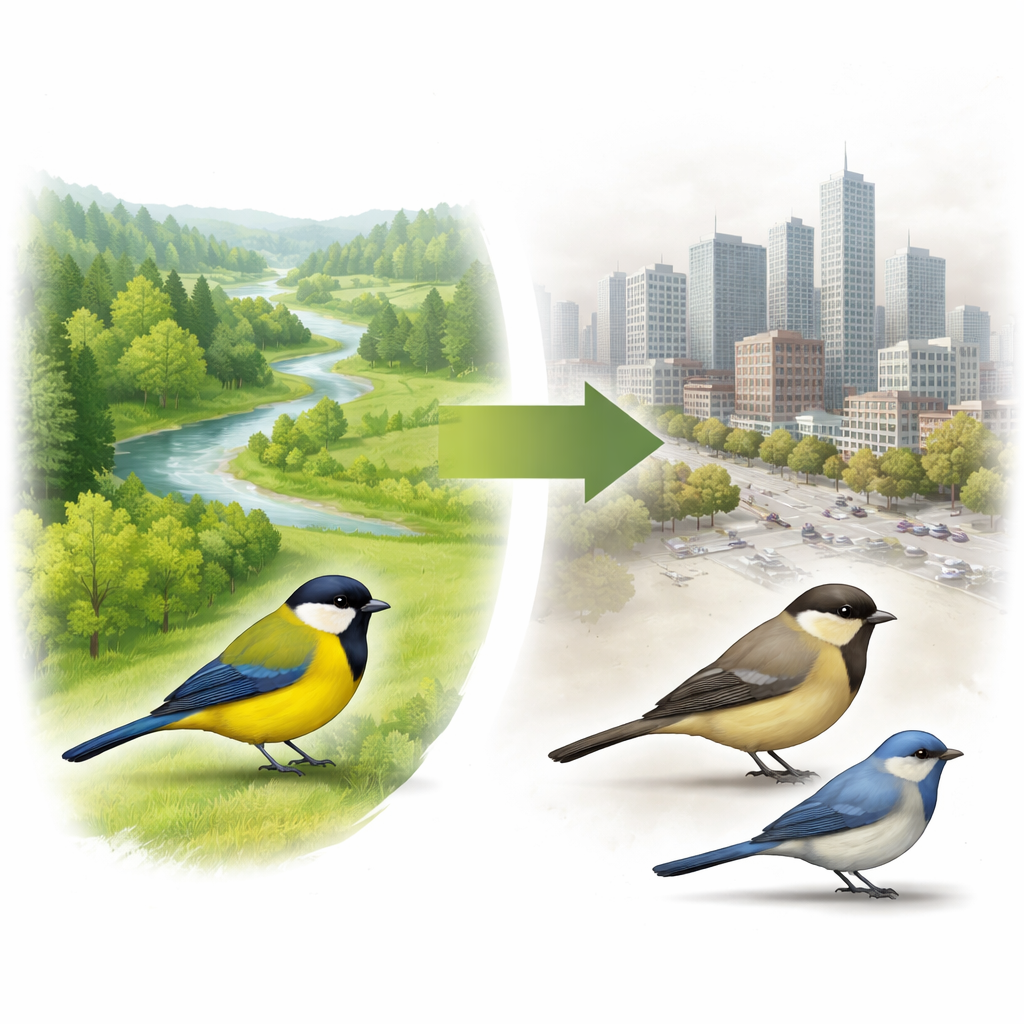
The researchers focused on two widespread European garden birds: the great tit and the blue tit. Both species have bright yellow breasts colored by carotenoids, pigments they must obtain from their insect-rich diets. Great tits also have dark, melanin-based markings, such as the black chest stripe, while blue tits carry shimmering blue tones created by microscopic structures in their feathers rather than by pigment alone. These different color mechanisms—pigment-based and structure-based—can respond very differently to diet, pollution, and stress, making the two species an ideal pair for comparison.
A Natural Experiment Across Polish Cities
To capture how city landscapes shape bird plumage, the team sampled 309 birds along urban–forest gradients in eight Polish cities. They caught birds in five habitat types ranging from dense forests and leafy river corridors to urban parks, housing estates, and busy city centers. Around each site, they measured how much of the ground was sealed by concrete or asphalt and how much was covered by trees. Using precise optical instruments, they then quantified the brightness and color quality of breast, wing, and tail feathers, and also measured the area of the black chest stripe in great tits. This design allowed them to test not only whether average color changed with urbanization, but also whether the range of variation within populations shifted.
City Birds Are Duller—but Not All in the Same Way
In great tits, the classic "urban dullness" pattern emerged clearly: birds from more urbanized, less tree-covered areas had less intense yellow on their breasts, indicating reduced carotenoid content. Interestingly, their feather brightness and melanin-based traits—such as the black tie and dark wings and tail—did not change with urbanization, suggesting that diet and pigment availability, rather than overall feather quality or dark pigment production, were the main drivers. At the same time, the spread of yellow intensity among individual great tits grew larger in cities, pointing to greater differences between neighbors, likely caused by patchy green spaces and uneven access to caterpillar-rich food.
A Different Response in Blue Tits
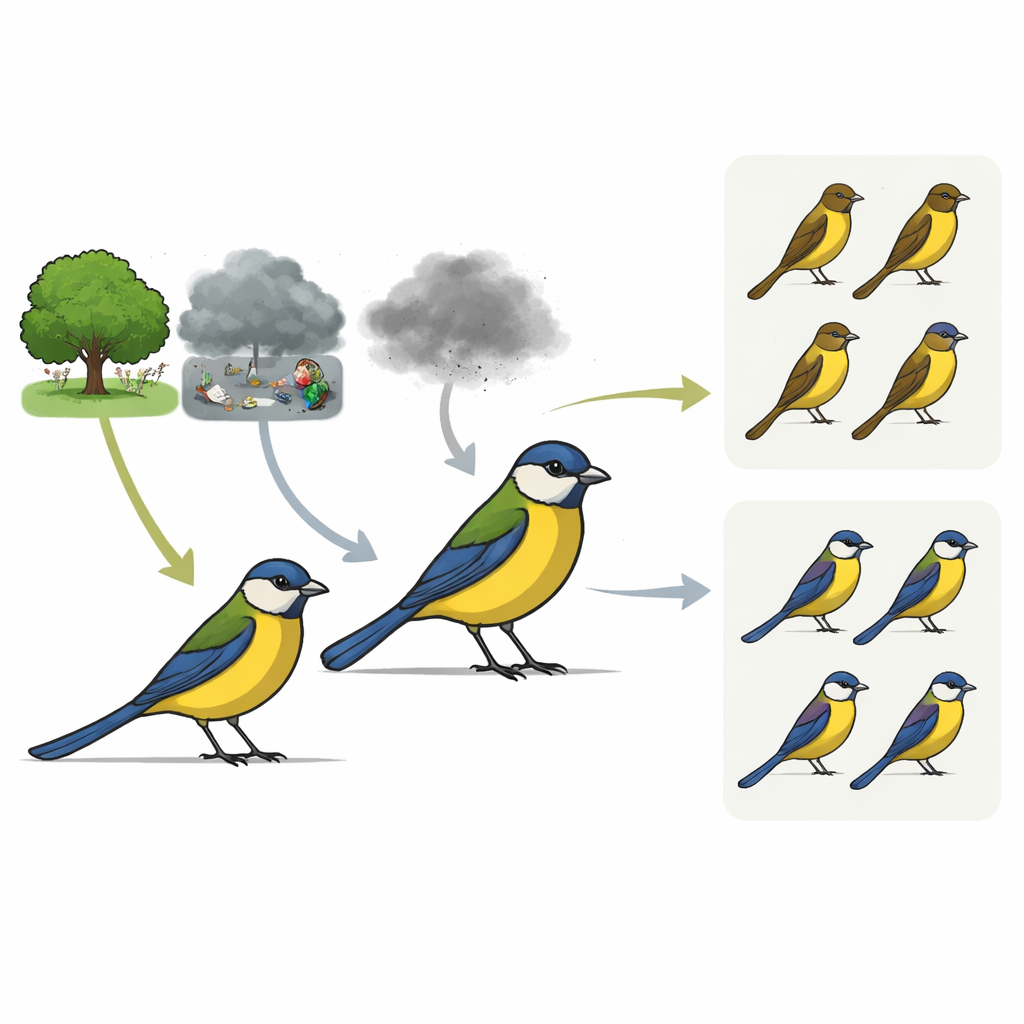
Blue tits told a different story. Their yellow breasts did not become less saturated in more urban settings, even though the same carotenoid pigments are involved. However, the brightness of their yellow breast feathers tended to decline toward city centers, hinting at changes in feather structure or condition rather than pigment content alone. In contrast, their structurally colored blue tail feathers actually became brighter in more urban habitats. This unexpected pattern may reflect easier access to human-provided food during feather growth or reduced wear on tail feathers in less densely vegetated areas. Age and sex also influenced some of these structural color traits, suggesting that city life can blur or reshape the usual visual differences between young and old birds.
What These Color Shifts Mean for City Wildlife
Overall, the study shows that urbanization does not impose a single, uniform effect on bird colors. Even two closely related species, living side by side, can respond very differently depending on how their colors are produced and how they use city resources. For great tits, cities mean paler, more variable yellow signals, which could alter mate choice and competition. For blue tits, cities mainly change how bright their feathers appear, especially in structurally colored tails. These findings suggest that as cities expand, they may quietly reshape the visual signals that birds rely on, with consequences for mating, social interactions, and long-term evolution. They also caution against assuming that results from one species automatically apply to others, even when they look and live much the same.
Citation: Janas, K., Chatelain, M., Corsini, M. et al. Replicated urban mosaics reveal trait- and species-specific shifts in carotenoid and structural plumage colouration of two passerines. Sci Rep 16, 14132 (2026). https://doi.org/10.1038/s41598-026-44382-y
Keywords: urbanization, bird plumage, great tit, blue tit, urban ecology