Clear Sky Science · en
Multi-omics analysis of associations between host demographics and saliva metabolome, sugar profiles, and microbiome profiles
Why Spit Can Tell a Story About You
Most of us think of saliva as something we barely notice—until we are too nervous to speak or the dentist asks for a sample. But this everyday fluid is packed with chemicals and microbes that quietly mirror what is happening in our bodies. This study shows that a simple spit sample carries a surprisingly rich fingerprint of who we are, especially our age and, to a lesser extent, our sex. That finding could help turn saliva into an easy, painless source of health clues, much like a blood test but far more convenient.

Looking Closely at Spit
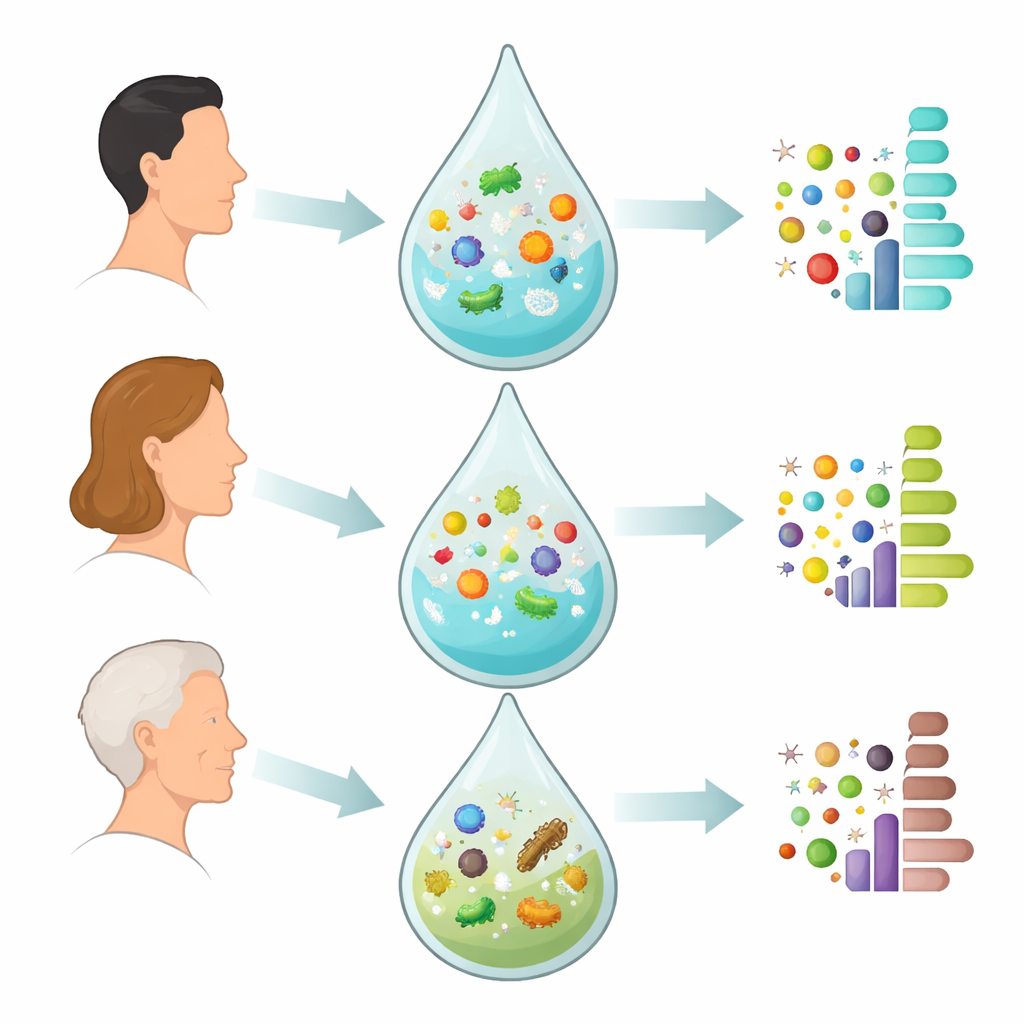
The researchers collected stimulated saliva—produced while chewing—from 423 healthy volunteers in northern Sweden, ranging in age from 16 to 79 years. They then examined saliva from three different angles. First, they used advanced chemistry tools to scan thousands of small molecules, such as nutrients, breakdown products from food and drugs, and compounds made by our own cells. Second, they measured dozens of different sugars and related molecules. Third, they mapped out the community of bacteria living in the mouth with high-resolution DNA sequencing. Together, these three layers of information created a multi-dimensional picture of what saliva contains and how it varies from person to person.
Age Leaves the Strongest Mark
When the team asked which basic traits—age, sex, or body weight—best explained differences in saliva, age clearly came out on top. Statistical models showed that age could account for as much as 30 percent of the variation in certain small molecules, about 17 percent in sugars, and up to 25 percent in bacterial species. With the help of machine-learning methods, the overall pattern of molecules in saliva predicted a person’s age with fairly high accuracy, while sex could be guessed moderately well. Body mass index, a measure of body weight relative to height, had surprisingly little impact, suggesting that being heavier or lighter did not leave a strong signature in saliva in this generally healthy group.
What Changes With Age and Sex
Diving deeper, the scientists found that specific molecules and microbes tracked with age. Older adults tended to have higher levels of caffeine and related breakdown products, as well as the coffee compound trigonelline, partly reflecting greater coffee intake. They also had more of certain bacterial by-products linked to gum disease. Younger participants, in contrast, showed higher amounts of urocanic acid, a molecule tied to immune responses, and more sugars such as glucose and trehalose. Their mouths were richer in bacteria that thrive on sugar and tolerate oxygen, some of which are associated with tooth decay. With increasing age, the balance shifted toward bacteria that prefer oxygen-poor niches and have been linked to gum problems. Sex differences were more subtle but still noticeable: for example, some energy-related molecules and sugars were more common in men, while certain cosmetic-related compounds and sugar derivatives appeared more often in women.
How Microbes and Sugars Interact
Because the team measured sugars and bacteria in the same people, they could look at how these two worlds interact. They found strong links between several common mouth bacteria—especially species of Streptococcus, Prevotella, and Veillonella—and particular sugars. Some groups of bacteria shared similar sugar patterns, hinting that they may feed on the same resources or form tiny food chains where one species’ waste becomes another’s meal. Other closely related species showed opposite sugar relationships, underscoring that even bacteria from the same family can play very different roles. These patterns suggest that as people age, not only do the types of microbes in saliva shift, but the way they process sugars and other nutrients may change as well.
What This Means for Future Health Checks
Overall, the study shows that saliva carries a detailed snapshot of our biology that changes in predictable ways with age and, to a lesser degree, with sex. In contrast, body weight left only a faint trace. This matters because scientists and clinicians are increasingly interested in using saliva to spot early signs of disease or monitor lifestyle factors such as diet, tobacco use, or medication. The results suggest that any saliva-based test must take basic demographics into account, especially age, to avoid confusing normal differences with signs of illness. While combining many types of saliva data offered only a small boost in prediction power, it provided a clearer view of how microbes, sugars, and other molecules fit together. As tools improve and more studies add dental exams and long-term follow-up, spit samples may become a standard, painless window into both oral and overall health.
Citation: Noerman, S., Esberg, A., Mack, C.I. et al. Multi-omics analysis of associations between host demographics and saliva metabolome, sugar profiles, and microbiome profiles. Sci Rep 16, 10494 (2026). https://doi.org/10.1038/s41598-026-44287-w
Keywords: saliva biomarkers, oral microbiome, metabolomics, aging and health, noninvasive testing