Clear Sky Science · en
Development and validation of a stability-indicating high-performance liquid chromatography method for iomeprol
Why this matters for medical scans
Many people undergo CT scans or angiography with a contrast dye that makes blood vessels and organs show up clearly. One such dye, iomeprol, is widely used but can sometimes trigger unwanted reactions. This study explains how scientists built a careful laboratory test to check that iomeprol products are pure and stable, keeping harmful byproducts at very low levels and helping to make imaging procedures safer.
The role of a common contrast dye
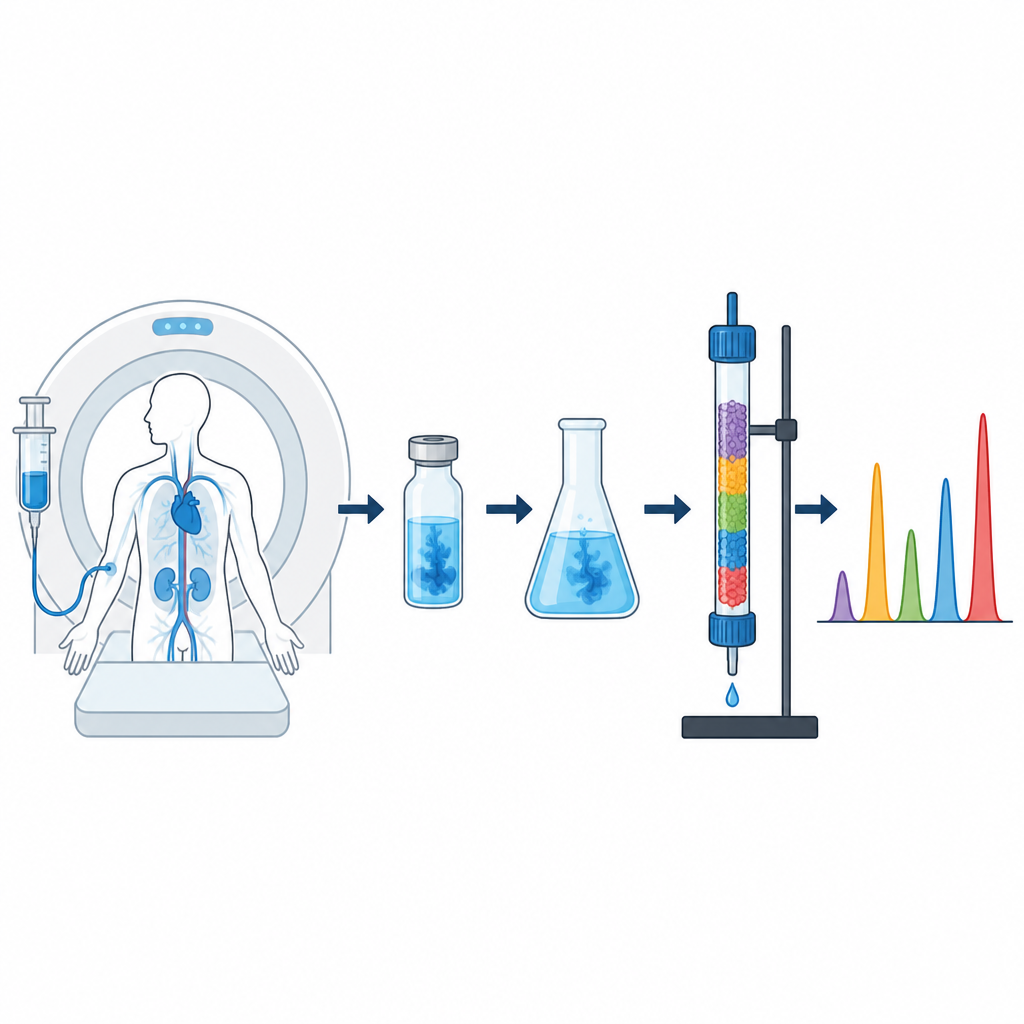
Iomeprol is a non-ionic, low osmolar contrast agent used in CT scans, angiography, kidney imaging and heart vessel exams. It works by strongly blocking X rays so that structures filled with the dye stand out on images. Because it is used in huge quantities worldwide and at very high concentration in each bottle, even tiny amounts of unwanted impurities can matter. Studies involving more than a million patients show that iomeprol is associated with a higher rate of acute reactions than some similar dyes, including allergy-like symptoms and rare but serious anaphylaxis. Parts of its chemical structure, particularly a carbamoyl side chain that is also present in its impurities, are suspected of making immune reactions more likely, so keeping impurity levels tightly controlled is a key safety goal.
Why existing tests were not enough
Earlier laboratory methods to check iomeprol quality relied on advanced tools such as liquid chromatography coupled to mass spectrometry or specialized fast chromatography systems. While powerful, these approaches had drawbacks for routine quality control in drug factories and hospitals. They often separated only a few known impurities, showed noisy or distorted signals, and required costly instruments, complex operation and intensive maintenance. Some methods could measure only the main drug without clearly distinguishing impurity peaks. This left manufacturers without a simple, affordable test that could reliably track both iomeprol and all of its related impurities in everyday production.
Building a clearer chemical fingerprint
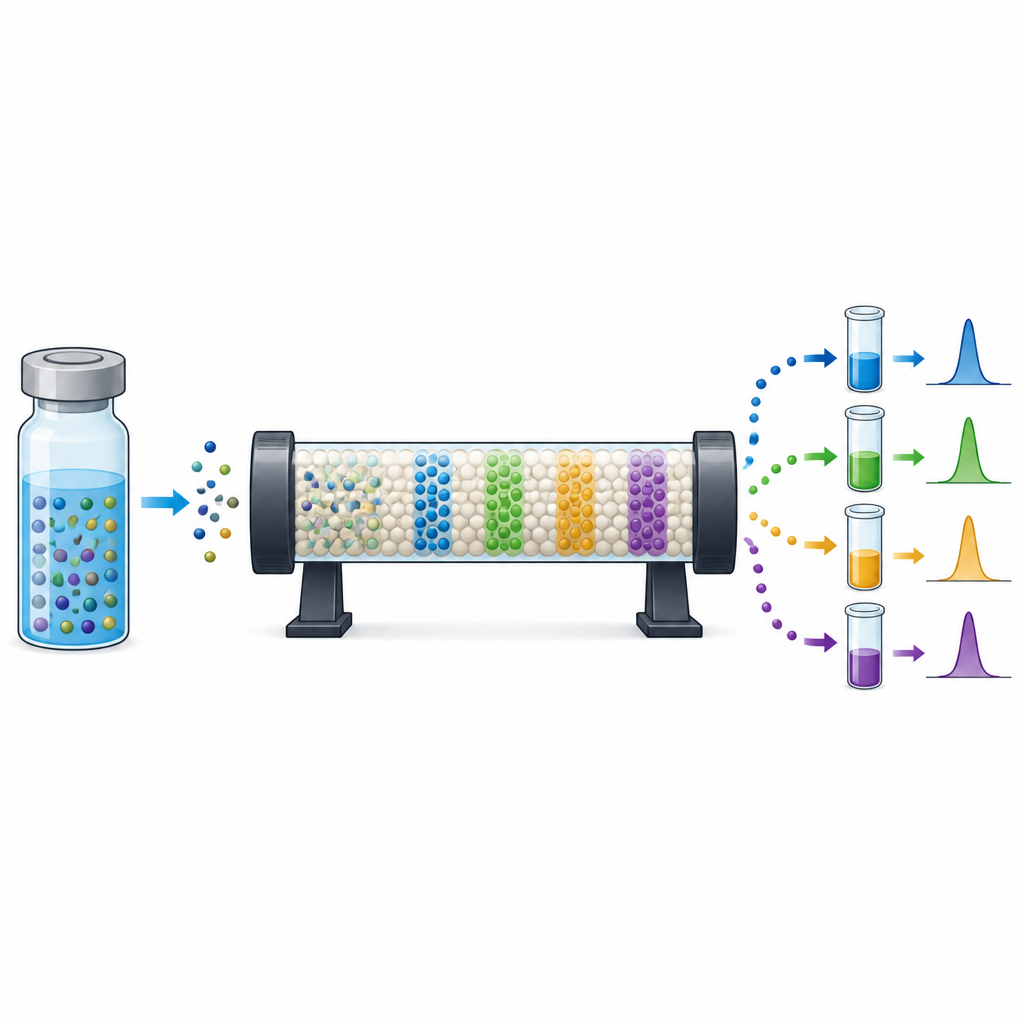
The researchers designed a new test based on reversed phase high performance liquid chromatography, a widely available technique that separates molecules as they travel through a packed column. They carefully chose the column type, temperature and a flowing mixture of water, phosphate salt, acetonitrile and a small amount of 2-butanol. The added 2-butanol was crucial for teasing apart one stubborn impurity from the main drug without needing very high temperatures that can damage columns. With this setup, the method cleanly separated iomeprol from five known impurities and additional unknown breakdown products, producing sharp, stable peaks that could be measured precisely at a single ultraviolet wavelength.
Putting the method to the test
To prove that the method is reliable, the team followed international guidelines for analytical method validation. They showed that blank solutions and formulation ingredients did not interfere with the drug or impurity signals, and that the relationship between concentration and signal was straight over a wide range. The smallest detectable impurity levels were a few ten-thousandths of the sample concentration, and repeated measurements varied by less than two percent. By deliberately stressing the drug with acid, base, heat, light and oxidizing agents, they forced it to degrade and confirmed that all new products were still separated from the main peak. These trials revealed that iomeprol breaks down most easily in alkaline conditions and is mildly sensitive to light, but remains stable under mild acid, gentle heat and controlled oxidation when kept near neutral pH.
What this means for patient safety
The new test gives manufacturers and regulators a practical, sensitive tool to monitor the purity and stability of iomeprol throughout its life, from raw material to finished injection. Because it relies on standard HPLC equipment and simple sample dilution, it can be adopted widely without massive investment. The method pinpoints how pH and light exposure affect iomeprol, guiding better formulation and packaging choices to keep degradation low. For patients, this work does not change how scans feel, but it supports more consistent quality checks behind the scenes, helping make contrast enhanced imaging safer and more dependable.
Citation: Lou, T., He, J., Wu, G. et al. Development and validation of a stability-indicating high-performance liquid chromatography method for iomeprol. Sci Rep 16, 15200 (2026). https://doi.org/10.1038/s41598-026-44276-z
Keywords: iomeprol, contrast agent, HPLC, drug impurities, stability testing