Clear Sky Science · en
Ghost-peak-based estimation of modulation amplitude in optical correlation-domain reflectometry
Sharper Maps for the Internet’s Hidden Highways
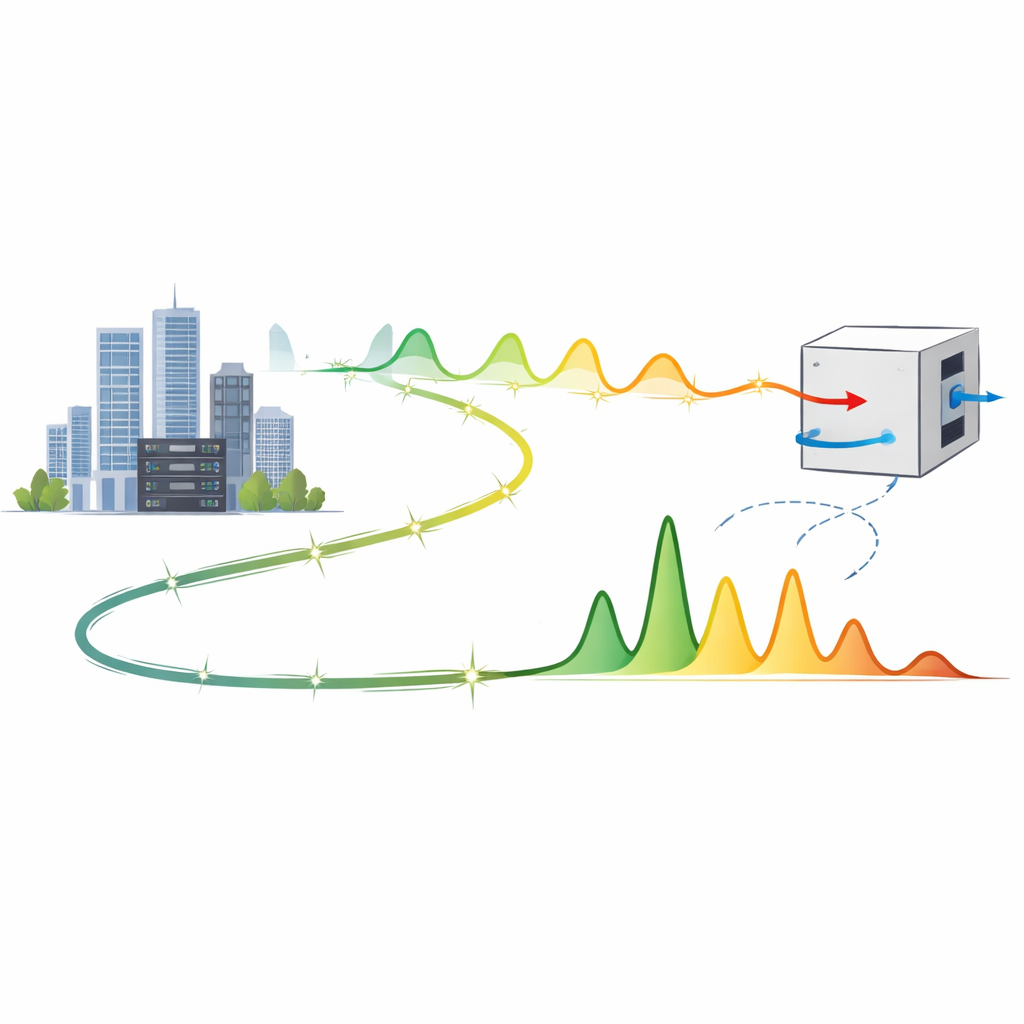
Every video call, movie stream, and cloud backup depends on hair-thin glass fibers that crisscross the planet. To keep these invisible highways healthy, engineers need ways to "see" inside them—spotting tiny defects or losses before they cause outages. This study introduces a clever trick that makes one such inspection method both simpler and more accurate, by turning what were once nuisance signals—so‑called ghost peaks—into a built‑in measuring tool.
How We Look Inside Glass Fibers Today
Optical fibers can stretch for many kilometers, and checking their condition is not as easy as just looking at them. Engineers send light down the fiber and analyze what comes back, using specialized techniques called reflectometries. One popular approach, optical correlation‑domain reflectometry (OCDR), balances several practical needs at once: it can cover useful distances, offer fine detail on where reflections occur, work in real time, and avoid very expensive hardware. In OCDR, the key to how sharply we can locate a fault—its spatial resolution—is how strongly the frequency of the laser is wiggled, a quantity called the modulation amplitude. Knowing this amplitude accurately is essential, but until now it typically required extra instruments and separate calibration steps.
Turning Extra Hardware into Simple Mathematics
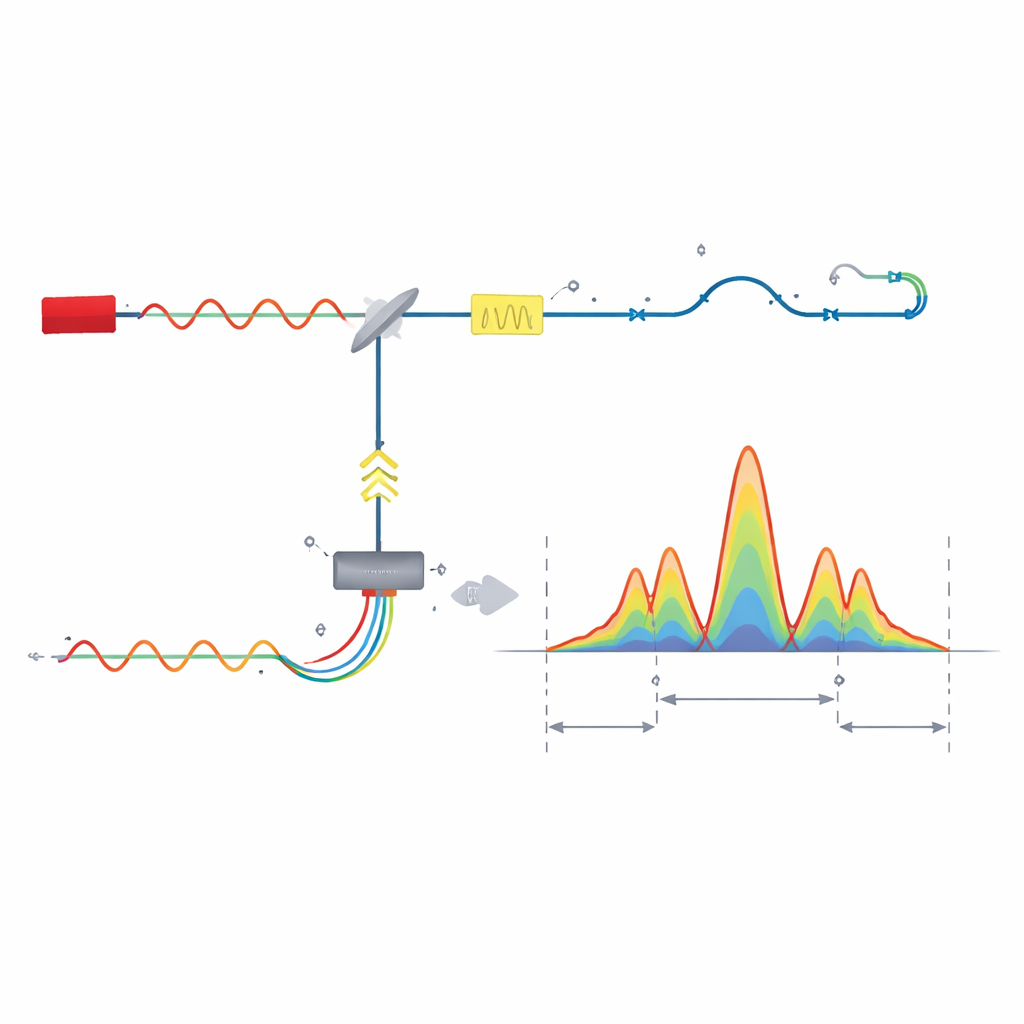
Traditionally, researchers measured the modulation amplitude using separate spectrum analyzers and an additional detection setup. These add cost, bulk, and complexity, and they often force users to pause measurements and rewire equipment. The new method keeps everything inside the existing OCDR system. A small device called an acousto‑optic modulator slightly shifts the frequency of the light in one arm of the setup—a routine step already used to push signals away from low‑frequency noise. The authors show that this shift naturally produces faint secondary features in the measurement trace, the ghost peaks, and that the spacing between the main peak and these ghosts is directly tied to the modulation amplitude through a simple formula.
Listening Carefully to the Ghosts
In practice, the researchers swept the modulation frequency while monitoring reflections from a known point in the fiber. They then pinpointed the locations of the main reflection peak and its neighboring ghost peaks in the OCDR readout. By plugging the measured separation into their analytic expression, they could calculate the modulation amplitude without touching the analyzer settings or adding new instruments. To check accuracy, they compared these values with a conventional heterodyne method that examines the beat between two lasers on a separate analyzer. Across a wide range of modulation frequencies, the ghost‑based estimates matched the reference values to within 1.4 percent, and an approximate version of their formula was even closer—within about 0.015 percent.
Robust Across Noise, Settings, and Hardware
A key question is whether this approach only works in ideal lab conditions. The team therefore pushed the method in several directions. They gradually weakened the reflected signal to see when noise would obscure the ghost peaks, and defined a simple contrast measure to describe how visible the ghosts were above the surrounding trace. The method remained reliable as long as the ghost peak stood just a fraction of a decibel above the local dip in the signal. They also varied analyzer settings, repeated measurements many times, changed how strongly they modulated the laser, swapped in a different fiber sample, and even replaced the laser diode with another unit of the same type. In all cases, the estimated modulation amplitudes stayed consistent, and the remaining uncertainty mainly came from how finely the peak positions could be picked.
Why This Matters for Future Fiber Monitoring
By turning ghost peaks from a side effect into a measuring stick, this work lets OCDR systems calibrate themselves on the fly. Users gain accurate control over spatial resolution without relying on bulky, expensive extras or tedious reconfiguration. That makes it easier to build compact, stable, and easily calibrated monitoring tools for optical networks—tools that could be deployed more widely in data centers, long‑haul links, and sensing applications. For the non‑specialist, the takeaway is that the study finds a smart way to get more precise information out of existing hardware, helping keep the world’s fiber‑optic backbone both more reliable and more affordable to maintain.
Citation: Motoda, K., Mizuno, Y. Ghost-peak-based estimation of modulation amplitude in optical correlation-domain reflectometry. Sci Rep 16, 14567 (2026). https://doi.org/10.1038/s41598-026-44272-3
Keywords: optical fiber sensing, reflectometry, ghost peaks, modulation amplitude, OCDR