Clear Sky Science · en
The control mechanisms of clearance ratio on squeeze film dampers performance
Why tiny gaps matter in big machines
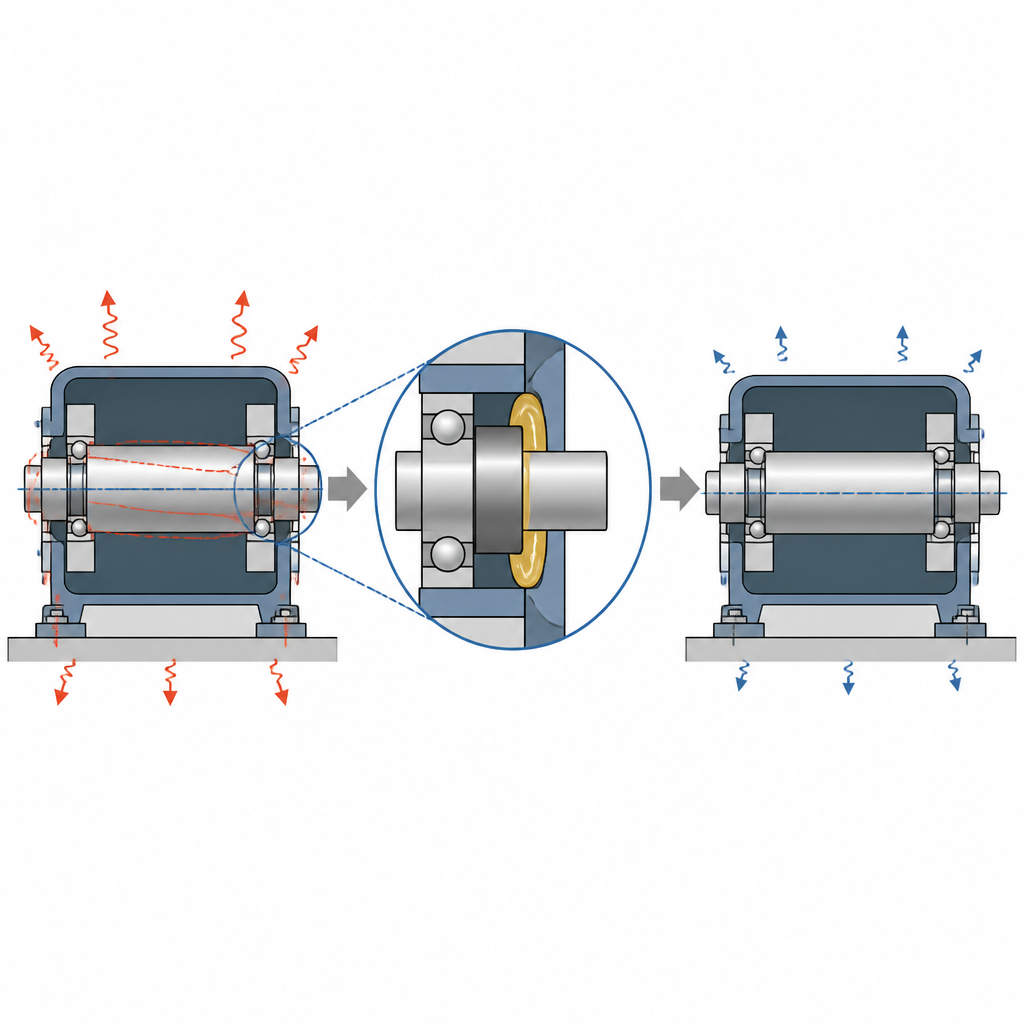
Many of the world’s most powerful machines depend on fast spinning shafts to move energy, from jet engines to power plant turbines. Over time, even small manufacturing imperfections can make these rotors wobble, wearing out parts and risking failure. This study looks at a surprisingly simple but vital detail in devices called squeeze film dampers: the tiny gap of oil between moving and stationary parts. By asking how wide that gap should be, the work shows how careful tuning of this clearance can keep large rotating machines running more smoothly and safely.
Keeping a spinning shaft under control
When a rotor spins at high speed, any slight weight imbalance generates strong, repetitive forces that can shake the entire machine. Squeeze film dampers are rings filled with oil that surround the shaft and sit inside the bearing supports. As the rotor moves, it squeezes the oil in this narrow gap, turning vibration energy into heat and reducing what is passed on to the rest of the structure. Engineers know these devices work, but have often chosen their dimensions using trial and error. One of the most important dimensions is the clearance ratio, the size of the oil gap relative to the shaft radius. This paper set out to understand how that ratio controls vibration reduction and stability.
From equations to a digital damper
The researchers first built a mathematical model that describes how the oil behaves as it is squeezed in and out of the narrow gap while the rotor precesses around its axis. Their formulation includes not just oil viscosity but also the inertia of the moving fluid, which becomes important at high speeds. From this they calculated the resulting forces on the shaft in radial and tangential directions, and converted these into effective stiffness and damping values. Using a simplified rotor model, they then related these properties to how much of the unbalanced force is transmitted through the damper to the outer casing at different spin speeds and different clearance ratios.
Finding a sweet spot in the oil film
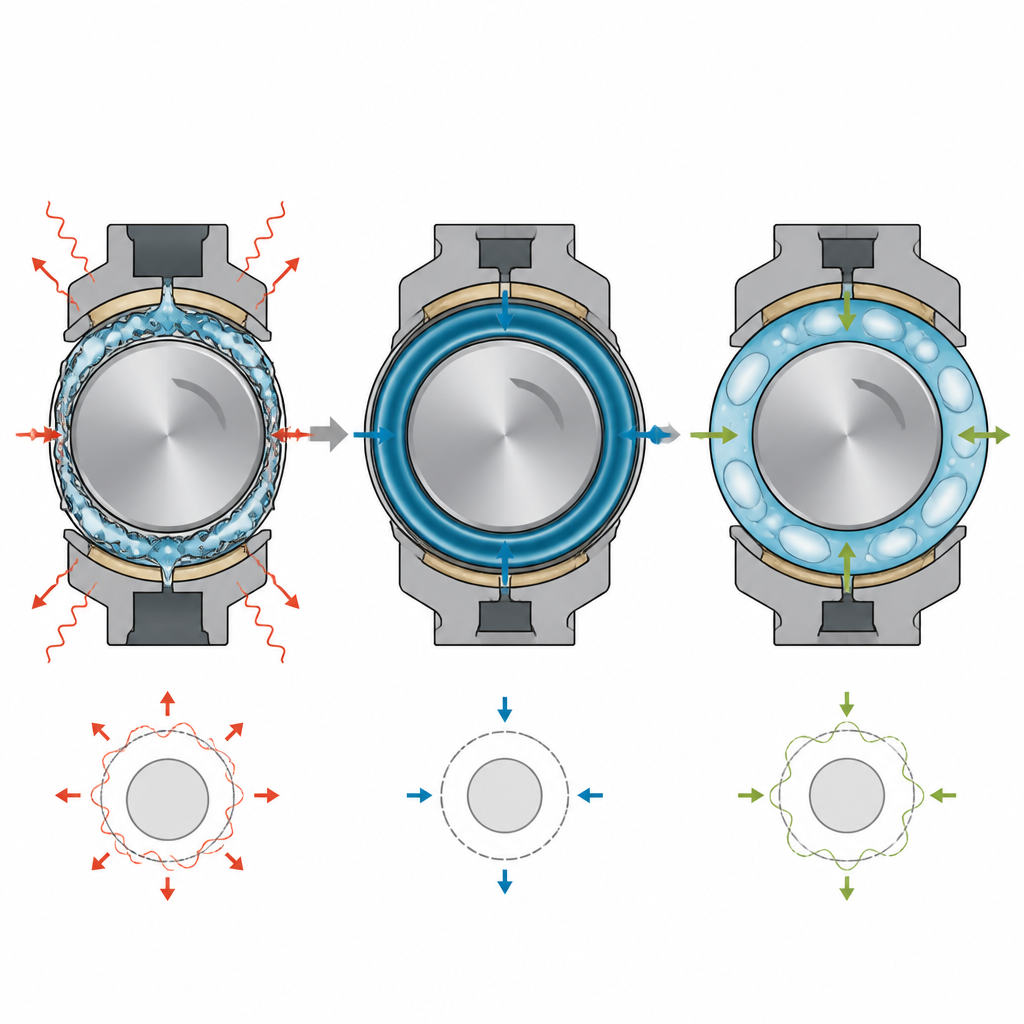
Numerical simulations revealed that the clearance ratio has a non-intuitive effect. When the gap is extremely small, the model shows very high oil pressures but also strong nonlinear behavior, with the damper response becoming wavy and unstable. As the gap is increased, the transmission of vibration drops and the response curve becomes smoother. Around a clearance ratio of about 0.3 percent, the pressure distribution and gas content in the oil film reach a favorable balance: the film is continuous and load-carrying, yet does not suffer from intense cavitation or air being drawn in. Above this value, the oil film becomes more mixed with gas again, weakening the damper’s support and reducing its effectiveness.
Putting the damper to the test
To check the theory, the team constructed a full test rig with a long steel shaft, a heavy disk, and two bearings, only one of which was backed by a squeeze film damper and elastic support. They measured the rotor’s natural frequencies, then ran it at various speeds while changing the damper clearance. Using accelerometers and displacement sensors, they tracked the motion of the shaft and supports over time. The experiments showed that very small gaps led quickly to irregular, chaotic shaft paths, while moderate gaps kept the motion mostly smooth and quasi-periodic across a wide speed range. At the same time, overall vibration levels near the machine’s critical speeds were lowest when the clearance ratio was close to 0.3 percent.
What this means for real machines
For engineers designing high speed rotating equipment, the study’s message is clear: the size of the oil-filled gap in a squeeze film damper is not just a minor detail, but a key control knob for vibration and stability. A clearance ratio near 0.3 percent allows the damper to form a stable oil layer that carries load well, while keeping troublesome two-phase effects, like cavitation and air ingestion, to a minimum. In simple terms, tuning this tiny gap helps large machines shake less, last longer, and operate more reliably without relying purely on trial and error.
Citation: Yang, Z., Li, J., Shi, Y. et al. The control mechanisms of clearance ratio on squeeze film dampers performance. Sci Rep 16, 15544 (2026). https://doi.org/10.1038/s41598-026-44261-6
Keywords: squeeze film damper, rotor vibration, clearance ratio, gas turbine, oil film dynamics