Clear Sky Science · en
Value of transcranial color-coded duplex sonography-derived middle cerebral artery pulsatility index in intracranial pressure assessment at moderate to high altitudes
Why brain pressure matters in thin air
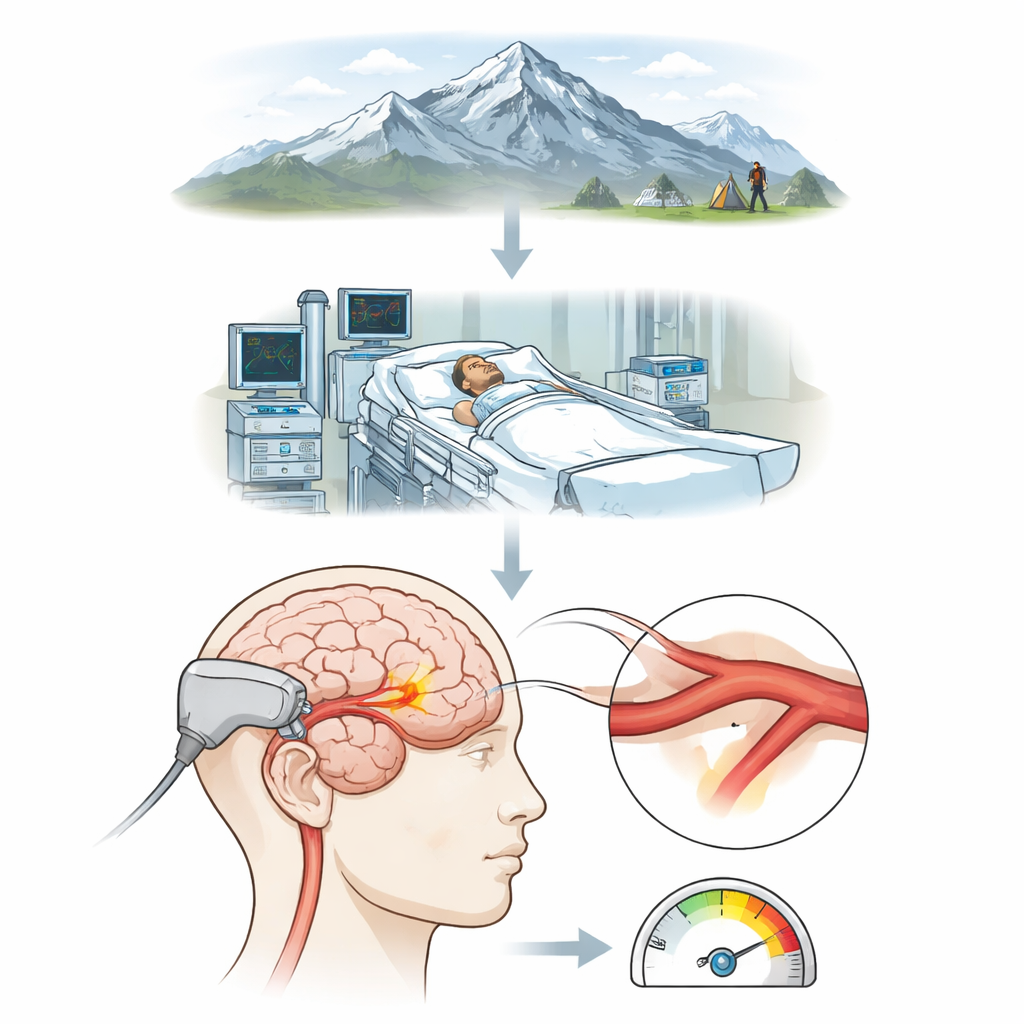
People who live, work, or travel at high altitudes face an invisible challenge: the brain must cope with thinner air and changing blood flow. For patients who suffer a head injury or brain disease in these environments, doctors urgently need to know whether pressure inside the skull is rising to dangerous levels. The standard tools to measure this pressure are invasive, costly, and not always available on remote plateaus. This study asks whether a bedside ultrasound test of blood flow in a key brain artery can safely stand in as a “pressure gauge” for the brain in people living at moderate to high altitudes.
Looking for a safer brain pressure check
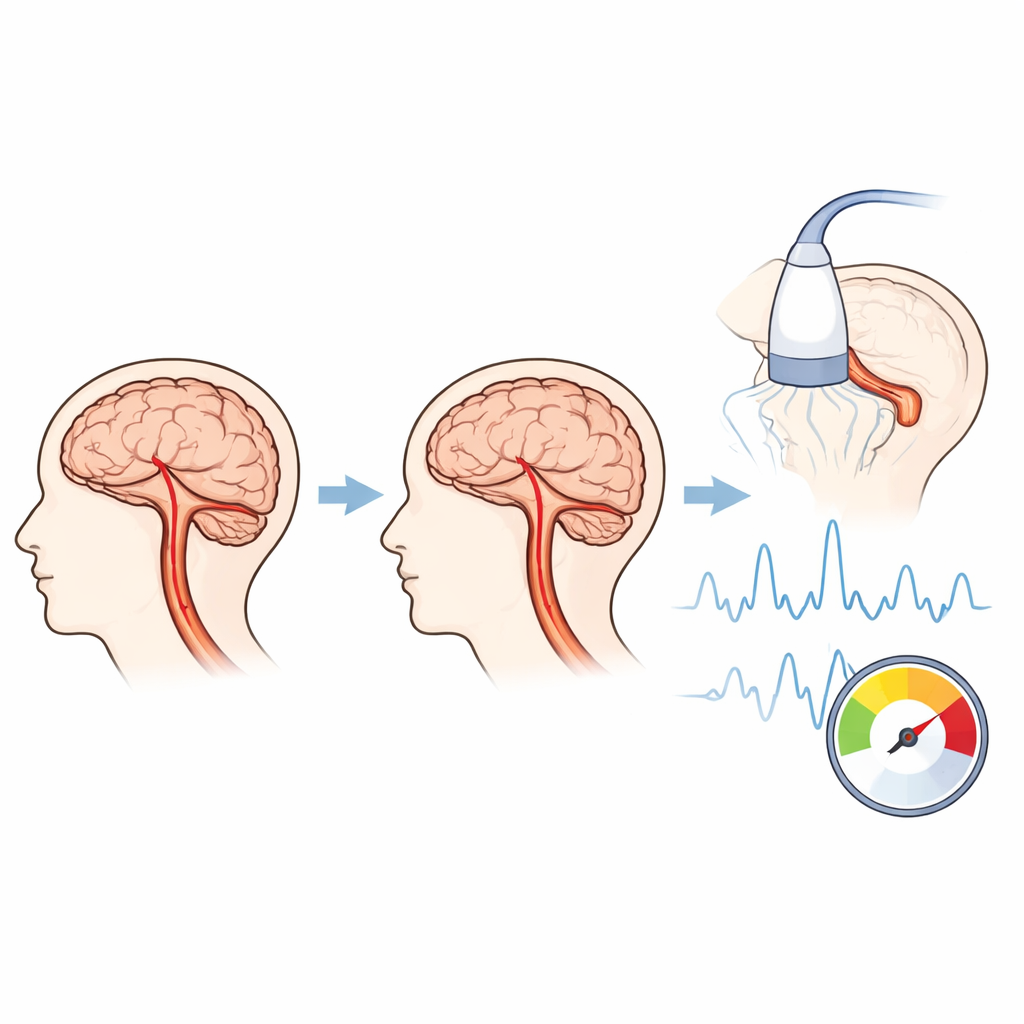
Pressure inside the skull, called intracranial pressure, must stay within a narrow range to keep brain cells supplied with blood and oxygen. Traditional measurements require drilling a small hole in the skull or placing a tube in the spinal fluid, procedures that carry risks of bleeding, infection, and pain, and cannot easily be repeated in basic hospitals. The researchers explored an alternative: transcranial color‑coded duplex sonography, or TCCD. This is a type of ultrasound performed through the thin bone near the temple that shows both brain structures and moving blood. From the shape of the blood‑flow signal in the middle cerebral artery, they calculated a pulsatility index, a simple number describing how strongly the blood pulses with each heartbeat.
Studying patients on the Qinghai–Tibet Plateau
The team collected data from adults treated in an intensive care unit on the Qinghai–Tibet Plateau, at around 2,260 meters above sea level, all of whom had brain conditions that required measuring pressure via a lumbar puncture in the lower back. These patients were long‑term residents of moderate‑to‑high altitude regions, making them representative of millions of people who live on plateaus worldwide. For each of 158 paired measurements in 54 patients, doctors first performed TCCD to obtain the pulsatility index in the middle cerebral artery, then measured intracranial pressure with the spinal needle within ten minutes, without giving any treatment in between.
Connecting blood‑flow pulses to brain pressure
When the researchers compared all the paired readings, they found a clear pattern: higher pulsatility index values strongly tracked with higher brain pressure. Using statistical methods that account for repeated measurements in the same person, they derived a simple equation that estimates non‑invasive intracranial pressure from the pulsatility index: estimated pressure equals about four and a half times the index, plus roughly ten. They also asked a practical bedside question: could a single cutoff in the pulsatility index flag patients whose pressure is above the commonly used safety limit of 15 millimeters of mercury? A threshold just above 1.2 identified raised pressure with both high sensitivity (few dangerous cases missed) and high specificity (few false alarms), meaning the test performed well as a quick screen.
High altitude, breathing, and blood gases
Because thin air at altitude changes breathing and the level of carbon dioxide in the blood, the team checked whether this gas disturbed the link between pulsatility index and brain pressure. They found only weak associations between carbon dioxide levels and either pressure or the index, and when both factors were placed in a combined model, the pulsatility index remained the dominant predictor while carbon dioxide added little. This suggests that, in real‑world high‑altitude intensive care units where perfect control of breathing is not always possible, the ultrasound‑based estimate remains reasonably stable.
What this means for patients in mountain regions
For people with serious brain problems who live or fall ill at moderate to high altitudes, this study shows that a quick ultrasound scan of blood flow in a single brain artery can provide a useful window into pressure inside the skull. A pulsatility index above about 1.2 warns doctors that pressure is likely elevated, and a simple formula offers a rough numerical estimate without opening the skull or repeatedly tapping the spine. While the method still needs testing in larger groups and in patients with very severe pressure crises, it offers a non‑invasive, low‑cost tool that is especially attractive for plateau hospitals and resource‑limited settings where traditional invasive monitoring is difficult to provide.
Citation: Qu, X., Wang, H., Du, C. et al. Value of transcranial color-coded duplex sonography-derived middle cerebral artery pulsatility index in intracranial pressure assessment at moderate to high altitudes. Sci Rep 16, 13488 (2026). https://doi.org/10.1038/s41598-026-44246-5
Keywords: intracranial pressure, brain ultrasound, high altitude, cerebral blood flow, noninvasive monitoring