Clear Sky Science · en
Analytical modeling of pcm-based cooling system for lithium-ion batteries
Why cooler batteries matter
Lithium ion batteries power our phones, laptops, and electric cars, but they quietly fight a problem: they get hot. Extra heat can shorten a battery’s life and, in extreme cases, trigger dangerous failures. This study looks at a smart way to tame that heat using special materials that melt and soak up energy, and it offers a fast pencil and paper style method to predict how well such cooling will work before engineers ever build a pack. 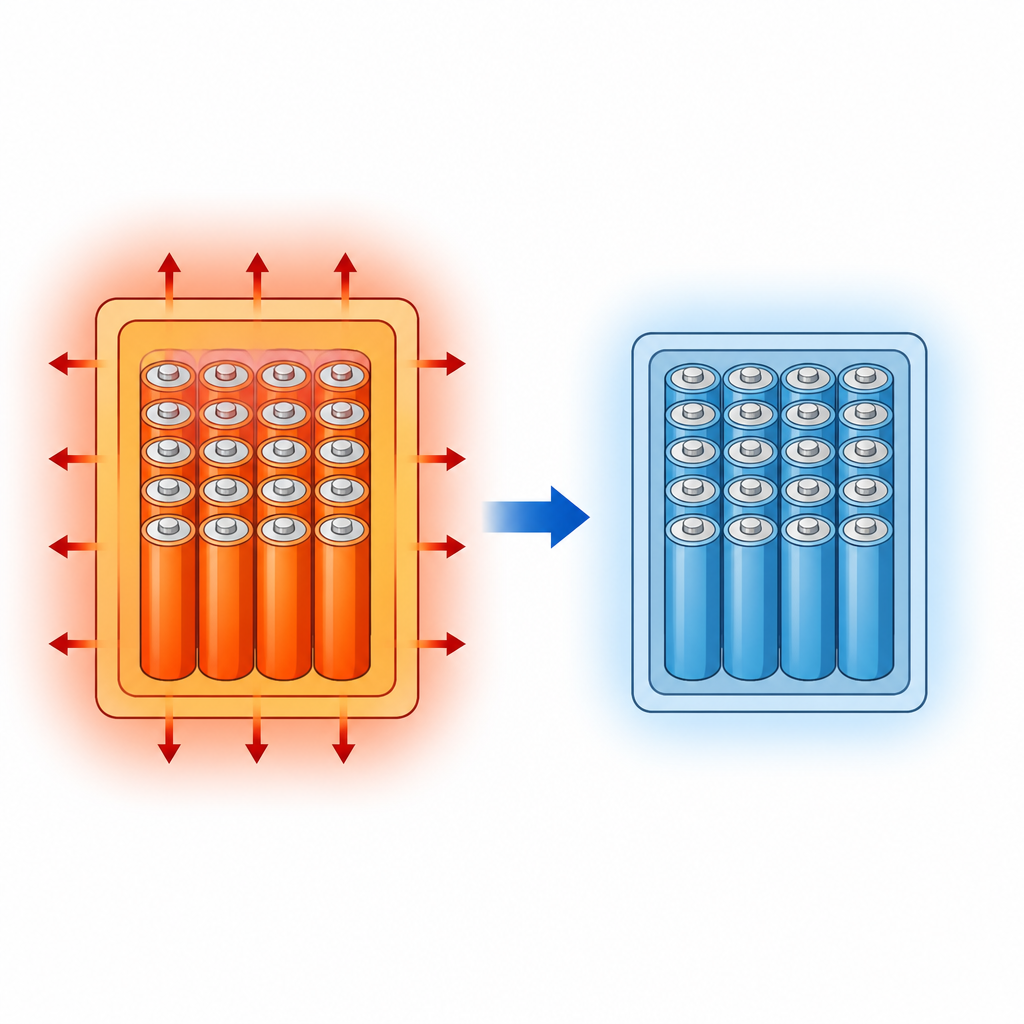
Storing energy and shedding heat
As we shift away from fossil fuels, batteries have become central to storing clean electricity and moving vehicles. Lithium ion cells are attractive because they store a lot of energy in a small volume and can be charged and discharged many times. The downside is that the same reactions that give high power also produce heat. If the temperature gets too high or varies sharply inside a pack, the cells age faster, lose capacity, and are more likely to enter thermal runaway, the chain reaction that can lead to fire.
A wax like jacket around each cell
One promising way to cool batteries is to encase each cell in a phase change material, often a wax like substance. When the battery heats up, this material melts and absorbs large amounts of energy while staying near a single temperature, a bit like ice holding a drink cold as it melts. Past experiments and computer simulations have shown that such phase change jackets can keep the outer surface of batteries cooler and more uniform, but until now, theory for cylindrical cells has been limited, slow to run, or based on heavy simplifications. 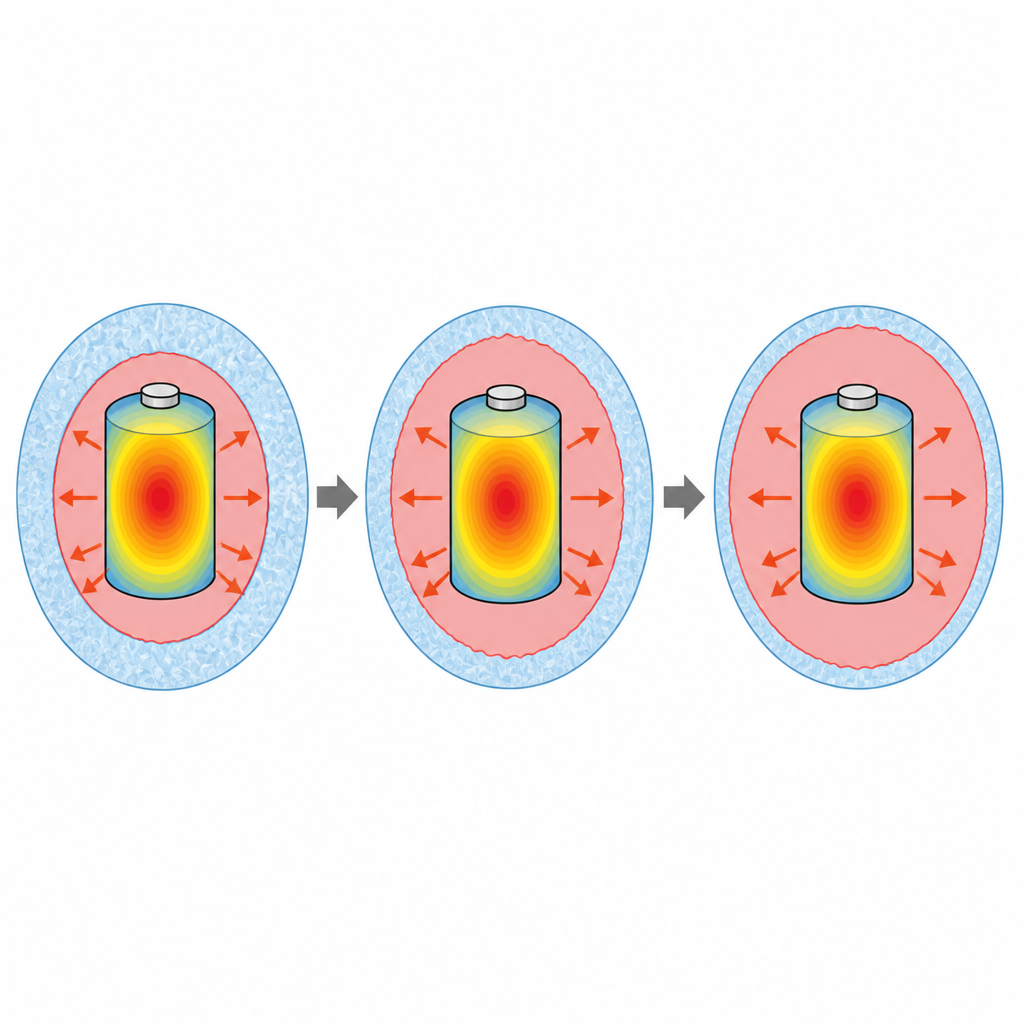
A faster way to predict heat inside round cells
The authors develop an analytical model, meaning a set of equations that can be solved directly rather than by heavy numerical simulation. They split the problem into two linked parts: heat being generated and conducted inside the round battery, and heat being absorbed and transported in the surrounding phase change material as it melts outward from the cell surface. Using a mathematical tool called a Green’s function for the cell and a perturbation expansion for the melting material, they iteratively match the temperature and heat flow at the shared boundary until both sides agree. This gives the temperature at every radius inside the cell and the position of the melting front as time passes.
What controls how hot the battery core gets
With the new equations, the researchers test how different properties shape cooling performance. They confirm that raising the thermal conductivity of the phase change material lowers the battery surface temperature and helps spread heat, but only to a point. The hottest spot in the system remains the cell core, and this region responds most strongly to the battery’s own conductivity: making the cell conduct heat better can cut the peak core temperature by roughly two thirds in their sample cases. Increasing the phase change material’s ability to store melting heat further smooths surface temperatures, yet it has a relatively small effect on the hottest region deep inside the cell.
Designing packs for power and safety
The model also shows how fast discharge cycles and higher currents drive faster heating and faster melting of the surrounding material. By tracking how far the melting front moves, the authors can estimate how thick the phase change layer should be so that it finishes melting just as the battery finishes its most demanding discharge. This balance keeps temperatures within a safe window while avoiding extra wax that would add weight and lower overall energy storage. The study concludes that while phase change cooling is an effective passive tool, its full benefit for cylindrical cells is only realized when the cells themselves are designed to let heat escape more easily from their cores.
Citation: Farajollahi, A., Gheshlaghchaei, B.A., Jalalvand, M. et al. Analytical modeling of pcm-based cooling system for lithium-ion batteries. Sci Rep 16, 14791 (2026). https://doi.org/10.1038/s41598-026-44226-9
Keywords: lithium ion batteries, battery cooling, phase change material, thermal management, cylindrical cells