Clear Sky Science · en
A new free surface identification method for 3D MPS method
Why tracking moving water surfaces matters
From crashing waves against seawalls to fuel sloshing inside spacecraft tanks, engineers increasingly rely on computer simulations to predict how liquids move and what forces they exert. Many of these simulations use a swarm of virtual particles instead of a rigid grid to represent water. But there is a subtle problem: the computer must constantly decide which particles lie on the liquid’s outer surface, where the pressure of the surrounding air applies. If that decision is even slightly wrong, the predicted pressures on walls and structures can become noisy or misleading. This study introduces a new way to find those surface particles in three-dimensional simulations, making virtual water behave more like the real thing.
A different way to draw the line between water and air
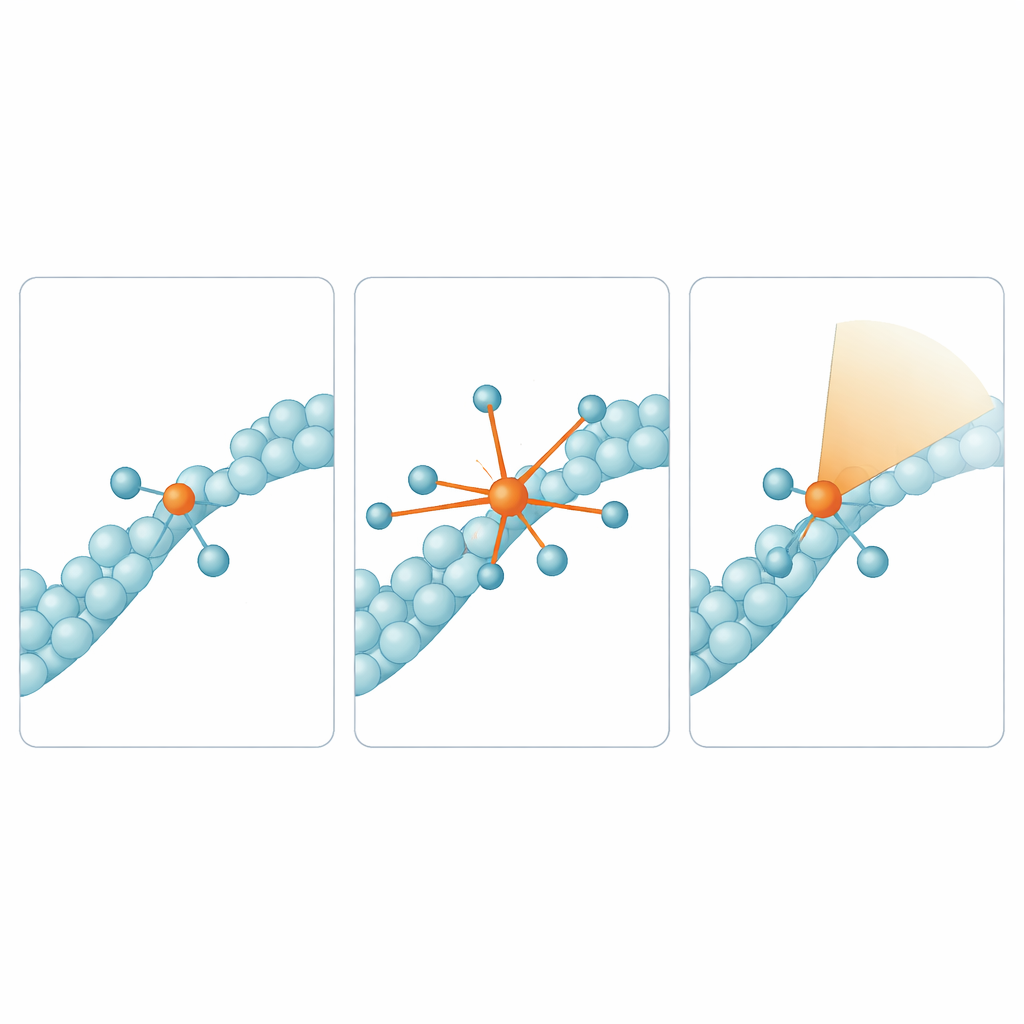
In the Moving Particle Semi-Implicit (MPS) method, water is modeled as countless tiny particles that move and interact. Traditional approaches decide whether a particle sits on the free surface by simply counting how many neighbors it has. Fewer neighbors usually means it is at or near the surface. However, this rule of thumb can fail when particles are unevenly spaced, as often happens in turbulent flows or near sharp corners. The authors instead focus on how neighboring particles are arranged in space, using a quantity called relative position divergence, which measures how "spread out" neighbors are around a given particle. If the neighbors tend to lie mostly on one side, the divergence value changes in a way that signals a likely surface.
Adding direction to the surface test
Although the improved divergence measure matches theoretical expectations very well, the authors show that in three dimensions a simple threshold on this value cannot perfectly separate interior and surface particles, especially near sharp edges and inside cavities. To fix this, they introduce an extra step that estimates the local surface direction, or normal vector, from the surrounding particles. Using this direction, the method defines a cone-shaped region that points outward from each candidate particle. If that cone contains no other particles within a certain distance, the particle is judged to lie on the free surface. This combined approach, called RPD+NV, uses both how neighbors are arranged and where empty space lies, giving a more reliable picture of the true interface between liquid and air.
Testing the method on complex shapes and calm water
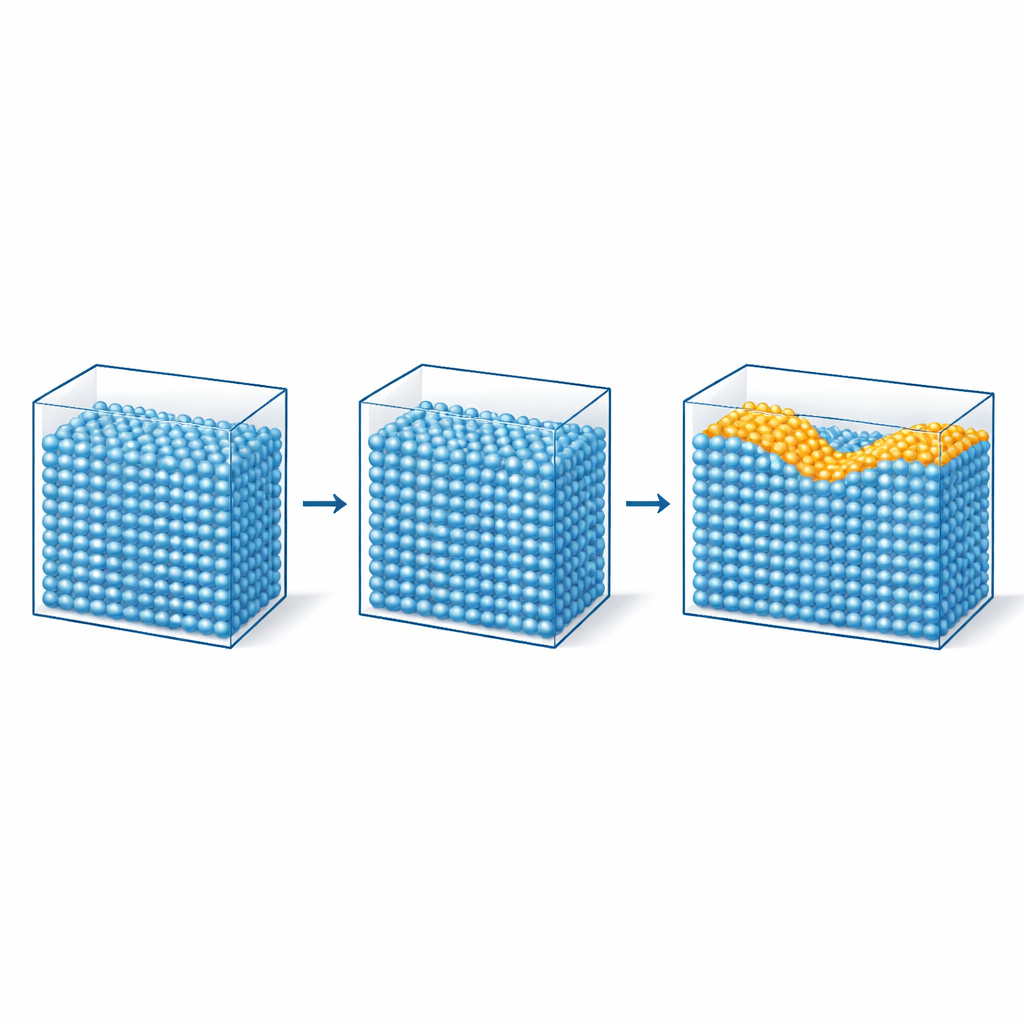
The researchers first test their method on still, purely geometric shapes: a cube topped with a dome, a cube with a bowl-shaped recess, and an S-shaped tube containing an internal cavity. These cases challenge the algorithm with both bulging and hollowed surfaces. By comparing the detected surface particles with the known true surfaces, they show that the new method correctly captures convex and concave regions and accurately resolves hidden cavities. They then apply the approach to a simple hydrostatic container of water and verify that, with reasonable choices of particle spacing and time step, the predicted pressure at the bottom matches the theoretical value very closely. In these calm conditions, the new surface detector produces fewer pressure oscillations than older methods, while keeping computational cost nearly the same.
Capturing waves, impacts, and sloshing
Next, the team challenges the method with highly dynamic situations. In a three-dimensional dam-break simulation, a water column collapses and slams into a wall, creating rapidly changing free surfaces, splashes, and air pockets. Compared with traditional criteria based on neighbor count or divergence alone, the RPD+NV method tracks more continuous and detailed surfaces and yields smoother, more realistic pressure fields. Crucially, the peak impact pressure at the wall comes much closer to laboratory measurements. In a damped sloshing case, where waves inside a tank gradually settle, the new method leads to the smoothest evolution of forces on the walls, indicating reduced numerical noise. Finally, in a test mimicking fuel sloshing inside a ring-shaped tank that rocks back and forth, surface shapes and pressure peaks from simulation agree well with high-speed camera images and pressure sensor data, again without spurious pressure spikes at the surface.
What this means for real-world simulations
For readers outside computational fluid dynamics, the practical message is that this work improves how computers decide where water ends and air begins in particle-based models. By combining a refined measure of how neighbors surround each particle with a directional "empty cone" test, the new RPD+NV method sharply reduces mistaken classifications of surface particles. The result is cleaner, more stable pressure predictions across a range of flows, from standing water to violent impacts and complex three-dimensional sloshing. Because the method adds little computational cost, it offers a practical upgrade for engineers simulating coastal structures, ship motion, storage tanks, and other systems where accurately capturing moving water surfaces is essential.
Citation: Geng, C., Wang, Wh., Heng, My. et al. A new free surface identification method for 3D MPS method. Sci Rep 16, 13829 (2026). https://doi.org/10.1038/s41598-026-44218-9
Keywords: particle-based fluid simulation, free surface detection, numerical wave impact, sloshing in tanks, moving particle method