Clear Sky Science · en
Study on key strata and surface deformation prediction for overburden separation grouting mining in adjacent panel based on foundation beam theory
Why the ground above coal mines sinks
Across many coal mining regions, people have watched cracks creep across house walls, roads dip into shallow troughs, and small bridges twist out of line. These changes are often caused by the slow bending and breaking of rock layers deep underground when coal is removed. This study explores a way to predict and control such ground sinking by carefully filling hidden gaps in the rocks with grout, so that mining can continue while reducing damage at the surface.
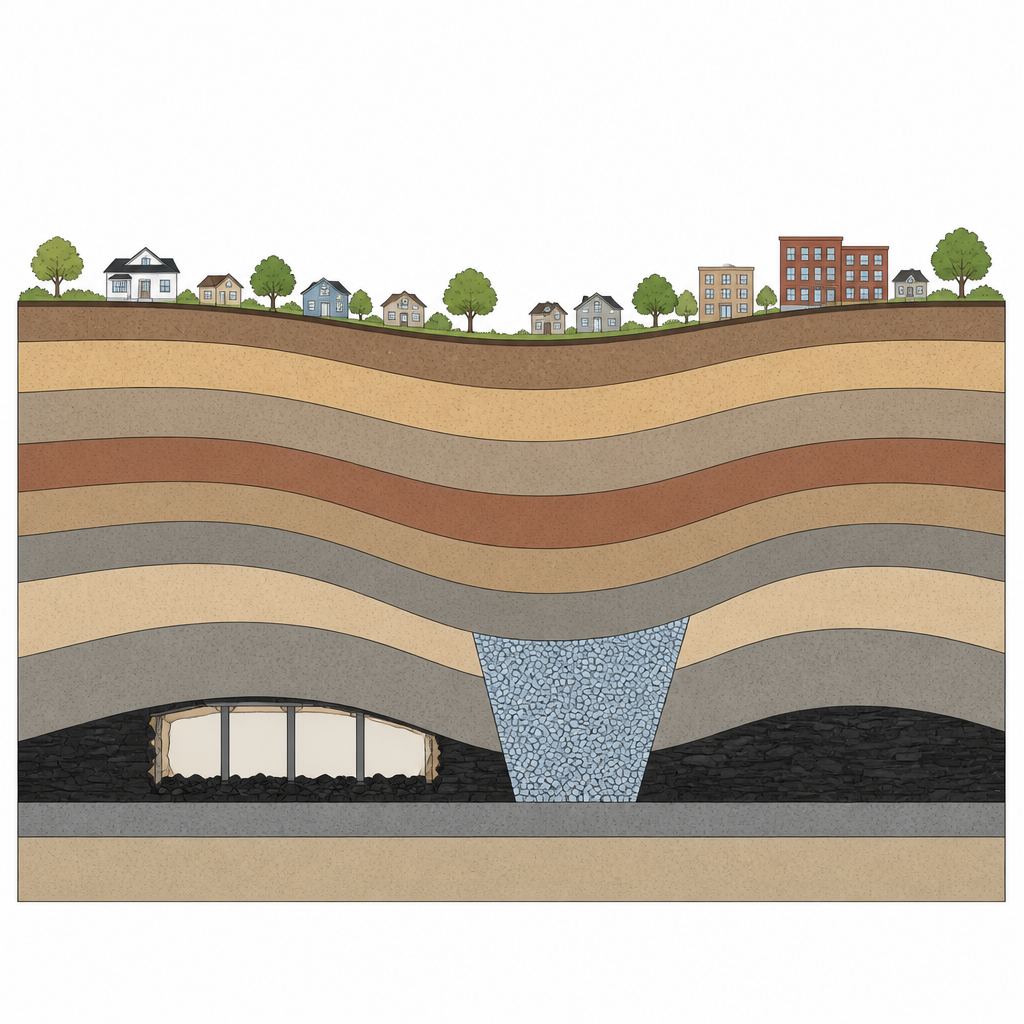
Cracks underground and damage on the surface
When a coal seam is mined, the solid rock above it no longer has full support. Some strong layers, called key layers, act like stiff beams that carry the weight of all the rock and soil above. As the coal is taken away, these layers bend and sometimes crack, and the motion slowly works its way up to the ground. In China’s Xiadian Coal Mine, this process has already led to cracked building walls, uneven roads, and the risk of new ground fissures. With coal seams being mined ever more deeply and widely, understanding how these key layers move has become essential for protecting homes, roads, and local ecosystems.
Filling hidden gaps to hold up the roof
One popular method to limit sinking is called separation grouting. After mining opens a space, small voids often appear between rock layers above the seam. Engineers drill boreholes from the surface and pump grout into these hidden gaps. Once hardened, the grout acts like a support pillar that helps carry the load and keeps the layers from bending too much. The study focuses on a set of long working zones, or panels, in Xiadian Mine where this grouting is applied. Two simple control knobs are examined in detail: how much grout is pumped in, expressed as the injection–production ratio, and how wide each mined panel is made.
Rock layers treated as a buried beam
To describe how the key layers bend, the authors treat them like an elastic beam resting on a springy base. In this picture, the beam is the stiff rock layer and the softer layers and grout below behave like a mattress of springs. The team used a mathematical shortcut called the initial parameter method to calculate how the beam deflects over several zones: solid coal, loosely packed rubble, and tightly compacted rock and grout. They combined this with computer simulations that model how rock breaks and settles as mining advances. By matching the computed beam shapes to the numerical results, they could estimate how stiff each zone really is and then link that stiffness to practical design variables such as panel width and grout amount.
From underground bending to surface sinking
Knowing how much the key layers bend is only part of the story. The researchers then connected this bending to the shape of the ground surface using a probability-based method that spreads the influence of underground movement upward, and an “equivalent height” trick that replaces complex curves with simple rectangular blocks. In single panels and in neighboring panels that do not have the same width, they worked out how the subsidence trough at the surface grows, shifts sideways, and becomes more or less steep. Tests with real monitoring data from panel 3119 showed that the predicted maximum sinking of the ground differed from measurements by only about six percent, which is considered very accurate for field conditions.
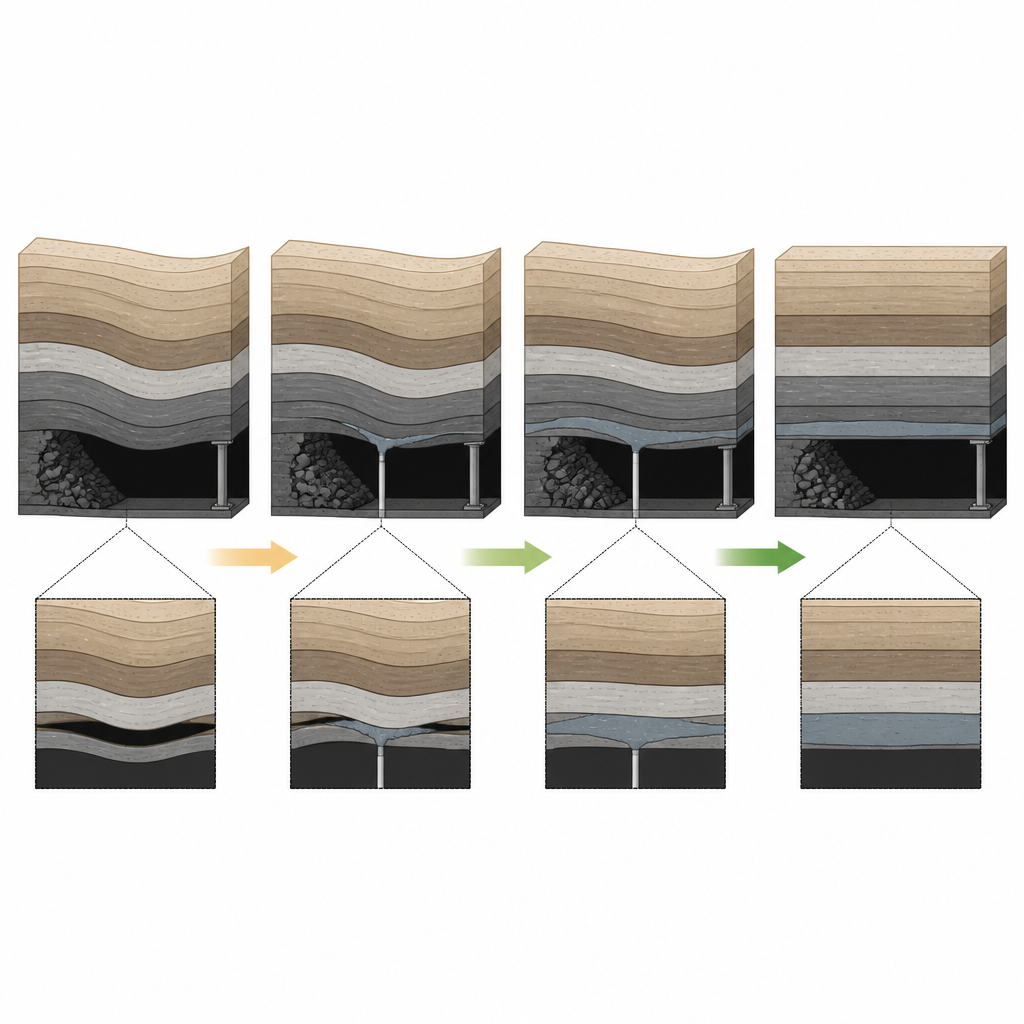
Finding a safe operating window for mines
The results show clear trends that mine planners can use. Increasing the amount of grout generally reduces how far the key layers and the surface sag, while widening a panel makes them bend more and deepens the trough. When nearby panels have different widths, the sinking pattern becomes uneven and the deepest point can shift closer to sensitive structures. However, by choosing a suitable grout ratio, that unevenness can be largely smoothed out. In the Xiadian case, an injection–production ratio of about 45 percent for panel 3119 produced nearly symmetric bending in the key layers and moderate surface movement.
What this means for mining communities
For people living above coal mines, the study offers a way to reduce the risk that their homes and roads will suffer serious damage as mining progresses. By treating the strong rock layers as a supported beam and tying the model directly to controllable factors like panel width and grout volume, the method lets engineers forecast where and how much the ground will sink months in advance. They can then adjust mining plans, reinforce buildings in high-risk areas, or change grouting schemes before problems appear. While real sites also depend on details such as grout pressure and timing, this work provides an important step toward more predictable and less damaging underground coal extraction.
Citation: Shibao, L., Yan, L., Huaidong, L. et al. Study on key strata and surface deformation prediction for overburden separation grouting mining in adjacent panel based on foundation beam theory. Sci Rep 16, 14926 (2026). https://doi.org/10.1038/s41598-026-44188-y
Keywords: coal mining, ground subsidence, grouting, rock layers, surface deformation