Clear Sky Science · en
Rotary cutting tests and rock-breaking characteristics of triple-ridged PDC cutters in tight hard sandstones from Xujiahe Formation in Sichuan Basin in China
Why breaking hard rock matters
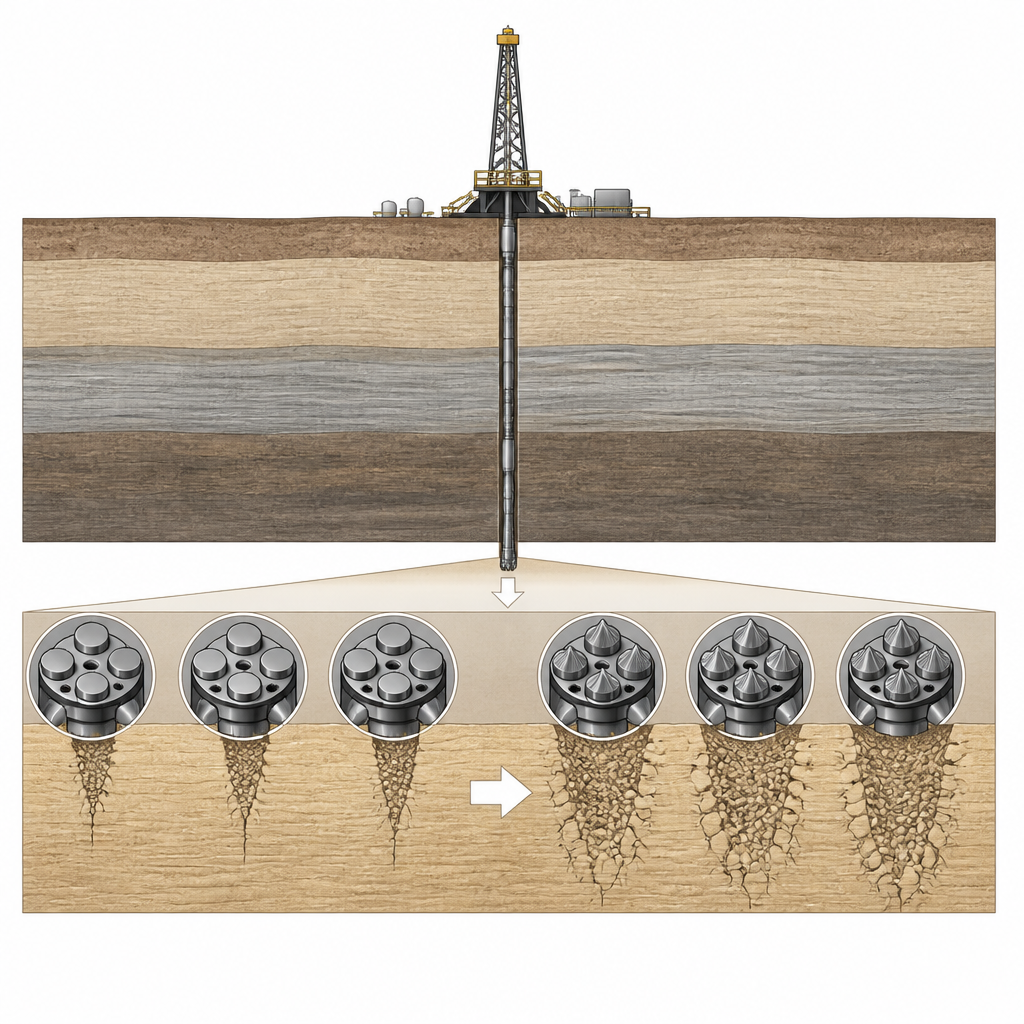
Getting natural gas out of deep, stubborn rock depends on how fast and safely we can drill through it. In southwest China, the Xujiahe Formation holds large reserves of tight sandstone gas, but its rock is so hard and abrasive that drill bits wear out quickly, slowing drilling and raising costs. This study explores a new style of diamond cutter for drill bits and shows how changing the tiny geometry of each cutting tooth can make a big difference to how efficiently we chew through the underground rock.
A tough gas rich rock layer
The Xujiahe Formation sandstones lie deep beneath the Sichuan Basin and are packed with quartz grains that make the rock both very hard and very tight. These conditions are good for trapping gas but bad for drill bits: the rock quickly dulls the cutting edges, shortens the distance a bit can drill before it must be replaced, and increases the risk of the borehole going out of gauge. Around the world, polycrystalline diamond compact (PDC) bits are now the workhorse of oil and gas drilling, but standard flat faced cutters struggle in formations like this. Engineers have begun to explore three dimensional cutter shapes that do more than simply scrape; they aim to crack and break rock in a more energy efficient way.
A new shape for diamond cutters
The team focused on triple ridged PDC cutters, whose working face is shaped into three raised ribs, and compared them with traditional flat or planar cutters. Using a specialized test rig, they pressed and dragged single cutters across blocks of tight hard sandstone taken from Xujiahe outcrops. The apparatus let them control how fast the cutter pushed into the rock, how quickly the rock sample rotated beneath it, and how far from the bit center the cutter would work, mimicking different parts of a real drill bit. Sensitive force sensors recorded how the pushing and cutting forces changed as the cutter penetrated from the surface down several millimeters into the rock.
Watching how the rock fails
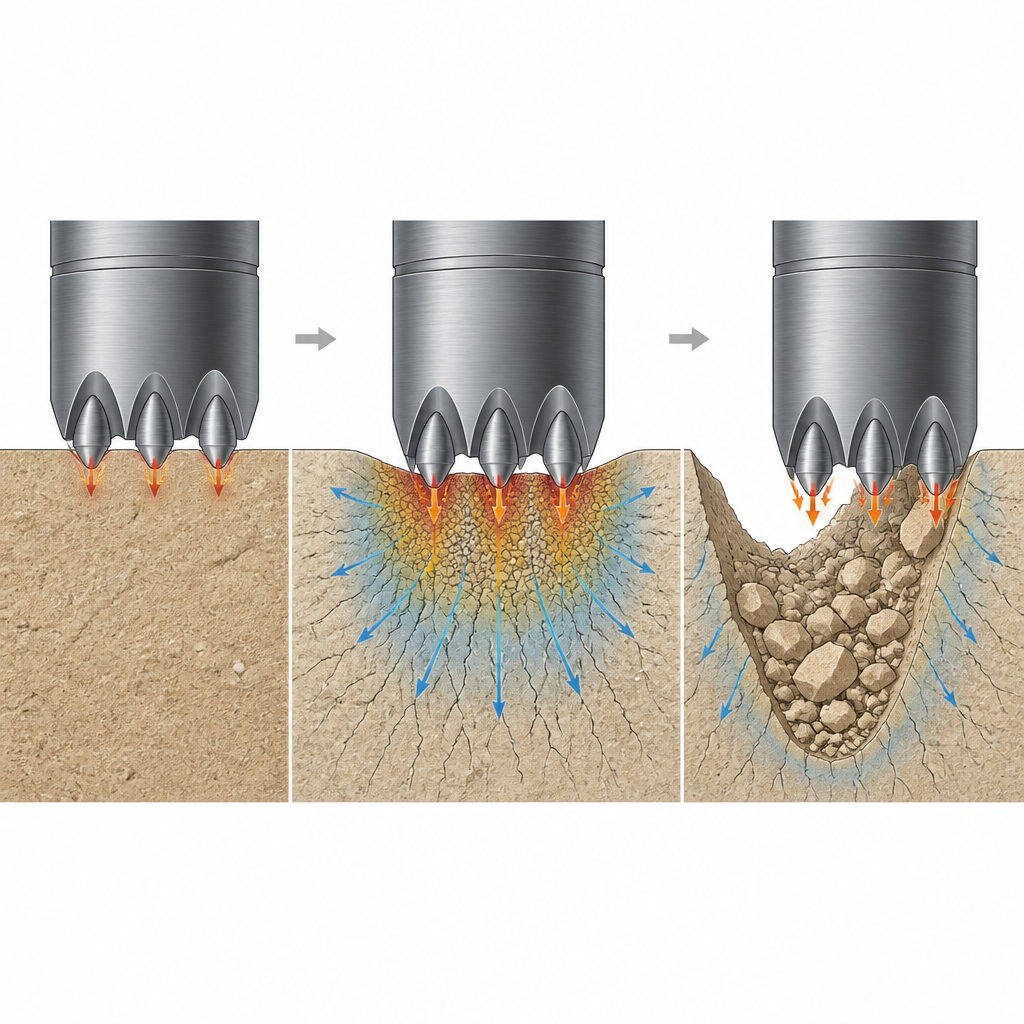
By tracking force over time, the researchers found a repeated pattern as the cutter advanced: force built up steadily, then fluctuated as the rock cracked and chips broke away, then climbed again. These stages matched elastic bending, brittle failure, and another phase of elastic loading. For both cutter types, there was an optimal tilt angle that gave the best penetration for a given load, but the values differed: about 30 degrees for flat cutters and 25 degrees for triple ridged cutters. The triple ridged design needed a higher peak force at the same depth because its ribs contact more rock, yet it produced larger damage zones and more broken volume beneath the surface. Detailed scans of the pits and grooves showed that the ridged cutters carved deeper channels and drove cracks farther out into the rock.
Chips, energy use, and drilling settings
After each run, the team collected the broken rock, sieved it into different size classes, and used fractal analysis to describe how fragmented it was. When the cutter advanced faster while the rotation speed was lower, it took deeper bites, creating larger chips and a lower degree of fine grinding. Under these conditions, the volume of rock removed per unit length increased, and the mechanical specific energy, a measure of energy spent per unit of rock broken, went down. Higher rotation speeds had the opposite effect: more frequent contact between cutter and rock ground the surface into finer powder, raised the energy cost, and shrank the size of individual chips. Across comparable tests, the triple ridged cutters consistently removed more rock volume while consuming less energy than flat cutters, and their cutting forces fluctuated less, indicating a more stable drilling process.
What this means for drilling tough sandstone
For engineers designing drill bits and choosing how to run them, these experiments point to clear guidance. Triple ridged diamond cutters can break tight, quartz rich sandstone more efficiently than flat cutters, especially when paired with higher weight on bit and moderate to low rotation speeds. This combination favors deeper individual cuts, larger rock chips, and lower energy use, while also improving the stability of the drilling process. In practical terms, better cutter shapes and smarter operating settings could help wells in formations like the Xujiahe be drilled faster and with fewer bit changes, reducing costs and making it easier to tap hard to reach natural gas resources.
Citation: He, W., Li, X., Zhang, Z. et al. Rotary cutting tests and rock-breaking characteristics of triple-ridged PDC cutters in tight hard sandstones from Xujiahe Formation in Sichuan Basin in China. Sci Rep 16, 15247 (2026). https://doi.org/10.1038/s41598-026-44154-8
Keywords: PDC drill bits, hard sandstone, rock cutting, drilling efficiency, triple ridged cutter