Clear Sky Science · en
SmartSport: crowd counting meets large language models for smart facility management
Why smarter sports spaces matter
In many cities, new parks, courts, and fitness trails keep appearing, yet people still find basketball courts packed while nearby walking paths sit empty. This mismatch wastes public money and frustrates residents who just want a fair chance to exercise. The SmartSport study introduces a way to use cameras and advanced AI to measure how public sports facilities are actually used and then turn those numbers into concrete advice for city managers. The goal is simple: help communities get more health and enjoyment from the spaces they already have.
From clipboards to continuous sensing
Today, most cities still rely on staff with clipboards or occasional surveys to estimate how busy a court or running track is. These methods capture only brief snapshots, miss many locations, and are too slow to guide day-to-day decisions. They also struggle to explain why some facilities are overloaded while others are nearly empty. SmartSport replaces these scattered efforts with an automated system that watches facilities through fixed cameras, counts how many people are present over time, and combines that information with maps, population data, and other context. 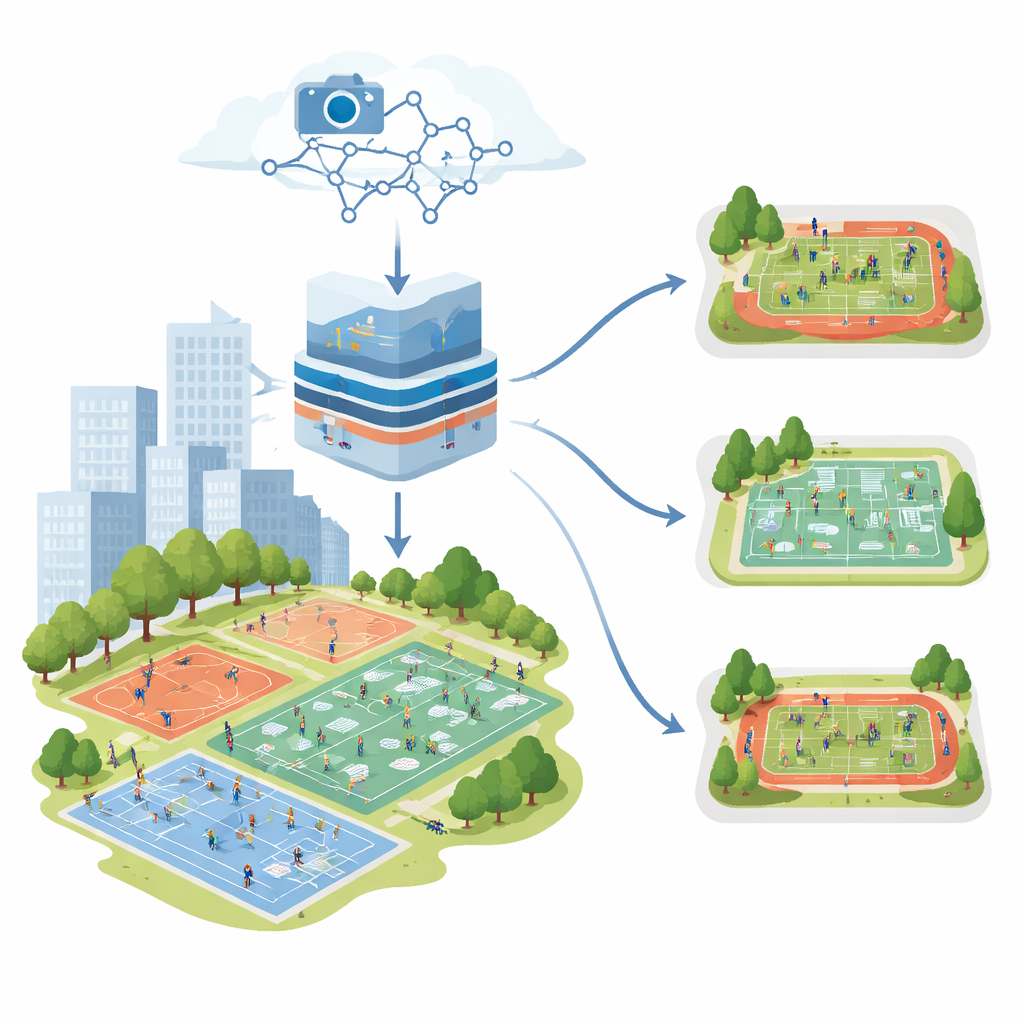
Teaching computers to see people fairly
The first half of SmartSport, called CrowdVision, focuses on seeing and counting people in open sports areas such as outdoor courts, fields, and fitness trails. Instead of tracking faces or identities, it looks for the small visual cues that signal a person in a wide scene, like tiny figures far in the background or partially hidden by others. The researchers designed a compact vision network that can scan images from different directions, piece together patterns over the whole scene, and handle people at very different sizes in the same frame. It represents each person as a point rather than a bounding box, which makes it easier to locate individuals accurately in crowded settings while staying fast enough to run on low-cost edge devices near the camera.
Turning raw counts into better decisions
The second half, LLM-Advisor, acts as a digital consultant for facility managers. It takes the time series of crowd counts produced by CrowdVision and blends them with other information: where each facility sits in the city, who lives nearby, how easy it is to reach by public transport, and what kind of equipment is available. Using large language models—the same type of AI that powers modern chatbots—the system is guided by carefully crafted prompts to follow a step-by-step reasoning process. It identifies daily and weekly patterns, spots signs of overload or underuse, and then proposes practical actions, such as shifting opening hours, upgrading certain courts, or adding new facilities in underserved neighborhoods. A supporting knowledge base of real-world best practices and policies helps keep these suggestions grounded in professional standards. 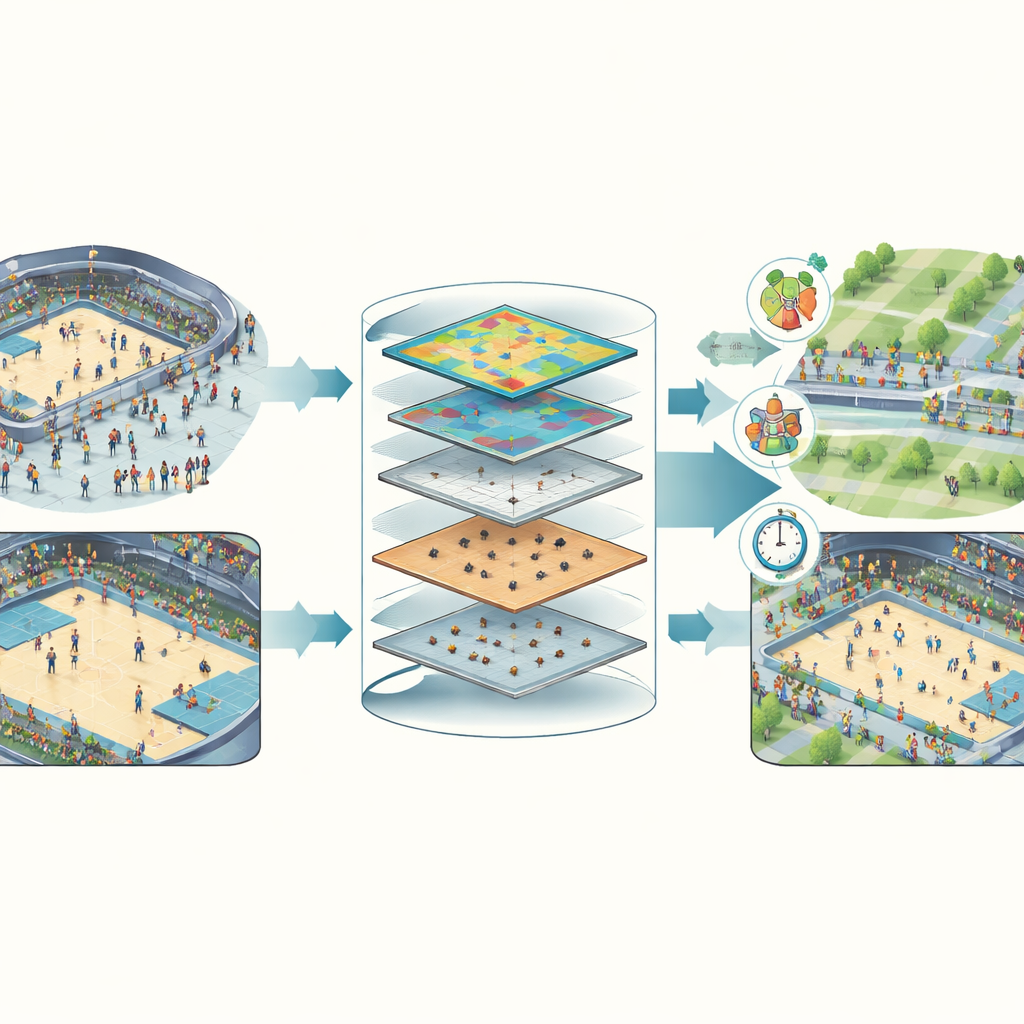
Proving it works in the real world
To test SmartSport, the team evaluated CrowdVision on standard crowd-counting datasets and on their own collection of images from 15 public sports facilities. The vision module achieved a counting accuracy of about 94 percent in these real sports settings, outperforming several recent research methods while also running efficiently enough for real-time monitoring. For the recommendation side, the authors asked 12 experts in sports facility management to blindly rate over 250 AI-generated reports. On average, the experts scored the advice at 4.2 out of 5 for overall quality, praising its completeness and logical reasoning while noting that very detailed, site-specific proposals remain challenging. Together, these results suggest that SmartSport can both measure usage reliably and offer management insights that professionals find genuinely useful.
What this means for everyday users
For residents, the promise of SmartSport is not more screens or gadgets, but better-run parks and courts. By quietly counting how many people use each facility and when, without tracking who they are, the system helps city officials see which spaces are starved for investment and which are underused opportunities. Over time, this could translate into shorter waits for popular courts, more thoughtfully placed walking paths and exercise stations, and schedules that fit local routines. While the authors note that future work must handle extreme lighting, privacy safeguards, and deeper behavior understanding, their study shows that pairing computer vision with language-based reasoning can move public sports management from guesswork toward evidence-based, citywide planning.
Citation: Li, P., Xu, C. SmartSport: crowd counting meets large language models for smart facility management. Sci Rep 16, 13991 (2026). https://doi.org/10.1038/s41598-026-44145-9
Keywords: public sports facilities, crowd counting, urban AI, smart city planning, facility management