Clear Sky Science · en
White matter microstructure and its association with visuospatial processing development during early infancy
Why baby brain wiring matters
From the first weeks of life, babies are constantly taking in sights and learning how to reach, grab, and look around. These early skills, often called visuospatial abilities, help infants understand where things are and how to act on them. They lay the groundwork for later achievements in school, sports, and everyday problem-solving. This study asks a deceptively simple question: can the way an infant’s brain is wired at just one month old help predict how they will explore toys and shift their gaze at six months?
Looking inside the newborn brain
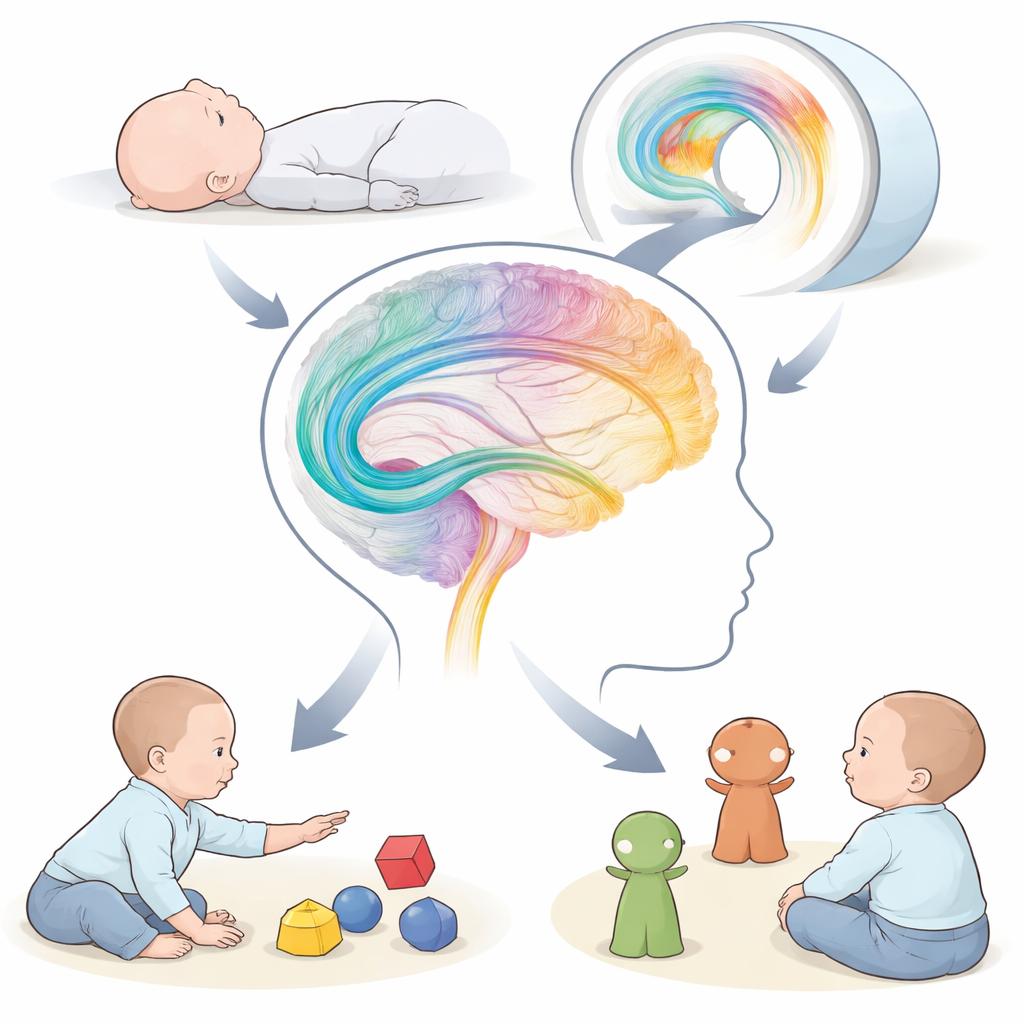
To explore this question, researchers used a type of MRI that tracks how water moves through brain tissue, providing a window into the structure of the brain’s wiring, or white matter. Ninety-one healthy one-month-old infants took part while naturally sleeping in the scanner. By following the direction and speed of water movement in different brain pathways, the team obtained several measures of how organized and mature those pathways were. This allowed them to focus on specific tracts already known in older children and adults to support movement, attention, and spatial thinking, such as the cerebellar connections at the back of the brain and pathways near the brain’s midline.
Everyday baby behaviors as a test
The same infants returned to the lab at six months for simple play-based assessments that mimic everyday situations. In one task, babies lay on a colorful quilt within arm’s reach of several toys. Researchers scored how intensely the babies manipulated the toys over time, capturing both their interest and their ability to coordinate seeing and reaching. In another task, a pair of lively puppets appeared above a screen, and observers counted how often infants looked away from the puppets for more than a few seconds. This “gaze shifting” reflects how readily babies can disengage from one sight and orient to another, a key ingredient in exploring the world visually.
Links between early wiring and later actions
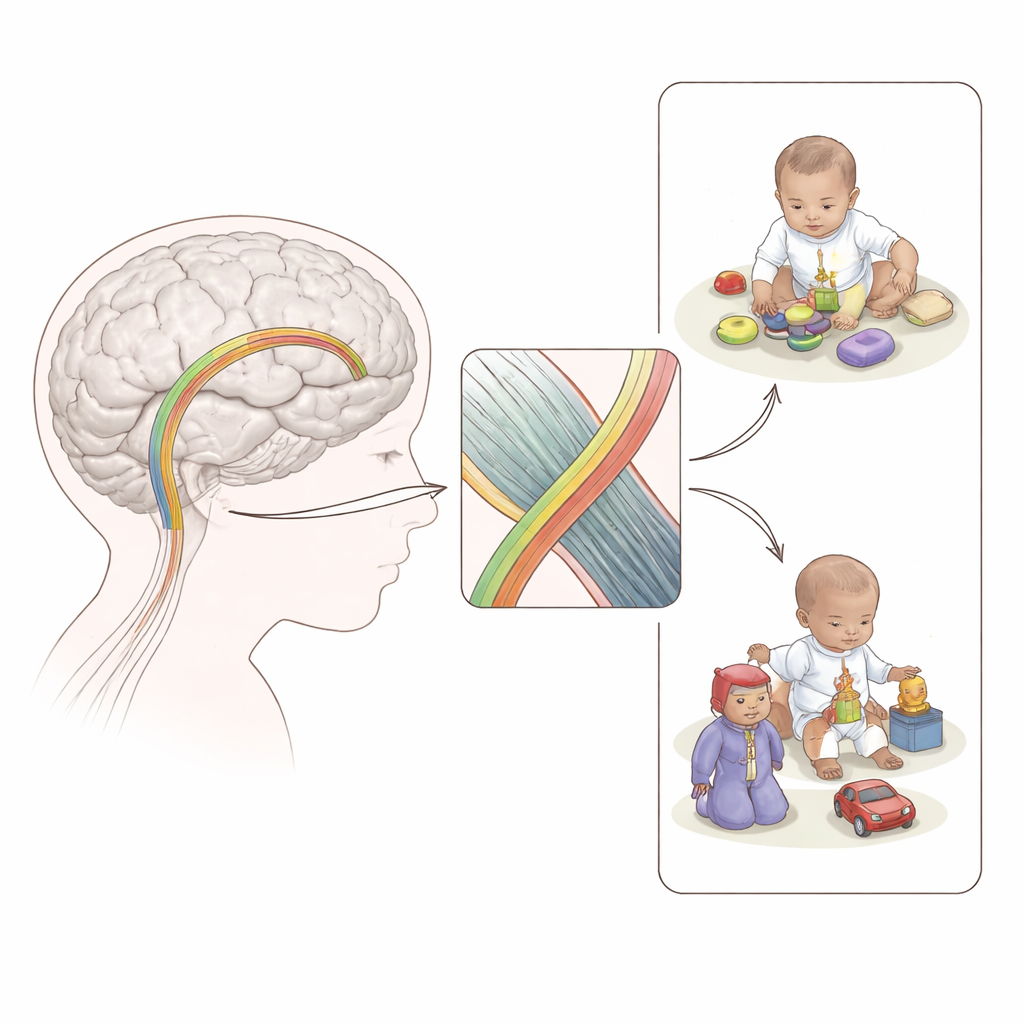
When the scientists compared brain scans from one month with behaviors at six months, clear patterns emerged. Babies who later showed more vigorous toy play tended to have more organized white matter in two main regions: the left and right superior cerebellar peduncles, which connect the cerebellum to the rest of the brain, and the right cingulate gyrus, a midline region involved in linking actions, feelings, and attention. Another measure of water movement in the right superior cerebellar peduncle was related to how often infants shifted their gaze away from the puppet display. Together, these findings suggest that even in the first month of life, the quality of certain brain pathways is already tied to how actively babies will explore and interact with the objects and scenes around them.
Subtle hints about timing and sex differences
The study also probed whether these brain–behavior links looked different for boys and girls. Some early analyses hinted that certain measures might relate more strongly to toy play or gaze shifting in one sex than the other. However, once the researchers applied strict statistical corrections to guard against false positives, these apparent differences did not hold up. This suggests that any sex-related patterns in the first months of life are likely small or require larger samples to detect. Another intriguing detail is that different types of diffusion measures pointed to different developmental stages: one measure associated with more mature wiring was linked to toy play, while measures more typical of earlier tissue states were linked to gaze shifting, hinting that these two behaviors may rely on brain circuits that come online at slightly different times.
What this means for early development
Taken together, the results support the idea that how infants manipulate toys and move their eyes is not just about muscles and reflexes; it is closely tied to the growth of specific brain connections in the first weeks of life. Although the work cannot yet serve as a screening tool on its own, it shows that advanced MRI methods can pick up meaningful differences in brain wiring long before children show clear learning or attention problems. With larger and longer-term studies, similar approaches may eventually help identify infants who could benefit from early support for visuospatial and attention skills, at a time when the developing brain is especially responsive to experience.
Citation: Javadova, N., DiPiero, M.A., Yoon, C.D. et al. White matter microstructure and its association with visuospatial processing development during early infancy. Sci Rep 16, 14462 (2026). https://doi.org/10.1038/s41598-026-44129-9
Keywords: infant brain development, visuospatial processing, white matter, cerebellum, diffusion MRI