Clear Sky Science · en
Effects of an orexin receptor 2-selective agonist on salivary secretion in rats
Why this matters for people with sleep disorders
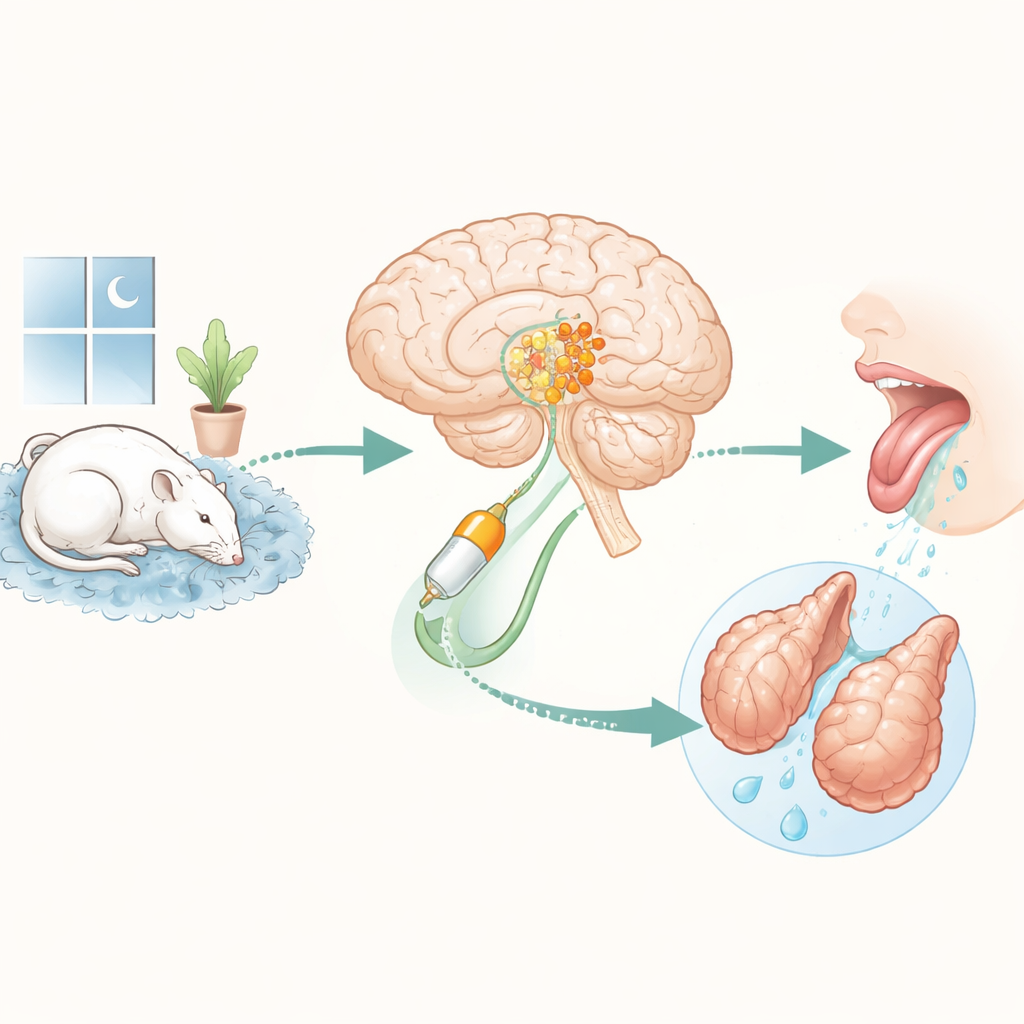
People with narcolepsy often struggle to stay awake during the day, and a new class of medicines that stimulate “wakefulness” brain circuits is offering real hope. But in early clinical trials, some volunteers reported unusually heavy drooling. This study asked a simple but important question: does activating one key wakefulness receptor in the brain directly make salivary glands pump out more saliva, at least in a common laboratory animal, the rat?
Turning on the brain’s wake switch
The researchers focused on orexin, a signaling system in the brain that helps keep us awake and alert. People with narcolepsy type 1 lose most of their orexin-producing nerve cells, which is why drugs that stimulate the orexin receptor 2 (OX2R) are being developed as treatments. Clinical candidates such as danavorexton, TAK-994, and oveporexton have already been shown to improve daytime sleepiness and reduce sudden muscle weakness attacks. However, some participants taking these drugs reported hypersalivation. Saliva production is normally controlled by automatic nerves and can be influenced by many things, from taste to medications, making it hard to know whether orexin drugs themselves are responsible. The team set out to test a tool compound, an OX2R-selective agonist called OX-202, under tightly controlled conditions in rats.
Measuring spit with a proven salivation trigger
To have a reliable yardstick, the scientists first used pilocarpine, a well-known drug that strongly stimulates salivary glands. They tested rats under anesthesia and while freely moving. In both situations, pilocarpine given by injection clearly boosted the amount of saliva collected from the mouth, confirming that their cotton-swab collection method could detect real changes. Under anesthesia, saliva levels normally drifted downward over time, likely because brain activity was dampened, but pilocarpine reversed this trend. In awake rats, pilocarpine caused a sharp rise in saliva within about 10 to 20 minutes, matching how quickly the drug appeared in the bloodstream.
Putting the orexin drug to the test
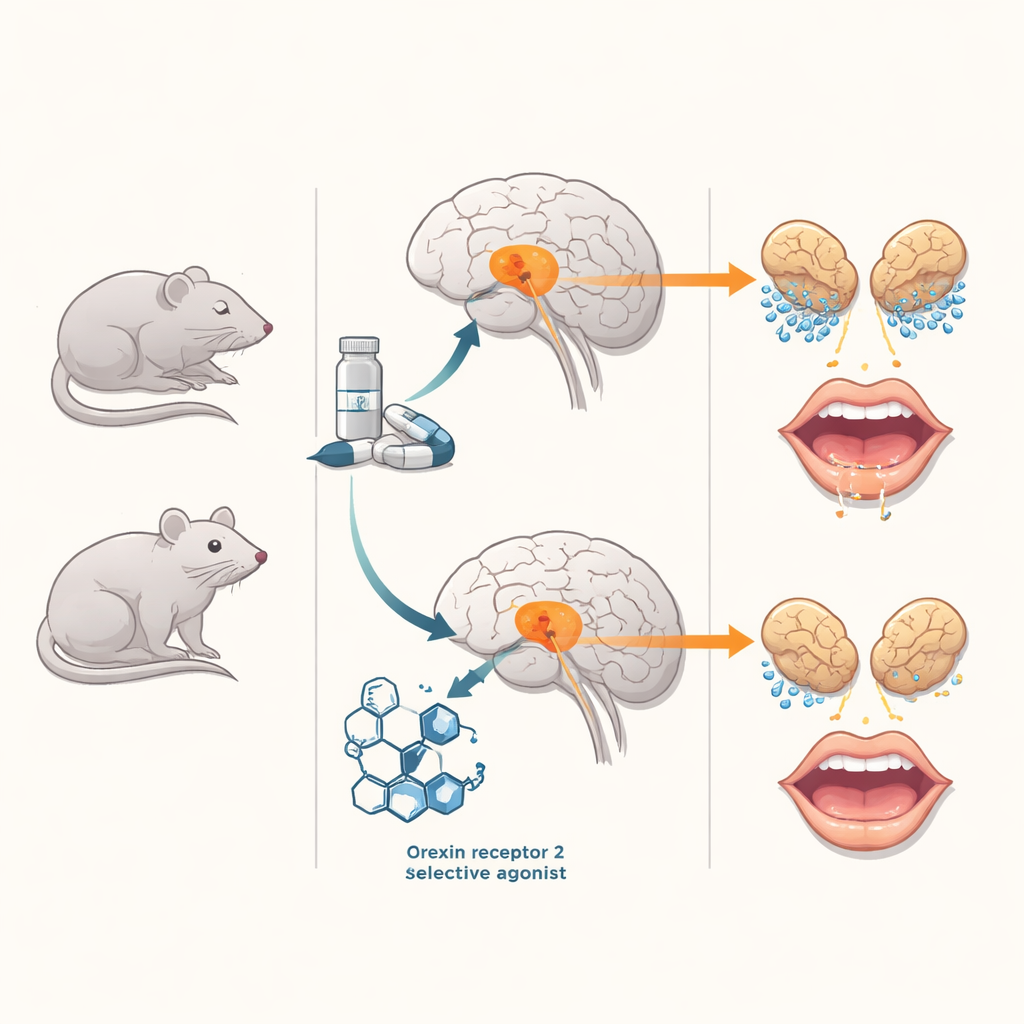
The key experiments examined what happened when rats received OX-202 instead. The researchers ensured that the drug reached blood levels known from earlier work to strongly promote wakefulness, a sign that OX2R in the brain was fully engaged. In anesthetized animals, OX-202 was given into the body cavity, rapidly achieving high blood concentrations. Despite this, saliva amounts declined over time just as in control animals, with no sign of extra secretion. In freely moving rats, OX-202 was given by mouth at two doses during both the usual sleep phase and the active (night) phase, and saliva was collected while drug levels were rising toward their peak. At neither time of day, and at neither dose, did OX-202 increase salivary output. If anything, saliva tended to decrease slightly, though this effect was small and not statistically convincing.
Bridging the gap between animal tests and human reports
These results suggest that directly stimulating OX2R with OX-202 does not make rat salivary glands work harder, even when the drug is clearly activating wakefulness pathways. That is somewhat surprising given that orexin-related receptors are present in brain regions that talk to salivary nuclei, and that clinical trials of other OX2R agonists have recorded higher rates of self-reported hypersalivation than placebo. The authors point out that human saliva production is shaped by many influences, including the autonomic nervous system, taste, age, other medications, and day–night rhythms. It is possible that orexin drugs subtly alter these wider networks, indirectly nudging saliva output in certain people, in ways that a controlled rat experiment cannot easily capture.
What this means going forward
For now, this work indicates that at least one OX2R-selective agonist, OX-202, does not directly trigger extra saliva in rats, whether they are anesthetized or awake and active. For drug developers and clinicians, that is reassuring news: powerful wake-promoting doses did not by themselves create a strong salivation side effect in this animal model. At the same time, the mismatch with human trial reports underlines that more research is needed to understand how orexin-based medicines interact with the many factors that govern salivation in real-world settings. As orexin agonists move closer to widespread use for narcolepsy and potentially other conditions, careful study of indirect effects on bodily functions like saliva will remain an important part of ensuring their safety.
Citation: Ichishima, J., Nakakariya, M. & Kimura, H. Effects of an orexin receptor 2-selective agonist on salivary secretion in rats. Sci Rep 16, 13830 (2026). https://doi.org/10.1038/s41598-026-44080-9
Keywords: narcolepsy, orexin receptor 2, salivation, rat study, wake-promoting drugs