Clear Sky Science · en
A quantum-inspired classification for random mixed states
Why hidden quantum patterns matter
Quantum technologies like ultra-secure communication and powerful new computers rely on a strange kind of linkage between particles called correlations, especially entanglement. In the lab, however, real quantum systems are messy and noisy, which makes it hard to tell what kind of correlations are actually present. This paper introduces a new way to automatically sort noisy quantum states into three broad families — uncorrelated, classically correlated, and truly entangled — using ideas borrowed from how a quantum device itself would try to tell states apart. The method runs on an ordinary computer but is guided by quantum physics from the ground up.

Sorting quantum states like email
Engineers increasingly use machine learning to recognize patterns in quantum data, much like spam filters sort email. Some approaches run directly on quantum hardware, while others use classical algorithms that simply take inspiration from quantum theory. A key benchmark for these methods is whether they can correctly classify different correlation patterns in small systems of quantum bits (qubits). For two and three qubits, states can be completely independent, only classically mixed, or genuinely entangled in ways that power quantum technologies. Distinguishing these cases is straightforward for idealized, perfectly prepared states; it becomes far more challenging once imperfections and noise enter, producing so‑called mixed states that blend many possibilities together.
A classifier inspired by quantum measurements
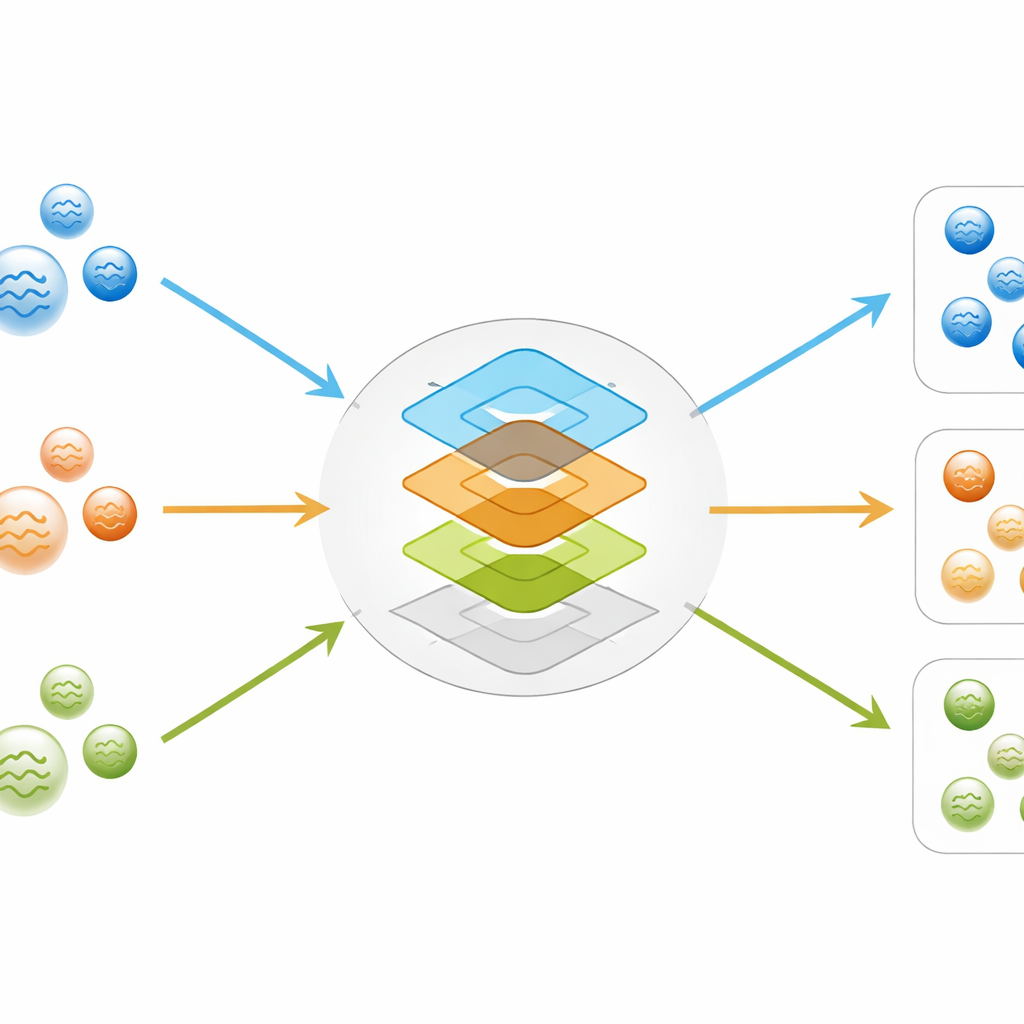
The authors build on a framework called the Pretty-Good-Measurement (PGM) classifier, previously tested on ideal pure states. In quantum theory, a measurement can be designed to tell apart several possible states as reliably as possible, given examples of each option. The PGM is a specific recipe for such a near-optimal measurement. The researchers translate this idea into a classification rule for numerical data: they first turn each quantum state in the training set into a matrix representation, then compute an average “prototype” matrix for each class. From these prototypes and their frequencies, they mathematically construct a set of measurement-like operators that, when applied to a new state, output scores indicating how likely it is to belong to each class. Unlike neural networks, this procedure does not require iterative training; once the class averages are known, the decision rule is mathematically fixed.
Generating fair and realistic quantum datasets
To test their method fairly, the authors must generate random mixed states that genuinely span the full landscape of possible correlations, without hidden biases. Naive ways of sampling matrices tend to produce almost pure or almost fully random states, missing much of the interesting middle ground. Instead, the team uses symmetry-based constructions from quantum theory: they start from uniformly random pure states in a larger system and mathematically “trace out” an unseen environment, leaving behind mixed states for the qubits of interest. By carefully choosing how large this environment is, they can control how noisy the resulting states are and how often entanglement appears. They define clear, operational rules to label each state — using standard tests to decide whether a state is separable, partly correlated, or certainly entangled — and they construct balanced datasets for both two-qubit and three-qubit systems.
How well does the quantum-inspired approach perform?
With these datasets in hand, the PGM classifier is put head-to-head with a range of well-known classical methods, including decision trees, random forests, support vector machines, and neural networks. For two-qubit systems, the PGM reaches balanced accuracies above 90 percent, close to the best neural and kernel-based models. For three-qubit problems, where the structure of correlations becomes richer and more subtle, the PGM maintains or even improves its relative performance, again matching leading classical techniques. When the authors refine the task to distinguish several different flavors of separable three-qubit states, the problem becomes harder for all methods. Even then, the PGM remains competitive: it captures the main patterns but, like other classifiers, occasionally confuses closely related classes whose statistical signatures naturally overlap.
What this means for future quantum tools
To a non-specialist, the central message is that there is a principled way to let the rules of quantum physics guide how we train machines to recognize quantum resources — without requiring access to an actual quantum computer. The Pretty-Good-Measurement classifier gives a transparent, physically grounded recipe for sorting noisy quantum states by the kind of correlations they hold. It performs on par with sophisticated black-box models while offering clearer links to measurable quantities and potential pathways for hardware implementation. As quantum devices grow in size and complexity, such quantum-inspired yet classical tools could become valuable workhorses for benchmarking, diagnosing, and ultimately harnessing entanglement in realistic, imperfect settings.
Citation: Sergioli, G., Cuccu, C., Rieger, C.S. et al. A quantum-inspired classification for random mixed states. Sci Rep 16, 10668 (2026). https://doi.org/10.1038/s41598-026-44068-5
Keywords: quantum entanglement, quantum machine learning, mixed quantum states, quantum state classification, pretty good measurement